Ancient Celtic War Trumpet, Silent for 2000 Years, Unearthed in Eastern England—What Secrets Does It Hold?
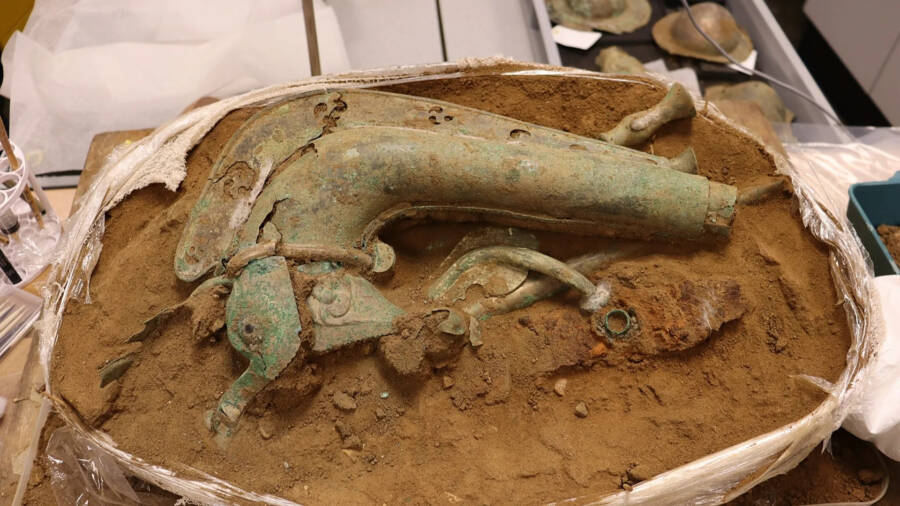
Imagine stumbling upon a relic so rare, it’s like finding the Iron Age’s version of a unicorn horn — only this one’s made of bronze and sounds like a battle cry that could still echo through the centuries. Well, that’s exactly what happened in West Norfolk, where an archaeological dig unearthed a war trumpet, known as a carnyx, that’s only the third ever found in England and hands down the most complete of its kind anywhere in Europe. Now, here’s the kicker — this isn’t just any old musical instrument; this beast of bronze might just have ties to Boudica’s Celtic tribe, the Iceni, who famously gave the Romans a run for their money over 1,900 years ago. So, what stories does this ancient horn hold, and what secrets might it blow back to us from a long-gone battlefield? Hold onto your helmets — this discovery is about to trumpet a whole new tune about Britain’s past.
This rare bronze relic is just one of only three ever found in England and is the most complete artifact of its kind unearthed anywhere in Europe.
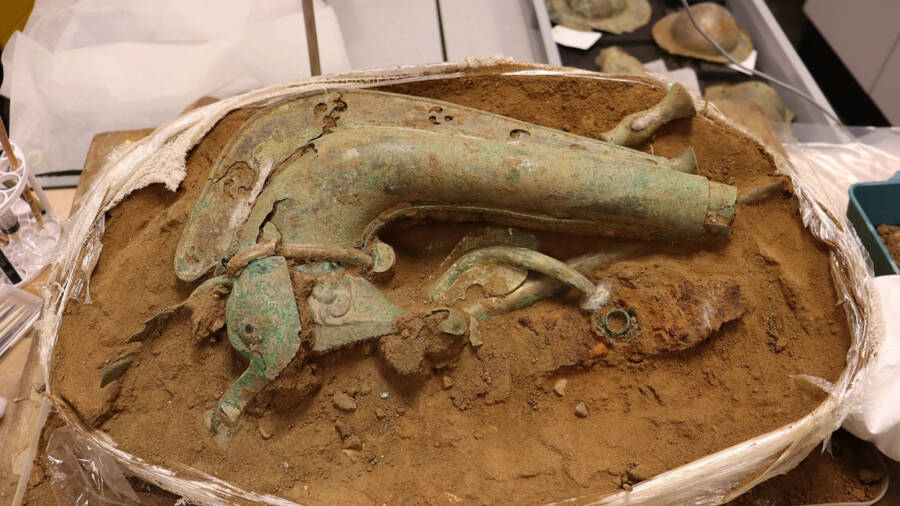
Norfolk Museum ServiceThe Iron Age battle trumpet, or carnyx, found in West Norfolk.
A routine archaeological excavation in West Norfolk has yielded the “extraordinary” discovery of an Iron Age war trumpet with possible links to the Celtic tribe led by Boudica.
The instrument, known as a carnyx, is just the third one found in Britain and the most complete example found anywhere in Europe. These bronze instruments were used by Celtic tribes to intimidate their enemies – namely, the Romans – during battle.
It was found alongside a collection of other Iron Age artifacts, including pieces of another carnyx, five shield bosses, and a bronze boar’s head battle standard.
The “Once-In-A-Career” Discovery Of A Celtic Carnyx In West Norfolk
The collection was uncovered last summer during archaeological excavations ahead of a new housing development.
This discovery was made in a region that was once within the territory of the Iceni, the Celtic tribe led by Queen Boudica that fought a fateful rebellion against the Roman army in 60 C.E.
While conservation work is still being conducted, researchers said they believe the hoard was buried in the first century C.E. – meaning it could have connections to Boudica’s tribe. That potential link is certainly exciting for historians and underlines just how significant this discovery might prove to be.
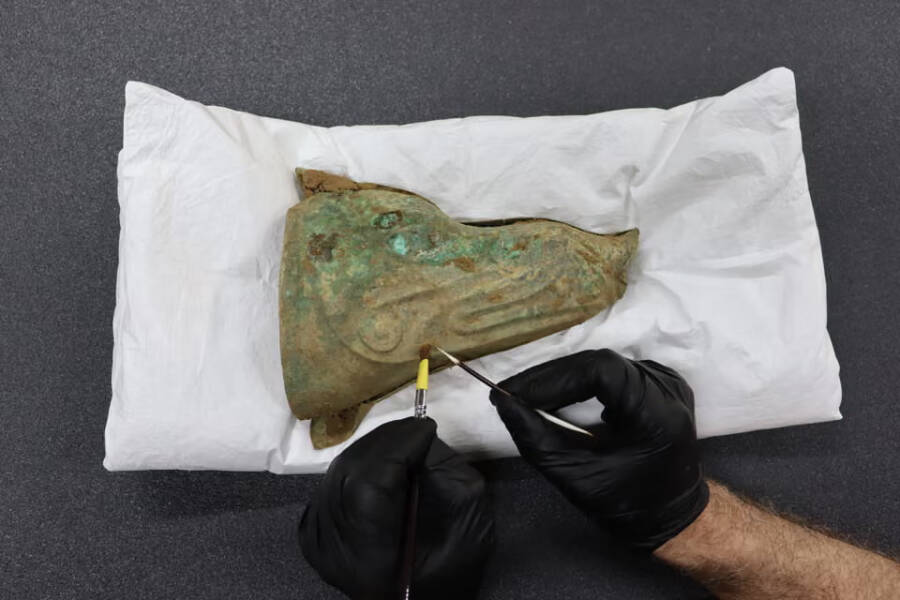
Norfolk Museum ServiceThe boar’s head battle standard found alongside the trumpet.
Mark Hinman, chief executive of Pre-Construct Archaeology, which made the discovery, told The Guardian that this was “a once-in-a-lifetime, once-in-a-career find.”
“I’ve been doing archaeology for over 40 years,” he added, “and I’ve never seen anything like this.”
Experts noted that the objects are incredibly fragile, and as such the conservation effort is a slow-moving, delicate process. Once it is done, though, they will be able to conduct a more thorough, full analysis of these ancient artifacts.
“The full research and conservation of these incredibly fragile remains will reshape our view of sound and music in the Iron Age,” Dr. Fraser Hunter, Iron Age and Roman curator at National Museums Scotland, told Euronews.
“The carnyces and the boar-headed standard are styles well known on the continent and remind us that communities in Britain were well-connected to a wider European world at this time.”
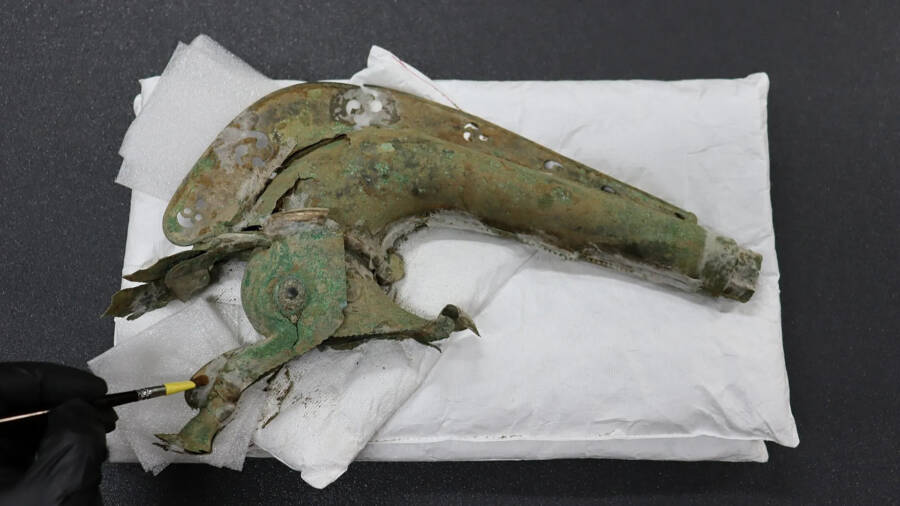
Norfolk Museum ServiceIt is the most complete example of an Iron Age carnyx ever found.
Hinman also noted that the newly discovered carnyx exhibited signs of repair, suggesting that it had been used over a long period of time. Its burial was also quite deliberate, as it was partially dismantled and covered by the shield bosses. Still, it is far more complete than any other known example and offers unique insight into Britain’s Iron Age past.
“Objects like this remind us how little we know about so many different aspects of our past,” Hinman said. “These objects had names, people thought they were imbued by power. They may even have thought that they were alive at certain times in their existence – and all of the stories that go with them are lost.”
Once conservation work is complete, Hinman said that exploring the potential links to the Iceni “is an obvious question and one that we will definitely be focusing on once we’re able to get closer to the objects.”
Potential Links To The Celtic Queen Boudica
The Iceni were a powerful Celtic tribe (or civitas) inhabiting the region of modern-day Norfolk and parts of Suffolk in East Anglia during the Late Iron Age.They were known to be a wealthy people, largely due to their control of fertile agricultural land and extensive trade networks across the North Sea.
They initially allied with Rome during Claudius’ invasion of Britain in 43 C.E., but the relationship remained tense and dependent on the whims of the Roman administration.
In the wake of the Roman conquest, the Iceni were ruled by King Prasutagus, Boudica’s husband. In an attempt to secure the future of his family and kingdom, Prasutagus made a will naming the Roman Emperor Nero as co-heir to his estate, alongside his two daughters. He likely believed this would preserve the dynasty and appease Rome.

RIVER OF GOODS LED Boho Ceiling Fan with Hand Woven Brown/Natural Rope - Macrame Knot Work and Hemp Rope Style Eclectic Cottage Decor - 52" L x 52" W - Rich Barnwood/Light Driftwood Fan Blades
(as of September 15, 2026 00:41 GMT +00:00 - More infoProduct prices and availability are accurate as of the date/time indicated and are subject to change. Any price and availability information displayed on [relevant Amazon Site(s), as applicable] at the time of purchase will apply to the purchase of this product.)
Skater Trainer Wheels - Beginners get Skateboard Tricks Fast, Safe and Fun | Viral accessory gift - Helps beginners stay excited about their new skateboard - Kids & parents love these
$28.99 (as of September 15, 2026 00:41 GMT +00:00 - More infoProduct prices and availability are accurate as of the date/time indicated and are subject to change. Any price and availability information displayed on [relevant Amazon Site(s), as applicable] at the time of purchase will apply to the purchase of this product.)
RIVER OF GOODS Stained Glass Magna Carta LED Ceiling Fan - 52" L x 52" W - Tiffany Style - Flush Mount Ceiling Fan with Remote - Teal
(as of September 15, 2026 00:41 GMT +00:00 - More infoProduct prices and availability are accurate as of the date/time indicated and are subject to change. Any price and availability information displayed on [relevant Amazon Site(s), as applicable] at the time of purchase will apply to the purchase of this product.)
RIVER OF GOODS Alabaster LED Mesh Caged Ceiling Fan - 52" L X 52" W - White/Oak Wood-Grain Blades
(as of September 15, 2026 00:41 GMT +00:00 - More infoProduct prices and availability are accurate as of the date/time indicated and are subject to change. Any price and availability information displayed on [relevant Amazon Site(s), as applicable] at the time of purchase will apply to the purchase of this product.)