Ancient Boar Tusk Engraving Unveiled: The Mysterious Medieval Charm With Secrets Hidden for a Millennium
Picture this: a 900-year-old wild boar tusk, flashing a glimmer that’s not quite silver but close enough to fool the eye—a blinged-out relic from medieval Russia that’s got archaeologists buzzing. Found in the posh digs of Veliky Novgorod, this tusk is no ordinary teethy souvenir; it’s a dazzling amulet that whispers secrets about the elite’s stylish beliefs and rituals back when Viking traders rubbed shoulders with Russian nobility. Who knew tin could strut around pretending to be silver so convincingly? And what kind of medieval high roller rocked a wild boar tusk necklace as their lucky charm? It’s a thrilling peek into a world where hunting was not just sport but power play, and jewelry had a story fiercer than a boar charging through the forest. Curious yet? Dive into the enigma of this rare find and discover how it sheds light on the mystique of medieval Russian aristocracy. LEARN MORE
Researchers believe the rare amulet will shed light on the beliefs and practices of the elite in medieval Russia.
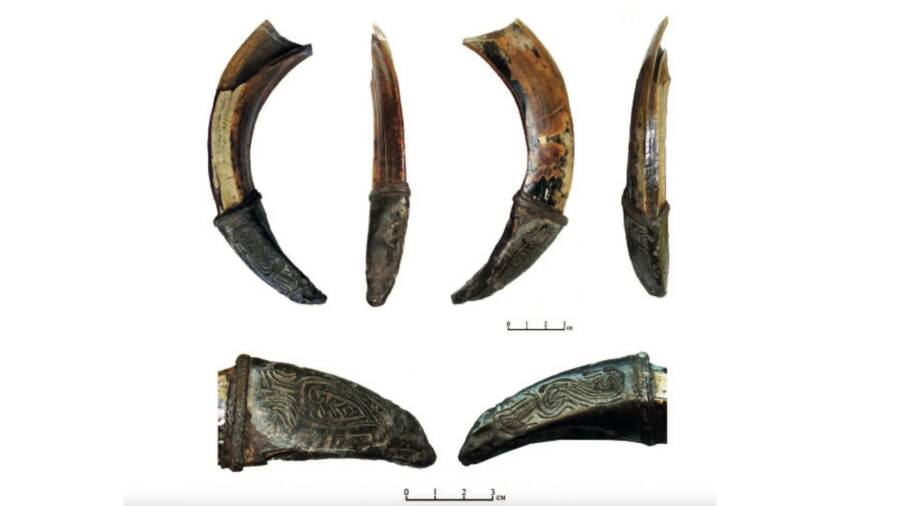
Tyanina, E. A., et al., 2026Researchers believe the 12th-century wild boar tusk served as a good luck amulet for an elite member of society.
When archaeologists in the Russian city of Veliky Novgorod discovered a large wild boar’s tusk from 900 years ago in 2020, they knew it was a rare find.
Now, after closer study of the object, researchers believe the tusk, which was set in intricately-engraved tin, served as a good luck amulet or hunter’s trophy of a high-status member of the city.
The Metal-Mounted Wild Boar Tusk Found In Veliky Novgorod
According to the researchers from Moscow State University, who recently published their findings in The Volga River Region Archaeology journal, the tusk was from the 12th or 13th century, and likely came from a wild boar that was at least eight years old and over 220 pounds.
“It’s extraordinary because of its size. It’s extremely big,” Natalia Eniosova, co-author of the study and a metal scientist in the Department of Archaeology at Moscow State University, told Live Science.
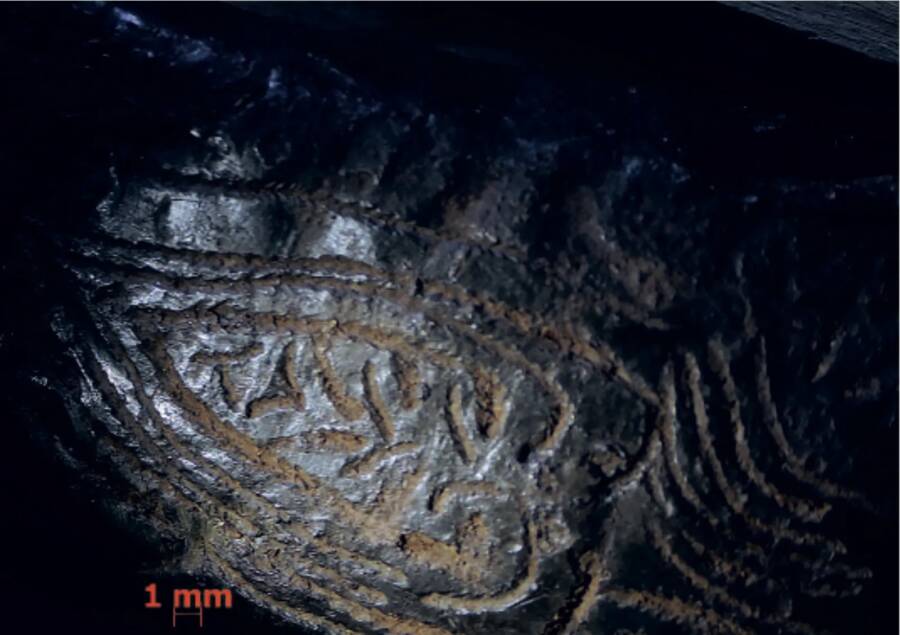
Tyanina, E. A., et al., 2026The tusk was set in an almost-fully tin alloy with intricate engravings.
Although the tusk was not fully preserved, it’s close to four inches long and a little over an inch wide. The size of the tusk was also a clue for the researchers on why the artifact was made and kept 900 years ago.
“Such an animal would not have been hunted for food,” Eniosova said.
At the time, people in Veliky Novgorod had domesticated pigs, which, the researchers explained, would have been a more practical source for food than a hunted wild boar. Still, the researchers are unsure, and believe the boar may have been eaten anyway, but under more ritualistic circumstances than utilitarian ones.
The team also think the tusk was special due to it being set in a decorated sheet of metal. Although the design looks like it is made of silver, it is actually a tin-lead alloy made to imitate the gleam of silver. Nine hundred years ago, silver was still more valuable than tin, but tin sources were not abundant in 12th-century Europe, so the tin design was still rare.
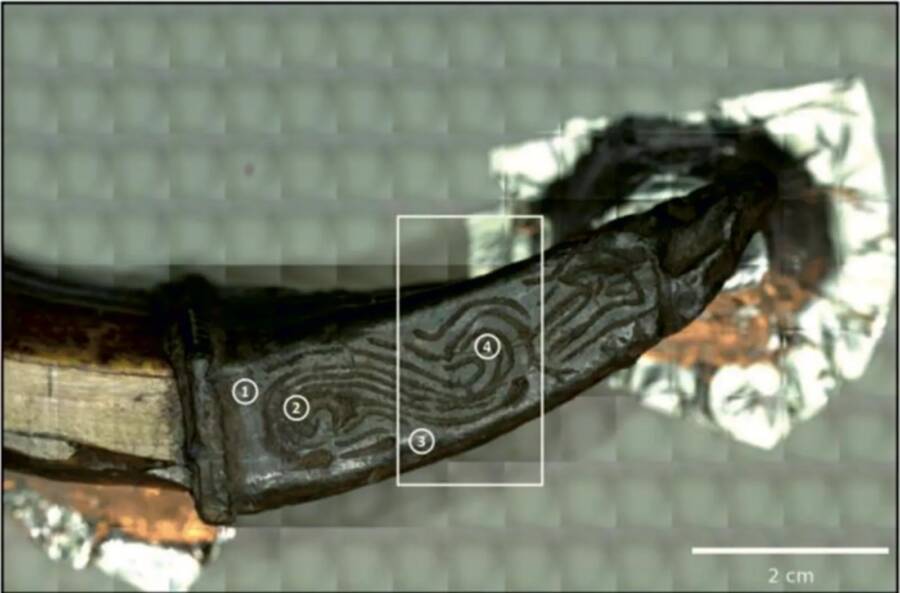
Tyanina, E. A., et al., 2026The tusk was found in an excavation area in a wealthy neighborhood in Veliky Novgorod.
Making such intricate engravings on the tin alloy, a softer metal, also showed the researchers that great care and craftsmanship went into the object.
“It wouldn’t have been easy, and this ornament is quite elaborate. It’s a very, very well-done object,” Eniosova said.
What This Unique Discovery Reveals About The Elite In Medieval Russia
Researchers believe that, due to the size, design, and location of the tusk, the artifact served as a charm or amulet of an elite member of the city.
The boar tusk might have been worn as a necklace, as animal amulets worn as necklaces were popular in Veliky Novgorod during this time period. Boar tusk amulets specifically, however, were more common in the first half of the 11th century and earlier, so this 12th-century tusk would have been a rare amulet made for a wealthy individual.
Although historians still debate about its origins, the city of Veliky Novgorod has been dated to around 9th century C.E. and was a major trading hub in the medieval state of Kievan Rus. Some of the town’s first settlers were Scandinavian, which has led the researchers to analyze the amulet for links to Scandinavian mythology.
Around the time the boar tusk artifact was made, archaeologists believe Veliky Novgorod was largely inhabited by landowners and fur traders. In particular, the area the tusk was discovered in—the Troitsky XVI excavation area—was likely the city’s elite neighborhood.
In Russia during medieval times, it has also been documented that wild boar hunting was a privilege of the “druzhina” or elite troops, and nobility.
“It is highly probable that this mounted tusk functioned as a martial or hunting talisman,” the researchers wrote in the study. “It symbolized the transfer of the beast’s physical prowess to the hunter and served concurrently as a charm for good fortune.”

The Door Balancer Eliminates The Need for Door Props, Door Stops and Door Wedges
(as of September 10, 2026 00:38 GMT +00:00 - More infoProduct prices and availability are accurate as of the date/time indicated and are subject to change. Any price and availability information displayed on [relevant Amazon Site(s), as applicable] at the time of purchase will apply to the purchase of this product.)
RIVER OF GOODS Alabaster LED Mesh Caged Ceiling Fan - 52" L X 52" W - White/Oak Wood-Grain Blades
(as of September 10, 2026 00:38 GMT +00:00 - More infoProduct prices and availability are accurate as of the date/time indicated and are subject to change. Any price and availability information displayed on [relevant Amazon Site(s), as applicable] at the time of purchase will apply to the purchase of this product.)
1MORE Triple Driver in-Ear Earphones Hi-Res Headphones with High Resolution, Bass Driven Sound, MEMS Mic, in-Line Remote, High Fidelity for Smartphones/PC/Tablet - Silver
$69.99 (as of September 10, 2026 00:38 GMT +00:00 - More infoProduct prices and availability are accurate as of the date/time indicated and are subject to change. Any price and availability information displayed on [relevant Amazon Site(s), as applicable] at the time of purchase will apply to the purchase of this product.)
Supa Ant Canning Supplies Starter Kit (Food Grade) - Canning Kits Set for Beginners - 3 Pcs. Including Wide Mouth Jar Funnel, Magnetic Lid Lifter, Stainless Steel Jar Lifter (Assembled in USA) Blue
$11.99 (as of September 10, 2026 00:38 GMT +00:00 - More infoProduct prices and availability are accurate as of the date/time indicated and are subject to change. Any price and availability information displayed on [relevant Amazon Site(s), as applicable] at the time of purchase will apply to the purchase of this product.)