Uncovered: The Mysterious New Human Species That Could Upend Everything We Know About Our Origins

Imagine discovering a massive ancient skull tucked away in China, only to find out decades later that it’s got DNA cousins all the way over in a Siberian cave from a tiny finger bone discovered back in 2008. Talk about family reunions nobody saw coming! For nearly twenty years, scientists were stuck piecing together a mystery with just a finger and a few teeth, until that “Dragon Man” skull decided to spill its genetic secrets—linking it to the elusive Denisovans, a brand-new branch on the human family tree nobody expected to find. Ever wonder what happens when a bone fragment and a huge, odd-looking skull collide in the world of anthropology? Well, it turns out we’re finally getting a face to match the fingerprint of one of history’s most enigmatic humans—plus some jaw-dropping twists along the way. Buckle up, this isn’t your average history lesson. LEARN MORE
DNA analysis revealed that the “Dragon Man” skull unearthed in China had genetic similarities to the finger bone of a Denisovan found in a Siberian cave in 2008.

Jiannan Bai and Xijun Ni/Natural History MuseumAn artist’s depiction of a Denisovan hunting.
For nearly two decades, scientists have had nothing more than a finger bone and some teeth to identify what may have been a long-lost species of human. Now, they think they might know what this ancient human actually looked like.
Back in 2008, archeologists discovered a fragment of finger bone in Denisova Cave in Russia’s Altai Mountains. The bone was small — a distal phalanx of a juvenile’s fifth finger. Still, the archeologists believed that there was something special about it. So, they sent it off for testing.
Their belief was correct. After researchers at the Max Planck Institute for Evolutionary Anthropology in Germany sampled the bone and sequenced its mitochondrial DNA, they discovered something shocking.
As paleoanthropologist Ella Al-Shamahi told NOVA (@novapbs) in a TikTok video with over 449,000 views, the scientists came to a stunning conclusion: “This is human DNA, but it’s not Neanderthal. It’s not Homo sapiens.”
“They realized they had accidentally just stumbled upon a whole new species of human,” Al-Shamahi summarizes.
A Tiny Fragment, DNA Sequencing, And A Major Discovery
After the DNA from the finger was sequenced, the population to which it belonged was given a name: Denisovans, after the cave where the bone had been discovered. A previous discovery in the same cave — a tooth — carried closely related mitochondrial DNA, strengthening the case that scientists had found a new, distinct archaic human population.
There was just one problem: All they had was a finger and a tooth. This put the scientists in, to use Al-Shamahi’s words, “uncharted territory.”
“Normally you would have a skull or, well, a fossil. You would have something,” she explains.

Демин Алексей Барнаул/Wikimedia CommonsDenisova Cave, where the pinky bone of the first identified Denisovan was discovered in 2008.
To make matters worse, some of the finger bone had been crushed up to carry out the DNA analysis. This meant that the only evidence of the existence of such a species was the DNA sequence itself and the limited physical matter that remained.
Despite this, scientists were able to draw some incredible conclusions with the information they had. For example, they determined that Denisovans shared a common origin with Neanderthals and that they likely interbred with the ancestors of some modern humans. They also found evidence of Denisovan ancestry in populations in Oceania and parts of Asia.
But those discoveries, while exciting, did not bring them any closer to understanding what a Denisovan may have looked like. In order to answer that question, scientists would have to get acquainted with the “Dragon Man.”
Who Was The ‘Dragon Man’?
Decades before all of this happened, a laborer was working near the city of Harbin, China, when he came across a massive human skull. When this occurred in 1933, this area of China was under Japanese occupation — and so, the man decided to hide the specimen, only confiding its whereabouts to his family near the end of his life.
Eventually, his family was able to locate the fossil, and they donated it to Hebei GEO University in 2018.
While this particular narrative has since been questioned, the bizarre circumstances around its discovery meant that the skull lacked the original archeological context that normally helps date and identify a fossil. To further complicate matters, the skull was significantly different from other specimens. It had an enormous cranium, a long brain case, a heavy brow ridge, and massive eye sockets.
Looking at this strange skull, researchers decided to dub the group it belonged to Homo longi — though the skull quickly became known as the “Dragon Man.”
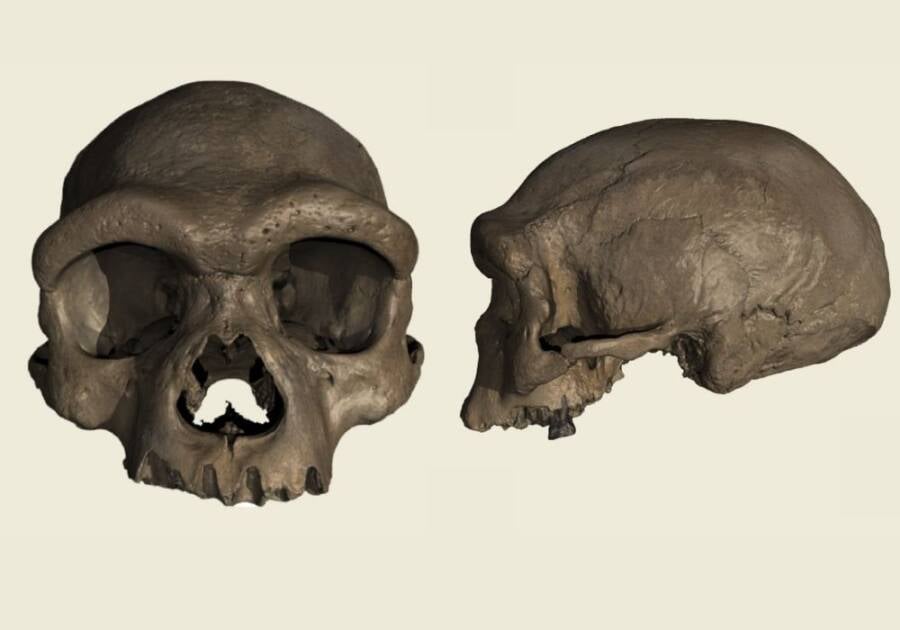
Xijun et al., CellPress (2021)A front and side view of the “Dragon Man” skull found in China.
As stories of these various discoveries spread, many scientists thought that there could be a link between the finger bone and the Dragon Man. However, attempts to sequence DNA from the skull proved fruitless until one scientist came up with an interesting workaround.

RIVER OF GOODS Alabaster LED Mesh Caged Ceiling Fan - 52" L X 52" W - White/Oak Wood-Grain Blades
(as of August 27, 2026 00:29 GMT +00:00 - More infoProduct prices and availability are accurate as of the date/time indicated and are subject to change. Any price and availability information displayed on [relevant Amazon Site(s), as applicable] at the time of purchase will apply to the purchase of this product.)
1MORE Triple Driver in-Ear Earphones Hi-Res Headphones with High Resolution, Bass Driven Sound, MEMS Mic, in-Line Remote, High Fidelity for Smartphones/PC/Tablet - Silver
$69.99 (as of August 27, 2026 00:29 GMT +00:00 - More infoProduct prices and availability are accurate as of the date/time indicated and are subject to change. Any price and availability information displayed on [relevant Amazon Site(s), as applicable] at the time of purchase will apply to the purchase of this product.)
Fire Blanket - 1500F CE Certified Emergency Fire Blanket for Home and Kitchen. 500GSM Fabric & 0.5mm Thick - 100% Fiberglass Fire Extinguisher for Car,Warehouse Office - 2pc (47x47 inches) by Supa Ant
$53.45 (as of August 27, 2026 00:29 GMT +00:00 - More infoProduct prices and availability are accurate as of the date/time indicated and are subject to change. Any price and availability information displayed on [relevant Amazon Site(s), as applicable] at the time of purchase will apply to the purchase of this product.)
Skater Trainer Wheels - Beginners get Skateboard Tricks Fast, Safe and Fun | Viral accessory gift - Helps beginners stay excited about their new skateboard - Kids & parents love these
$28.99 (as of August 27, 2026 00:29 GMT +00:00 - More infoProduct prices and availability are accurate as of the date/time indicated and are subject to change. Any price and availability information displayed on [relevant Amazon Site(s), as applicable] at the time of purchase will apply to the purchase of this product.)





















Post Comment