7,000-Year-Old Burial Unearthed Beneath Future German School Site Sparks Archaeological Mystery
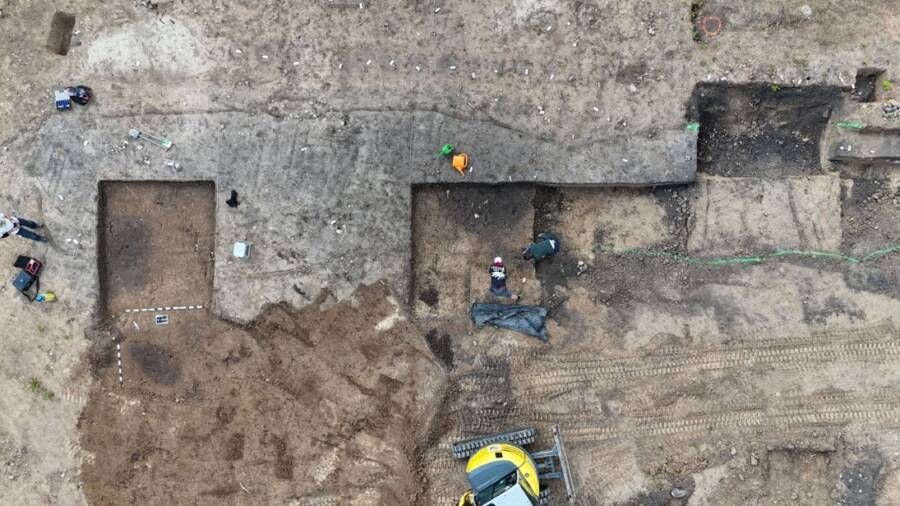
Ever wonder what it’s like to stumble upon a 7,000-year-old burial while digging the foundation for a school? Well, that’s exactly what happened in Leipzig, Germany—talk about an unexpected history lesson right beneath future classrooms! Archaeologists found a skeleton curled up in a mysterious crouched position—a hallmark of the Linear Pottery culture—but no one’s quite sure what that odd sleeping pose means in terms of ancient funerary customs. Imagine the surprises buried beneath modern life: alongside the grave, remnants of massive wooden longhouses hint at a time when Neolithic folks were trading hunting for farming and laying down roots. It’s like unearthing an ancient episode of “This Old House,” only way, way older and a whole lot cooler. Curious to dive deeper into this prehistoric hide-and-seek? LEARN MORE
The remains were found in a crouched position characteristic of the Linear Pottery culture, though experts still don’t know the significance of this unusual funerary procedure.

State Office for Archaeology SaxonyArchaeologists discovered a Neolithic burial as well as the remains of a Linear Pottery culture wooden house at the site of a future school in Leipzig.
Before the construction of an elementary school in Leipzig, Germany could commence, archaeologists did preventative excavations at the site in order to protect any historical artifacts that could be hiding underground.
Although archaeologists expected to make at least a few finds, they were shocked to unearth fully intact remains in a burial that dates back a whopping 7,000 years — making this the oldest-known grave ever found in the area.
The Discovery Of A 7,000-Year-Old Burial At A German Construction Site
Preventative excavations were essential at this location because it’s near a previously-known Bronze Age archaeological site, according to the Saxony State Office for Archaeology’s announcement of the discovery.
Moreover, prehistoric artifacts are relatively common in the area because it’s shielded against flooding from the White Elster River, and lies within the Leipzig Lowland Basin, which has repeatedly proven to be a rich archaeological region.

Wikimedia CommonsThe site is protected against flooding from the White Elster River, seen here running through the city of Leipzig.
This land had been occupied by a building complex in the 1960s, which had since been torn down. Despite this previous construction and the resulting disruption of the terrain, archaeologists made a number of well-preserved discoveries that exceeded their expectations.
Rather than a few scattered objects, the team instead found evidence of an entire prehistoric settlement, complete with the remains of houses and the 7,000-year-old grave.
“The discovery of a burial in the middle of the settlement was a surprise,” the officials said in the statement. “This is a rare stroke of luck, as bone preservation is so poor in large parts of Saxony that graves can only be identified by the objects placed in the grave and the shape of the grave pits.”

State Office for Archaeology SaxonyThe crouched position of the skeleton allowed the researchers to identify the burial as belonging to the Linear Pottery culture.
The archaeologists have not yet identified the sex or age of the deceased, but were able to note that the skeleton was buried lying down on its left side, with its legs drawn up in a crouching position.
In addition to the grave, archaeologists unearthed the remains of a 98-foot wooden house, and they also partially excavated two others.
What This Burial Reveals About The Linear Pottery Culture

Wikimedia CommonsAn example of a vessel made by the Linear Pottery culture, this one found elsewhere in Germany.
Researchers believe that the person buried here belonged to the Linear Pottery culture, a group that flourished throughout Europe between roughly 5500 and 4500 B.C.E.
The culture is named for its distinctive decorating of pottery, which has been found across the continent, from Hungary to the Paris Basin. Over the years, many such artifacts have also been found in and around Leipzig.
Although the grave contained no pottery or other grave goods, archaeologists were nevertheless able to link the body to the Linear Pottery culture due to its crouched position — a characteristic of Linear Pottery culture burials — as well as the context clues provided by the remains from the surrounding settlement.
The wooden longhouses that made up this settlement are also characteristic of the Linear Pottery culture. Such houses are identified via postholes that are still preserved in the ground. These holes would have held wooden posts that served to support the house’s roof and walls.
In this most recent discovery, the largest longhouse would have once measured an astonishing 98 feet in length.

M. Bajka/Provincial Office for the Protection of MonumentsAnother example of the remains of a Linear Pottery culture longhouse, this one discovered in Poland.
During the Linear Pottery era, Neolithic people were experiencing a transition from hunting and gathering to a more sedentary lifestyle, in which they began to live in settlements where they could farm and domesticate livestock.

PROMIXX FORM Protein Shaker Bottle - A Premium Shaker Bottle for Protein Shakes Infusions and Hydration - Durable Gym Shaker Bottle, Leakproof Lid, Odorless - 26oz (Graphite Gray)
$14.62 (as of October 22, 2026 01:01 GMT +00:00 - More infoProduct prices and availability are accurate as of the date/time indicated and are subject to change. Any price and availability information displayed on [relevant Amazon Site(s), as applicable] at the time of purchase will apply to the purchase of this product.)
RIVER OF GOODS Stained Glass Magna Carta LED Ceiling Fan - 52" L x 52" W - Tiffany Style - Flush Mount Ceiling Fan with Remote - Teal
(as of October 22, 2026 01:01 GMT +00:00 - More infoProduct prices and availability are accurate as of the date/time indicated and are subject to change. Any price and availability information displayed on [relevant Amazon Site(s), as applicable] at the time of purchase will apply to the purchase of this product.)
Rhythm Superfoods Kale Chips, Zesty Nacho, Organic and Non-GMO, 2.0 Oz (Pack of 4), Vegan/Gluten-Free Superfood Snacks
(as of October 22, 2026 01:01 GMT +00:00 - More infoProduct prices and availability are accurate as of the date/time indicated and are subject to change. Any price and availability information displayed on [relevant Amazon Site(s), as applicable] at the time of purchase will apply to the purchase of this product.)
1MORE Triple Driver In-Ear Headphones - Silver - Wired - Adult - In Ear - 18 grams - 90 days limited warranty
(as of October 22, 2026 01:01 GMT +00:00 - More infoProduct prices and availability are accurate as of the date/time indicated and are subject to change. Any price and availability information displayed on [relevant Amazon Site(s), as applicable] at the time of purchase will apply to the purchase of this product.)





















Post Comment