A Mysterious Medieval Scepter Head Emerges from 1,000-Year-Old Armenian Ruins—What Secrets Does It Hold?
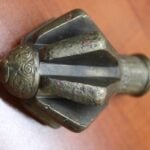
So picture this: buried beneath the medieval ruins of Kapan, Armenia, archaeologists just dusted off a copper scepter head decked out with swirl patterns and sharp decorative blades—an ornate symbol of medieval power that’s been chilling underground since the 10th or 11th century C.E. Now, here’s the question that’s been tickling my brain: who in their right mind needed a bladed scepter? Was it just a royal fashion statement, or did they secretly double as medieval sword enthusiasts? Either way, this relic and other finds from the Kingdom of Syunik’s capital give us a fresh peek into a fortified city that was both a political hotspot and a strategic fortress about a thousand years ago. Intrigued? You’ll want to dive into the full saga of Kapan’s rise, fall, and the treasures it still hides.
Made of copper and adorned with everything from swirl patterns to decorative blades, this ornate relic is believed to date back to the 10th or 11th century C.E.

Institute of Archaeology and Ethnography, ArmeniaThis royal scepter head was discovered among the ruins of the capital of a medieval kingdom in Armenia.
Archaeologists have recently recovered many treasures from the medieval ruins of the Armenian city of Kapan, which once stood as the center of the Kingdom of Syunik. The remains of the city’s royal palace and other impressive structures have shed invaluable light on what life was like in southeastern Armenia roughly 1,000 years ago.
One of the most intriguing recent finds in Kapan was a copper scepter head, once used as a symbol of power and authority during the Middle Ages.
The Discovery Of A Medieval Scepter Head And Other Relics Among The Ruins Of Kapan
Excavations in Kapan — situated along the Voghji River and the capital of Armenia’s Syunik province — began in 2024. Today, the dig site is referred to as Tandzu Lenj, meaning “the slope of pear trees.”
The excavations are being conducted by archaeologists from Armenia’s Institute of Archaeology and Ethnography, led by Gagik Sargsyan.

Institute of Archaeology and Ethnography, ArmeniaExcavations at Old Kapan began in 2024.
Kapan was first mentioned in historical sources in about the 5th century C.E., but the city truly rose to prominence as the capital of the Kingdom of Syunik, founded in 987 C.E. The current excavations of the site are focused mainly on the royal palace complex.
The ruins have slowly revealed an ancient city surrounded by fortified walls, including some that are double-layered, as well as a defensive tower in the eastern part of the city that looms above one of the entrances to the palace.
This suggests that Kapan served not only as an administrative hub for the Kingdom of Syunik, but as a strategic, fortified settlement.

Institute of Archaeology and Ethnography, ArmeniaArchaeologists also discovered two metal coins, pictured here.
Among the latest finds from these ruins is a copper scepter head that’s decorated with intricate swirl patterns flanked by eight decorative blades. This impressive piece was likely used as a symbol of power and authority here in the capital of this medieval kingdom.
In addition to the scepter head, archaeologists unearthed pieces of a parchment manuscript or scroll, two metal coins, glass and pottery fragments, as well as iron nails and rivets.
Archaeologists also exposed a polished stone structure on the edge of the settlement, which they believe was used as a heating mechanism for a bath. However, further investigation needs to be done before confirming this theory.

Institute of Archaeology and Ethnography, ArmeniaWhile archaeologists did not provide precise dating for the artifacts, they are likely around 1,000 years old.
These recent finds add to the quickly-growing list of important discoveries made at this newly-active excavation site. In 2025, for instance, researchers discovered the foundations of an early medieval basilica as well as a stone from an olive press.
What These Finds Reveal About The Kingdom of Syunik And Its Place In Armenian History
Kapan became a prominent seat of power in medieval Armenia by around 1000 C.E., as the Kingdom of Syunik rose in regional importance.
The city held a strategic location, protected by the Voghji River and surrounding mountains, while also situated near Baghaberd, a major fortress of the Kingdom of Syunik.
Throughout the 11th century, more and more monasteries and churches were built across the kingdom, contributing to the rich history of Armenian literature, art, and architecture. Meanwhile, crafting and agriculture also developed in ancient cities across Syunik, including Kapan.

Institute of Archaeology and Ethnography, ArmeniaOld Kapan fell in 1126 during an invasion by the Seljuk Empire led by Amir Harun.
According to the Armenian historian and bishop Stepanos Orbelian, however, the ancient city was destroyed and pillaged in 1126 during an invasion by the Seljuk Empire led by Amir Harun.
Still, the larger kingdom was able to survive the loss of Kapan by relying on the nearby Baghaberd. But, in 1170, the kingdom faced increasing pressures from Seljuk forces, who ultimately captured Baghaberd.

1MORE Triple Driver In-Ear Headphones - Silver - Wired - Adult - In Ear - 18 grams - 90 days limited warranty
(as of November 20, 2026 01:13 GMT +00:00 - More infoProduct prices and availability are accurate as of the date/time indicated and are subject to change. Any price and availability information displayed on [relevant Amazon Site(s), as applicable] at the time of purchase will apply to the purchase of this product.)
RIVER OF GOODS Stained Glass Magna Carta LED Ceiling Fan - 52" L x 52" W - Tiffany Style - Flush Mount Ceiling Fan with Remote - Teal
(as of November 20, 2026 01:13 GMT +00:00 - More infoProduct prices and availability are accurate as of the date/time indicated and are subject to change. Any price and availability information displayed on [relevant Amazon Site(s), as applicable] at the time of purchase will apply to the purchase of this product.)
RIVER OF GOODS Stained Glass Bird Accent Lamp - 8" W x 13.5" H - Tiffany Style Table Lamps for Home, Office Desk, Bedroom, Nightstand - Blue Jay Decor
(as of November 20, 2026 01:13 GMT +00:00 - More infoProduct prices and availability are accurate as of the date/time indicated and are subject to change. Any price and availability information displayed on [relevant Amazon Site(s), as applicable] at the time of purchase will apply to the purchase of this product.)
PROMIXX FORM Sports Water Bottle - Premium BPA Free Water Bottle for Fitness Sports & Outdoors - Sustainable Drinks Bottle with Measurement Markers and Leakproof Lid - 760ml / 26oz (Midnight Blue)
$18.29 (as of November 20, 2026 01:13 GMT +00:00 - More infoProduct prices and availability are accurate as of the date/time indicated and are subject to change. Any price and availability information displayed on [relevant Amazon Site(s), as applicable] at the time of purchase will apply to the purchase of this product.)




















Post Comment