Ancient Ice, Modern Mystery: How Ötzi The Iceman Could Rewrite The History Of HPV!
“This supports the idea that oncogenic human papillomaviruses are not recent pathogens but long-term companions of their hosts, evolving alongside primates and humans over extended evolutionary timescales.”
Potential Challenges To The Neanderthal-Transmission Theory Of HPV
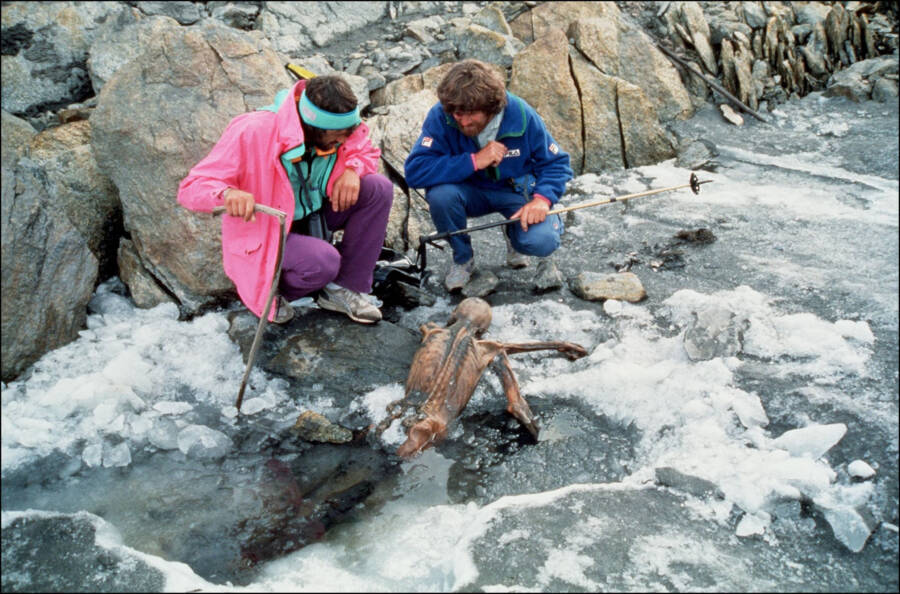
Both Ötzi and the prehistoric Siberian man also studied here, known as Ust’-Ishim, were chosen for this analysis because they represent two of the most well-preserved early human genomes ever found. Ötzi died roughly 5,300 years ago and was naturally mummified, but Ust’-Ishim, who was found in 2008, was much older. He lived around 45,000 years ago in what is now Siberia, and all that remains of him is a single leg bone. Still, that was enough material to sequence one of the oldest human genomes known to science.
Through these genomes, Briones and colleagues were able to find multiple DNA fragments matching HPV16, indicating both men were afflicted with the virus.
“We’re pretty confident there’s a signal there… We have the oldest evidence of HPV,” said study first author Juliana Yazigi.

Wikimedia CommonsA map of potential sites of Neanderthal-human interbreeding.
Given how far apart Ötzi and Ust’-Ishim lived, both geographically and in the historical timeline, both men showing signs of HPV16 provides further evidence that this disease has been with humanity for perhaps millions of years. It could also indicate, Briones says, that perhaps Homo sapiens transmitted the cancer-causing virus to Neanderthals, and not the other way around, contrary to popular belief.
Other experts feel this claim may be “overstated,” however. Koenraad Van Doorslaer, interim co-chair of the immunobiology department at the University of Arizona, tells Live Science that because Ust’-Ishim also has Neanderthal DNA in his genome, “it does not prove that HPV16 does not come from Neanderthals.”
Still, Van Doorslaer says he is “genuinely excited about the implications of this study because it supports some critical assumptions about the history of this family of important viruses.”
“Is this gonna make better vaccines, better treatments, better cures? Probably not. But not all science should be about that,” he says. “It should just be about learning cool things.”
After reading about this discovery, learn more about nine of history’s most fascinating mummies. Then, read about six of the most interesting diseases to ever ravage humanity.
RIVER OF GOODS LED Boho Ceiling Fan with Hand Woven Brown/Natural Rope - Macrame Knot Work and Hemp Rope Style Eclectic Cottage Decor - 52" L x 52" W - Rich Barnwood/Light Driftwood Fan Blades
(as of March 3, 2026 16:43 GMT +00:00 - More infoProduct prices and availability are accurate as of the date/time indicated and are subject to change. Any price and availability information displayed on [relevant Amazon Site(s), as applicable] at the time of purchase will apply to the purchase of this product.)
The Door Balancer Eliminates The Need for Door Props, Door Stops and Door Wedges
$7.99 (as of March 3, 2026 16:43 GMT +00:00 - More infoProduct prices and availability are accurate as of the date/time indicated and are subject to change. Any price and availability information displayed on [relevant Amazon Site(s), as applicable] at the time of purchase will apply to the purchase of this product.)
RIVER OF GOODS Coastal 52 Inch Wooden Bead LED Ceiling Fan, Brown
(as of March 3, 2026 16:43 GMT +00:00 - More infoProduct prices and availability are accurate as of the date/time indicated and are subject to change. Any price and availability information displayed on [relevant Amazon Site(s), as applicable] at the time of purchase will apply to the purchase of this product.)
RIVER OF GOODS Alabaster LED Mesh Caged Ceiling Fan - 52" L X 52" W - White/Oak Wood-Grain Blades
(as of March 3, 2026 16:43 GMT +00:00 - More infoProduct prices and availability are accurate as of the date/time indicated and are subject to change. Any price and availability information displayed on [relevant Amazon Site(s), as applicable] at the time of purchase will apply to the purchase of this product.)