Hidden for Centuries: Astonishing Ancient Roman Villa Unearthed Beneath Welsh Park

So here’s a curveball for all you history buffs: nestled beneath a tranquil patch of Margam Country Park in Wales lies a Roman villa that looks like it means business — with defensive walls, an agricultural storage barn, and even a meeting hall for local honchos. But here’s the kicker: we don’t know much about it yet, because the archaeologists haven’t even started digging! This discovery flips the old script that Romans only set up temporary forts on the Welsh frontier — turns out they might have been throwing down roots a bit deeper, maybe even hosting the ancient version of neighborhood BBQs with stern looks behind stone walls. The “Port Talbot Pompeii,” as they’re calling it, is like a history mystery box waiting to be cracked open — and honestly, I’m on the edge of my seat wondering what secrets it’s itching to spill. Ready to dig into this Roman enigma? LEARN MORE
The villa included everything from defensive walls to an agricultural storage facility to a meeting hall for local leaders, but much of it will remain shrouded in mystery until archaeologists begin to excavate.

Gareth James/Wikimedia CommonsA stretch of Margam Country Park in Wales. The exact location of the villa has, so far, been kept under wraps.
Among historians, Wales has long been thought of as the distant frontier of the Roman Empire, a place where the Romans were more likely to build forts and roads than anything permanent. But a ground-penetrating scan of the area around Margam Park, near Port Talbot, has revealed the remains of an elaborate Roman villa, thought to be from the fourth century C.E.
This structure, dubbed the “Port Talbot Pompeii,” suggests that the Romans were far more established in Wales than previously known and that the region didn’t consist only of borderland outposts. Now, researchers are eager to excavate the site in order to investigate it further.
The Discovery Of An Ancient Roman Villa Beneath Margam Country Park In Wales
According to Swansea University, the villa was discovered during a project to better understand the pre-industrial heritage of Margam. While conducting a ground-penetrating survey in Margam Country Park, researchers “struck gold” when they detected the outlines of a sprawling structure underground that appeared to be a Roman villa.
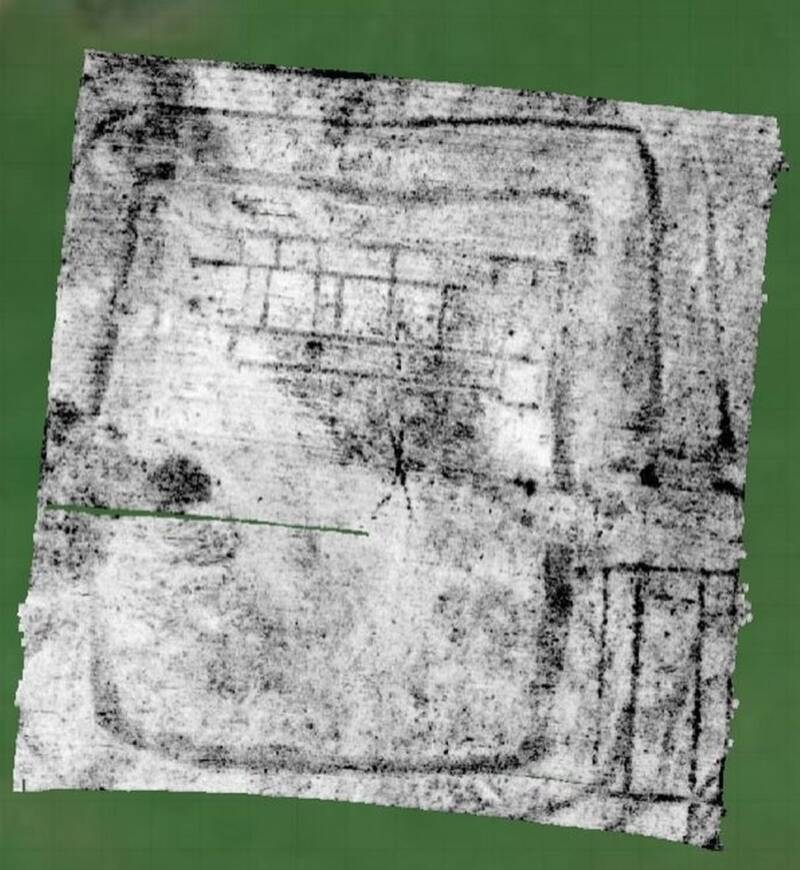
TerraDatA scan of the Roman villa that was detected beneath Margam Country Park.
“This is an amazing discovery,” said Alex Langlands, an associate professor of heritage and history at Swansea University, and the project lead for ArchaeoMargam. “We always thought that we’d find something dating to the Romano-British period, but we never dreamed it would be so clearly articulated and with so much potential in terms of what it can tell us about the elusive first millennium AD here in South Wales.”
Scans of the area — the exact location of which has been kept secret to prevent looting — suggests that the villa sat within a defensive enclosure. The enclosure itself is 141 feet by 180 feet, and was perhaps constructed as far back as the early Iron Age. The villa also includes a large building in its southeast corner, which was possibly an agricultural storage building that was transformed into a meeting hall after the fall of Rome.
“It is too early to speculate about the date range of the building, its architectural features, who constructed it, and how it fell out of use,” Langlands noted. “But from the geophysical survey alone we can start to build hypotheses about how important this site could be and what it can tell us about Margam’s long-term role in the social, cultural, and economic developments across the first millennium in Wales.”
Indeed, the discovery of the villa challenges the idea that Wales was merely a far-flung territory on the edge of the Roman Empire. Instead, this villa was a permanent structure, suggesting that the ancient Romans put down bona fide roots in this region.
The Murky History Of Roman-Era Wales
Roman history in Wales began in 48 C.E., five years after the Romans first arrived in Britain. At the time, the invading Roman armies encountered a number of formidable native tribes. In one memorable battle in 61 C.E., they fought against a combined force of warriors and druids, who terrified the Roman soldiers by shouting spells. However, they were easily defeated. “At the end of the battle, the Romans were victorious,” the Roman historian Tacitus wrote of the encounter, “and the holy oaks of the druids were destroyed.”
Indeed, Wales during the Roman era was thought of as a place of conquest — a nexus of Roman camps and roads, forts and armies. A place on the edge of the frontier, and not necessarily one of permanent structures.

Hazel LanglandsResearchers at Margam Park as part of the project to map the Roman villa recently found there.
The villa, which Langlands estimates is from the fourth century C.E., challenges this idea. It suggests that the Roman presence in Wales was far more deep-rooted than previously known, and that the Romans were established enough to build elaborate villas similar to ones found in Britain.

Fire Blanket - 1500F CE Certified Emergency Fire Blanket for Home and Kitchen. 500GSM Fabric & 0.5mm Thick - 100% Fiberglass Fire Extinguisher for Car,Warehouse Office - 5pc (40x40 inches) by Supa Ant
(as of March 3, 2026 16:43 GMT +00:00 - More infoProduct prices and availability are accurate as of the date/time indicated and are subject to change. Any price and availability information displayed on [relevant Amazon Site(s), as applicable] at the time of purchase will apply to the purchase of this product.)
KiddyCare Diaper Caddy Organizer for Baby Nursery Basket with Handle Lid Nursing Caddy with Changing Table Organizer Cart Newborn Caddy Rosy (Floral Print) X-Large
$16.50 (as of March 3, 2026 16:43 GMT +00:00 - More infoProduct prices and availability are accurate as of the date/time indicated and are subject to change. Any price and availability information displayed on [relevant Amazon Site(s), as applicable] at the time of purchase will apply to the purchase of this product.)
Joking Hazard Enlarged Box Empty Box for Card Storage
$12.00 (as of March 3, 2026 16:43 GMT +00:00 - More infoProduct prices and availability are accurate as of the date/time indicated and are subject to change. Any price and availability information displayed on [relevant Amazon Site(s), as applicable] at the time of purchase will apply to the purchase of this product.)
RIVER OF GOODS Alabaster LED Mesh Caged Ceiling Fan - 52" L X 52" W - White/Oak Wood-Grain Blades
(as of March 3, 2026 16:43 GMT +00:00 - More infoProduct prices and availability are accurate as of the date/time indicated and are subject to change. Any price and availability information displayed on [relevant Amazon Site(s), as applicable] at the time of purchase will apply to the purchase of this product.)