Inside the Secretive Cult’s 150 Mysterious Rules Finally Revealed Online—What They Don’t Want You to Know
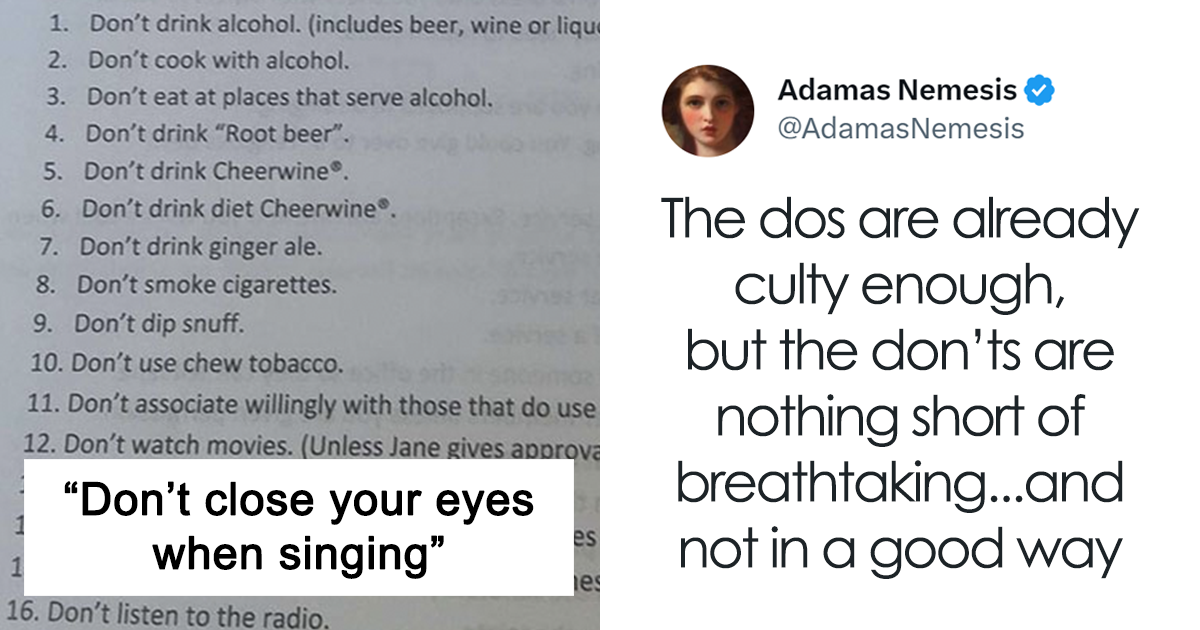
126. Don’t iron double creases in your pants.
127. Men: Don’t use urinals that are not enclosed.
128. Don’t store personal garments unless they are folded neatly in the drawer.
129. Don’t go to tanning beds.
130. Don’t ride motorcycles.
131. Don’t ride ATV’s or dirt bikes.
132. Men: African American- Don’t shave your head bald.
133. Don’t start a relationship without checking it out with Jane Whaley.
134. Don’t decide who you will marry without checking it out with Jane.
135. Don’t talk to the other person who you are in relationship with unless someone is listening and “guarding the conversation”.
136. Don’t talk loose and joke around. Don’t be foolish.
137. Don’t complain about the list of “don’ts”.
138. Don’t place the toilet paper on the roll unless it rolls over the top.
139. Don’t speak to those who have left unless you ask Jane.
140. Don’t ask anyone but Jane about those who have not been seen lately in services.
141. Don’t go in the sanctuary with “sin in your heart”, deal with
142. Don’t expect someone else to clean-up your mess.
143. Don’t back-talk or give excuses for your sin.
144. Don’t attack those in authority.
145. Don’t question Jane’s authority to run WOFF.
“We hope you will be with us for many years to come. Don’t worry about memorizing this list. When you violate a “don’t”, you will be told-“We don’t do that”.”
Typically guided by a charismatic leader, cults often isolate their members from the outside world
A cult is typically considered to be a group of people centered around veneration of a person, an idea, or certain beliefs. Research into cults pointed out that since the early 20th century, the term has often been used to describe a religious movement of some sort, teachings of which might seem bizarre or even dangerous for people outside the group.
According to the study, the religious movements that are often referred to as cults can be departures from specific doctrines or a combination of several religions together. It also emphasized that some cults are not related to religion after all, and can be based on humanistic psychology or meditation. The research also noted that a cult typically has an influential charismatic leader and creates a strong distinction between members and non-members, often by categorizing people into “us” and “them”.
According to MasterClass, most cults share at least some common characteristics; these often include authoritarian control, extremist beliefs, isolation from society, and veneration of a single individual, which is typically the aforementioned charismatic leader. All of these characteristics create a bubble around the member that isolates them from the outside world and encourages them to blindly follow the cult’s doctrines. Not only do they have to follow certain rules, they are taught not to criticize or even question them either.

Image credits: Josh Sorenson (not the actual photo)
There are certain characteristics that can help distinguish a cult
An article in The New York Times suggested that there are currently between 2,500 and 3000 cults in the US, adding up to roughly 300,000 to three million members. It pointed out that the latter are often manipulated by cult leaders and trainers who use techniques resembling brainwashing that can evoke behavioral changes.
Hyperfixation on a certain person, for example, often completely disregarding any practical consideration, can be one of the warning signs that someone is involved with a potentially unsafe group or leader. Cult Education listed such warning signs, which also include dependency upon the leader for problem solving, isolation from family and old friends, and obsessiveness over the group or the leader that supersedes personal goals and individual interests, among other things.
The list shared on Twitter ticks numerous boxes of characteristics specific to cults. In addition to having to check with their leader Jane about everything from watching a movie to buying a house, it also restricts a multitude of other activities (it even prohibits people from enjoying a game of Monopoly or playing an imaginary guitar), which would most likely weird out anyone outside the group. And people replying to Degen Dilly’s post showed that it did.

Image credits: RDNE Stock project (not the actual photo)
People on Twitter replied to Degen Dilly’s post with jokes and other remarks

Image credits: slugisland 
Image credits: AdamasNemesis 
Image credits: Alethios3
Image credits: ginfueledbrat

Image credits: joyofprinting
Image credits: TimSpursFan 
Image credits: AsuEve
Image credits: ztsekouras 
Image credits: Bandit__Streams
Image credits: HSI_TV

Image credits: cfredman 
Image credits: malinablue
Image credits: GammondTerry 
Image credits: olivekosheluk

1MORE Triple Driver In-Ear Headphones - Silver - Wired - Adult - In Ear - 18 grams - 90 days limited warranty
(as of March 3, 2026 16:43 GMT +00:00 - More infoProduct prices and availability are accurate as of the date/time indicated and are subject to change. Any price and availability information displayed on [relevant Amazon Site(s), as applicable] at the time of purchase will apply to the purchase of this product.)
1MORE Triple Driver in-Ear Earphones Hi-Res Headphones with High Resolution, Bass Driven Sound, MEMS Mic, in-Line Remote, High Fidelity for Smartphones/PC/Tablet - Silver
(as of March 3, 2026 16:43 GMT +00:00 - More infoProduct prices and availability are accurate as of the date/time indicated and are subject to change. Any price and availability information displayed on [relevant Amazon Site(s), as applicable] at the time of purchase will apply to the purchase of this product.)
Fire Blanket - 1500F CE Certified Emergency Fire Blanket for Home and Kitchen. 500GSM Fabric & 0.5mm Thick - 100% Fiberglass Fire Extinguisher for Car,Warehouse Office - 5pc (40x40 inches) by Supa Ant
(as of March 3, 2026 16:43 GMT +00:00 - More infoProduct prices and availability are accurate as of the date/time indicated and are subject to change. Any price and availability information displayed on [relevant Amazon Site(s), as applicable] at the time of purchase will apply to the purchase of this product.)
RIVER OF GOODS Stained Glass Magna Carta LED Ceiling Fan - 52" L x 52" W - Tiffany Style - Flush Mount Ceiling Fan with Remote - Teal
(as of March 3, 2026 16:43 GMT +00:00 - More infoProduct prices and availability are accurate as of the date/time indicated and are subject to change. Any price and availability information displayed on [relevant Amazon Site(s), as applicable] at the time of purchase will apply to the purchase of this product.)




















Post Comment