The Hidden Challenges NASA Overcame to Achieve the Impossible Moon Landing
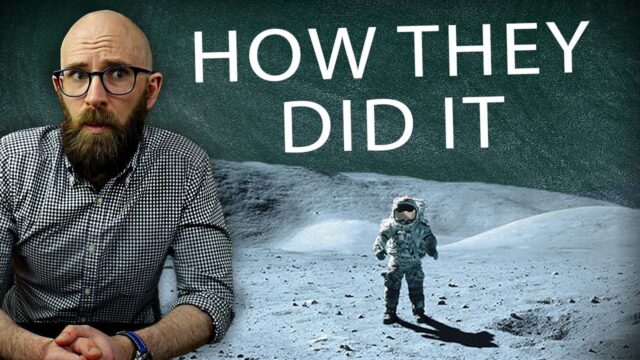
There were other, equally concerning flaws with the concept. For instance, nobody knew what the surface of the moon was like or whether it was stable enough to launch a giant spacecraft from. Also, in order to better withstand the G-forces of launch and reentry, the crew lay with their backs to the Command Module heat shield, meaning they would somehow have to land on the moon while facing away from the lunar surface.
Wernher von Braun, the former Nazi rocket engineer and director of the Marshall Space Flight Centre in Huntsville, Alabama, favoured an alternative approach known as Earth Orbit Rendezvous or EOR. Instead of being launched all at once with one massive super-rocket, the lunar spacecraft would instead be launched in pieces aboard many smaller Saturn C-5 rockets and assembled in earth orbit before setting off for the moon. Several variations of this scheme were proposed: in one, the spacecraft sections were launched into orbit pre-filled with rocket propellant; while in another they were launched empty and topped up with propellant by another spacecraft just prior to departure. And in yet another, the spacecraft was assembled by astronauts based aboard an earth-orbiting space station built ahead of time.
But while Earth Orbit Rendezvous eliminated the need to develop a giant and potentially troublesome super-rocket, it soon became clear that this approach was just as problematic and risky as Direct Ascent. For one thing, assembling such a spacecraft would require NASA to perfect techniques for orbital rendezvous and docking – the feasibility of which was unknown at the time and would not be demonstrated until the Gemini 6, 7, and 8 missions in 1965 and 1966 – and for more on how the former mission nearly ended in fiery disaster, please check out our previous video That Time NASA Almost Turned Two Astronauts into Roman Candles. Further, spreading the spacecraft components over multiple launches actually increased overall risk, since even a single failed or aborted launch would likely result in a mission being cancelled. Even a delayed launch could have serious consequences, for cryogenic rocket propellants like liquid oxygen and liquid hydrogen could potentially boil away into space by the time the spacecraft was ready for departure. The use of an orbiting space station as an assembly dock and home base would help mitigate some of these risks, but would also likely push the project far beyond President Kennedy’s 1970 deadline. And on top of all of this, once they reached the moon the crew would still face the same problem of safely landing a massive spacecraft on the lunar surface and blasting off again.
It is worth noting here that many of the difficulties NASA faced in selecting a lunar landing profile stemmed from a combination of politics and locked-in design decisions. The basic Apollo Spacecraft design had been conceived in 1960 by Maxine Faget, chief designer at NASA’s Langley Research Centre in Hampton, Virginia, as a more sophisticated, general-purpose successor to his primitive Mercury Capsule, which carried the first American astronauts into space. Faget chose a crew size of three so the spacecraft instruments could be continuously monitored in three eight-hour shifts, while the size of the spacecraft and the volume of oxygen, fuel, and other consumables carried aboard it were chosen based on a 14-day mission – the maximum time anticipated for a trip to the moon and back. These design decisions resulted in a spacecraft weighing around 4 metric tons. However, at the time lunar missions were seen as a far-off goal, and little thought was given to how the Apollo spacecraft would actually land on the moon. But after the Soviet Union leapfrogged the United States with a string of spectacular space “firsts” including the launch of Sputnik 1, the first artificial satellite, on October 4, 1957; and the first manned orbital flight of cosmonaut Yuri Gagarin aboard Vostok 1 on April 12, 1961, the U.S. government scrambled to choose a spaceflight goal that would allow them to beat the Soviets. Earth-orbiting space stations and manned lunar flybys were quickly rejected as the Soviets could likely accomplish these feats using existing hardware; the only mission that would require both superpowers to develop new launch vehicles from scratch – giving the US a chance to pull ahead – was a manned lunar landing. Maxine Faget’s Apollo design was thus pressed into service as America’s lunar spacecraft far ahead of schedule.
Meanwhile, aerospace contractor McDonnell-Douglas had submitted a number of proposals for Direct Ascent mission profiles using their own 2-man Gemini capsule or a simplified, 2-man version of the Apollo spacecraft – missions which could very feasibly be flown by the end of the decade using a great deal of off-the-shelf hardware. However, by the end of 1961 all the major government contracts for Project Apollo had already been handed out, and neither NASA administrator James Webb nor U.S. Vice President Lyndon Johnson – chairman of the National Aeronautics and Space Council – were willing to take the main spacecraft contract away from North American Aviation. Both Wernher von Braun and Jerome Wiesner, science advisor to the President, fought tooth and nail to have McDonnell-Douglas’s proposal accepted, until finally being silenced by the Kennedy administration. Thus, despite the many logistical advantages of the two-man direct-ascent approach, all subsequent lunar landing proposals were locked in around the more sophisticated – but far heavier – 3-man Apollo spacecraft. The political shenanigans behind North American retaining the Apollo contract would later come to light in the wake of the January 27, 1967 Apollo 1 fire, when shoddy workmanship and questionable design choices led to astronauts Gus Grissom, Edward White, and Roger Chaffee perishing in an oxygen fire during a routine dress rehearsal at Cape Canaveral’s Launch Complex 34.
Supa Ant 6x8ft. Welding Blanket Fireproof (Pack of 2) - Heavy Duty Weld Fire Blanket Tools - Welders Cover for Men Curtain with Gloves - Large Welding Gear for Welder Accessories
(as of March 3, 2026 16:43 GMT +00:00 - More infoProduct prices and availability are accurate as of the date/time indicated and are subject to change. Any price and availability information displayed on [relevant Amazon Site(s), as applicable] at the time of purchase will apply to the purchase of this product.)
Supa Ant Silicone Fire Cloak for Fireproof Suit Emergency Blanket for Home and Kitchen - Emergency Poncho as Heat Shield Blanket -Fire Resistant Hoodie-Escape Suit with Cape and Hood (70x55 in.-Large)
$83.99 (as of March 3, 2026 16:43 GMT +00:00 - More infoProduct prices and availability are accurate as of the date/time indicated and are subject to change. Any price and availability information displayed on [relevant Amazon Site(s), as applicable] at the time of purchase will apply to the purchase of this product.)
Joking Hazard Enlarged Box Empty Box for Card Storage
$12.00 (as of March 3, 2026 16:43 GMT +00:00 - More infoProduct prices and availability are accurate as of the date/time indicated and are subject to change. Any price and availability information displayed on [relevant Amazon Site(s), as applicable] at the time of purchase will apply to the purchase of this product.)
White Leaf Provisions Organic Purees / Baby Food Pouches - Fruits, Veggies & Grains, Toddler snack, Regeneratively Farmed, No Added Sugar, Non-GMO, BPA-Free Pouches 3.17 oz (Pack of 24, Mango + Carrot + Banana + Pear)
$70.37 (as of March 3, 2026 16:43 GMT +00:00 - More infoProduct prices and availability are accurate as of the date/time indicated and are subject to change. Any price and availability information displayed on [relevant Amazon Site(s), as applicable] at the time of purchase will apply to the purchase of this product.)

















Post Comment