The Hidden Challenges NASA Overcame to Achieve the Impossible Moon Landing
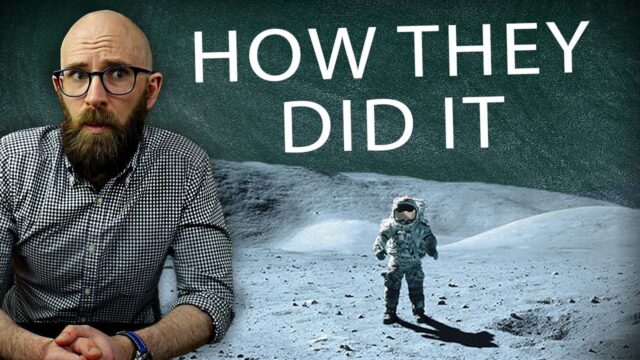
What is certain, however, is that Houbolt soon became the single most vehement champion within NASA for Lunar Orbit Rendezvous, aggressively championing the concept at every possible opportunity. But so deeply entrenched were the Direct Ascent and Earth Orbit Rendezvous camps that everywhere he went Houbolt faced stiff resistance. At one meeting attended by Maxime Faget, Wernher von Braun, and NASA Associate Administrator Robert Seamans, following Houbolt’s pitch of LOR, Faget suddenly sprang from his seat and angrily declared: “His figures lie! He doesn’t know what he’s talking about!” Meanwhile, Houbolt’s supervisor ordered him to drop the matter, pointing out that selecting lunar landing profiles was well outside his department’s jurisdiction. Yet Houbolt persisted, and in November 1961 he decided to cut through the red tape and write a now-legendary letter directly to Robert Seamans. This move violated every protocol at NASA and placed Houbolt’s career on the line, a fact he plainly acknowledged:
“Dear Dr. Seamans :
Somewhat as a voice in the wilderness, I would like to pass on a few thoughts on matters that have been of deep concern to me over recent months. This concern may be phrased in terms of two questions:
- If you were told that we can put men on the moon with safe return with a single C-3, its equivalent or something less, would you judge this statement with the critical skepticism that others have?
- Is the establishment of a sound booster program really so difficult?
I would like to comment on both these questions, and more, would like to forward as attachments condensed versions of plans which embody ideas and suggestions which I believe are so fundamentally sound and important that we cannot afford to overlook them. You will recall I wrote to you on a previous occasion. I fully realize that contacting you in this manner is somewhat unorthodox; but the issues at stake are crucial enough to us all that an unusual course is warranted.
Since we have had only occasional and limited contact, and because you therefore probably do not know me very well, it is conceivable that after reading this you may feel that you are dealing with a crank. Do not be afraid of this. The thoughts expressed here may not be stated in as diplomatic a fashion as they might be, or as I would normally try to do, but this is by choice and at the moment is not important. The important point is that you hear the ideas directly, not after they have filtered through a score or more of other people, with the attendant risk that they may not even reach you.”
But after this rather humble and apologetic introduction, Houbolt got straight to the heart of the matter, arguing that NASA’s approach to selecting a lunar landing profile was flawed, overly restrictive, and riddled with entrenced bias:
“The greatest objection that has been raised about our lunar rendezvous plan is that it does not conform to the “ground rules”. This to me is nonsense; the important question is, “Do we want to get to the moon or not?”, and, if so, why do we have to restrict our thinking along a certain narrow channel. I feel very fortunate that I do not have to confine my thinking to arbitrarily set up ground rules which only serve to constrain and preclude possible equally good or perhaps better approaches.
…Three ground rules in particular are worthy of mention: three men, direct landing, and storable return. These are very restrictive requirements. If two men can do the job, and if the use of only two men allows the job to be done, then why not do it this way? If relaxing the direct requirements allows the job to be done with a C-3, then why not relax it? Further, when a hard objective look is taken at the use of storables, then it is soon realized that perhaps they aren’t so desirable or advantageous after all in comparison with some other fuels.
…Perhaps the substance of this section might be summarized this way. Why is NOVA, with its ponderous ideas, whether in size, manufacturing, erection, site location, etc., simply just accepted, and why is a much less grandiose scheme involving rendezvous ostracized or put on the defensive?”
He then followed this with a thorough mathematical breakdown demonstrating the inherent advantages of LOR, before concluding that:
“Naturally, in discussing matters of the type touched upon herein, one cannot make comments without having them smack somewhat against NOVA. I want to assure you, however, I’m not trying to say NOVA should not be built, i’m simply trying to establish that our scheme deserves a parallel front-line position. As a matter of fact, because the lunar rendezvous approach is easier, quicker, less costly, requires less development, less new sites and facilities, it would appear more appropriate to say that this is the way to go, and that we will use NOVA as a follow on. Give us the go-ahead, and a C-3, and we will put men on the moon in very short order – and we don’t need any Houston empire to do it.
In closing, Dr. Seamans, let me say that should you desire to discuss the points covered in this letter in more detail, I would welcome the opportunity to come up to Headquarters to discuss them with you.
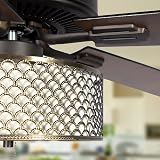
RIVER OF GOODS Mid-Century Modern Transitional LED Bronze Chrome Ceiling Fan - 52" L x 52" W - Rich Barnwood/Light Driftwood Fan Blades - Metallic Ceiling Fan with Light and Fabric Shade
(as of March 3, 2026 16:43 GMT +00:00 - More infoProduct prices and availability are accurate as of the date/time indicated and are subject to change. Any price and availability information displayed on [relevant Amazon Site(s), as applicable] at the time of purchase will apply to the purchase of this product.)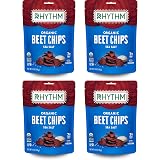
Rhythm Superfoods Cripsy Beet Chips, Salted, Organic and Non-GMO, Vegan/Gluten-Free Superfood Snacks, 1.4 Oz (Pack of 4)
(as of March 3, 2026 16:43 GMT +00:00 - More infoProduct prices and availability are accurate as of the date/time indicated and are subject to change. Any price and availability information displayed on [relevant Amazon Site(s), as applicable] at the time of purchase will apply to the purchase of this product.)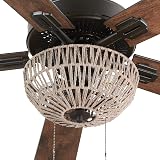
RIVER OF GOODS LED Boho Ceiling Fan with Hand Woven Brown/Natural Rope - Macrame Knot Work and Hemp Rope Style Eclectic Cottage Decor - 52" L x 52" W - Rich Barnwood/Light Driftwood Fan Blades
(as of March 3, 2026 16:43 GMT +00:00 - More infoProduct prices and availability are accurate as of the date/time indicated and are subject to change. Any price and availability information displayed on [relevant Amazon Site(s), as applicable] at the time of purchase will apply to the purchase of this product.)
Fire Blanket - 1500F CE Certified Emergency Fire Blanket for Home and Kitchen. 500GSM Fabric & 0.5mm Thick - 100% Fiberglass Fire Extinguisher for Car,Warehouse Office - 5pc (40x40 inches) by Supa Ant
(as of March 3, 2026 16:43 GMT +00:00 - More infoProduct prices and availability are accurate as of the date/time indicated and are subject to change. Any price and availability information displayed on [relevant Amazon Site(s), as applicable] at the time of purchase will apply to the purchase of this product.)
















Post Comment