The Hidden Challenges NASA Overcame to Achieve the Impossible Moon Landing
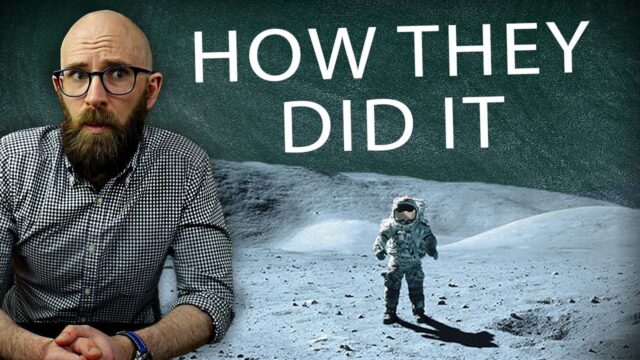
The first manned flight of the Block II CSM took place from October 11-22 aboard Apollo 7, crewed by Commander Wally Schirra – a veteran of the Mercury and Gemini programmes – Command Module Pilot Donn Eisle, and Lunar Module Pilot Walter Cunningham. Apollo 7 was supposed to be followed by an orbital test of the Lunar Module, but the political desire to achieve a spaceflight spectacular to intimidate the Soviets led to this flight being reconfigured as a lunar orbital mission. Crewed by Frank Borman, James Lovell, and William Anders, Apollo 8 was flown between December 21 and 27, 1968 and marked the first time in history that humans visited another celestial body and observed the far side of the moon.
The first manned orbital test of the Lunar Module was moved to the Apollo 9 mission, crewed by commander James McDivitt, Command Module Pilot David Scott, and Lunar Module Pilot Rusty Schewickart. Flown between March 3 and 13, 1969, Apollo 9 succeeded in fully proving out the LM design as well as achieving a number of spaceflight firsts, including the first docking and extraction of a LM from its adapter; the first independent flight of a pure spacecraft designed only for use in space; the first flight test of an independent life support system – i.e. the PLSS backpack the astronauts would later use on the lunar surface; the first manned “fire in the hole” test of the LM ascent stage engine; and and the second docking of two manned spacecraft after the Soviet Soyuz 4 and 5 mission on January 14, 1969. The mission also reintroduced a practice that would become standard on all subsequent Apollo missions. Prior to the March 23, 1965 Gemini 3 mission, Commander Gus Grissom – who would later perish in the Apollo 1 fire – dubbed his spacecraft the “Molly Brown” – a cheeky reference to the Broadway musical The Unsinkable Molly Brown and Grissom’s July 21, 1961 Mercury-Redstone 4 mission, during which a malfunctioning hatch led to the capsule sinking and Grissom nearly drowning in the Atlantic ocean – and for more on this forgotten near-disaster, please check out our previous video Forgotten History: NASA and the Sinking Spacecraft. Unfortunately, NASA administrators did not share Grissom’s macabre sense of humour, and banned all future astronauts from naming their spacecraft. However, the Apollo 9 crew pointed out that once separated, the CSM and LM would need different callsigns to differentiate them. The Apollo 9 Command Module arrived at the Vertical Assembly Building at Cape Canaveral wrapped in blue plastic, which reminded the crew of a giant candy; the CSM was thus dubbed “Gumdrop.” Meanwhile, the LM was given the callsign “Spider” for obvious reasons.
Apollo 9 was followed by Apollo 10, the final “dress rehearsal” of the Apollo program. Crewed by Commander Gene Cernan, Lunar Module Pilot Thomas Stafford, and Command Module Pilot John Young and flown between May 18 and 26, 1969, Apollo 10 carried out all the steps of a lunar mission except for the actual descent and landing, with Cernan and Stafford bringing the Lunar Module Snoopy within 15.6 kilometres of the lunar surface before firing the ascent stage engine and reuniting with Young aboard the CSM Charlie Brown. But if the astronauts were tempted to disobey orders and become the first men to land on the moon, it would have been a one-way trip, as Gene Cernan later explained:
“A lot of people thought about the kind of people we were: ‘Don’t give those guys an opportunity to land, ’cause they might!’ So the ascent module, the part we lifted off the lunar surface with, was short-fueled. The fuel tanks weren’t full. So had we literally tried to land on the Moon, we couldn’t have gotten off.”
George Mueller, NASA’s Associate Administrator for Manned Space Flight, further clarified:
“There had been some speculation about whether or not the crew might have landed, having gotten so close. They might have wanted to, but it was impossible for that lunar module to land. It was an early design that was too heavy for a lunar landing, or, to be more precise, too heavy to be able to complete the ascent back to the command module. It was a test module, for the dress rehearsal only, and that was the way it was used.”
But while they did not land on the moon, on their return to earth the Apollo 10 crew did set a record for the highest speed attained by a manned vehicle: 39,987 kilometres an hour – a record which still stands to this day.
With the functionality and reliability of the entire Apollo system now proven, NASA was finally ready to take the next step and attempt a manned lunar landing. Apollo 11, crewed by Commander Neil Armstrong, Lunar Module Pilot Edwin “Buzz” Aldrin, and Command Module Pilot Michael Collins, lifted off from Cape Canaveral on July 16, 1969. Four days later, Armstrong and Aldrin climbed into the Lunar Module Eagle, separated from the CSM Columbia, and fired the Eagle’s descent engine, starting their descent towards the lunar surface. However, five minutes later a pair of computer alarms – 1201 and 1202 – began to sound, putting the mission in jeopardy and proving that the LM still had some kinks to work out. After several tense minutes, software engineers determined that the alarms were caused by the LM’s landing and rendezvous radars both being switched on at the same time, leading to an “executive overflow” condition. The error was quickly corrected, and Armstrong and Aldrin continued the descent. However, the astronauts soon ran into further trouble as they realized that the guidance computer was sending them towards a large boulder field on the edge of the 91 metre-wide West Crater. With only 90 seconds of propellant left, Armstrong took manual control deftly guided the Eagle over the crater and towards a smooth area on the far side. At 8:17 PM UTC on July 20, 1969, Eagle touched down on the lunar surface – with only 25 seconds of propellant to spare. On shutting down the descent engine, Armstrong spoke the historic words:
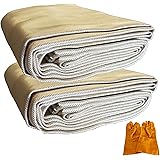
Supa Ant 6x8ft. Welding Blanket Fireproof (Pack of 2) - Heavy Duty Weld Fire Blanket Tools - Welders Cover for Men Curtain with Gloves - Large Welding Gear for Welder Accessories
(as of March 3, 2026 16:43 GMT +00:00 - More infoProduct prices and availability are accurate as of the date/time indicated and are subject to change. Any price and availability information displayed on [relevant Amazon Site(s), as applicable] at the time of purchase will apply to the purchase of this product.)
The Door Balancer Eliminates The Need for Door Props, Door Stops and Door Wedges
$7.99 (as of March 3, 2026 16:43 GMT +00:00 - More infoProduct prices and availability are accurate as of the date/time indicated and are subject to change. Any price and availability information displayed on [relevant Amazon Site(s), as applicable] at the time of purchase will apply to the purchase of this product.)
RIVER OF GOODS Stained Glass Magna Carta LED Ceiling Fan - 52" L x 52" W - Tiffany Style - Flush Mount Ceiling Fan with Remote - Teal
(as of March 3, 2026 16:43 GMT +00:00 - More infoProduct prices and availability are accurate as of the date/time indicated and are subject to change. Any price and availability information displayed on [relevant Amazon Site(s), as applicable] at the time of purchase will apply to the purchase of this product.)
Joking Hazard Deck Enhancement #1 - Expansion Pack for Fun Party Games by Cyanide & Happiness, 100 New Hilarious Comic Cards | Perfect for Game Night
$10.00 (as of March 3, 2026 16:43 GMT +00:00 - More infoProduct prices and availability are accurate as of the date/time indicated and are subject to change. Any price and availability information displayed on [relevant Amazon Site(s), as applicable] at the time of purchase will apply to the purchase of this product.)












Post Comment