The Hidden Challenges NASA Overcame to Achieve the Impossible Moon Landing
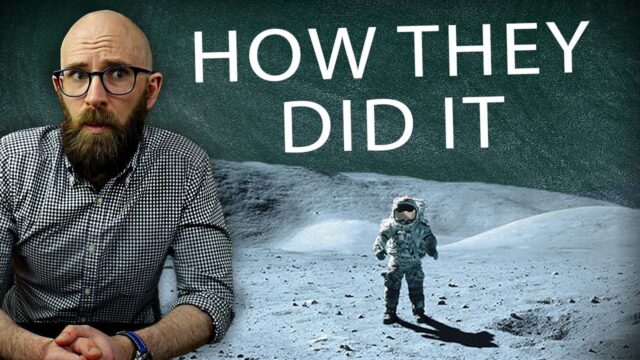
“Houston, Tranquility Base here. The Eagle has landed.”
To which fellow astronaut Charlie Duke, acting as Capsule Communicator or CapCom, replied, slurring his words in relief:
“Roger, Twan—Tranquility, we copy you on the ground. You got a bunch of guys about to turn blue. We’re breathing again. Thanks a lot.”
Watching from Mission Control in Houston that day was the man whose insight and perseverance had made this historic moment possible: John Houbolt. Despite the accolades he had received from NASA, Houbolt had left the agency in 1963 to work for the consulting firm Aeronautics Research Associates. Nonetheless, in July 1969 he was invited to Mission Control by none other than Wernher von Braun, whose dearly-held Earth Orbit Rendezvous concept he had overturned. According to Houbolt, moments after the Eagle touched down on the lunar surface:
“…a wonderful thing happened. Von Braun turned to me … and says, ‘Thank you, John. It is a good idea.’”
Houbolt returned to NASA Langley in 1976 as Chief Aeronautical Scientist, in which role he published more than 120 technical papers before retiring in 1985 to become a private consultant. He died of Parkinson’s in 2014 at the age of 95.
Aside from the program alarms during descent, Apollo 11 encountered only one other issue with the LM: on re-entering the cabin, one of the astronauts’ PLSS backpacks accidentally snapped off the plunger on an ascent engine circuit breaker. Thankfully, the astronauts were able to close the breaker by simply shoving a pen into the hole, and the liftoff carried on as planned.
Indeed, the strange-looking Grumman Lunar Module proved itself a solid and reliable flying machine, suffering only a handful of relatively minor failures throughout its career. For example, during the descent of Apollo 14’s LM Antares on February 14, 1971, the guidance computer began displaying intermittent abort signals. The cause of the fault was traced to a small ball of solder which had come loose beneath a control panel and drifted into a switch, shorting it out. Commander Alan Shepard and Lunar Module Pilot Edgar Mitchell’s initial solution – tapping the panel with a pen – worked at first, but the faulty signal soon reappeared. If the signal reappeared after the descent engine had fired, it would automatically trigger an abort, firing the ascent stage engine and sending the LM back into lunar orbit. Unfortunately, the guidance computer’s software was literally hard-wired in the form of “rope memory” and could not be altered in flight. Instead, software engineers at NASA and MIT came up with a clever workaround, which in simple terms convinced the computer that it was already in abort mode, preventing it from triggering an actual abort. Lunar Module Pilot Edgar Mitchell entered the fix into the LM’s display keyboard or DSKY with just minutes to spare, and he and Shepard made a successful landing – and for more on this and other heroic software fixes that saved NASA missions, please check out our previous video Where Did the NASA Expression “Steely-Eyed Missile Man” Come From?
The subsequent Apollo mission, Apollo 15, was the first of the so-called “J missions” designed for longer-duration stays on the lunar surface. The LM was thus modified to carry more weight in consumables like oxygen and equipment like the Lunar Roving Vehicle or LRV. Among these modifications was an extended descent engine bell for added thrust. However, this left very little clearance between the bell and the lunar surface – a fact Apollo 15 Commander David Scott would learn the hard way. The astronauts had been trained to shut off the descent engine as soon as the probes on the LM’s landing legs signalled ground contact in order to prevent exhaust and lunar dust from being blown back into the engine and potentially causing an explosion. But when Scott carried out this procedure, the Lunar Module Falcon was already travelling faster than usual and slammed to the lunar surface at 2.1 metres per second. The hardest landing in Apollo history, the impact crumpled the engine bell and tipped the LM over at a 9 degree angle, but neither of these proved critical and the rest of the mission was a success.
But of course, nowhere did the LM prove its worth more than during the ill-fated flight of Apollo 13. On April 13, 1970, while en route to the moon, an oxygen tank aboard the CSM Odyssey exploded, severely crippling the spacecraft and placing astronauts Jim Lovell, Fred Haise, and Jack Swigert in mortal danger. Wishing to preserve whatever power they could for reentry and splashdown, the crew powered down Odyssey and moved into the LM Aquarius, using it as a lifeboat. Though Aquarius required several improvised modifications – including, famously, a MacGyvered adaptor to make the CSM’s square CO2 scrubber canisters fit the LM’s round canister holes – Grumman’s strange “bug” nonetheless performed above and beyond its designed capabilities, keeping the astronauts alive throughout the harrowing four-day journey to the moon and back. So proud was Grumman of this achievement that they cheekily sent North American Aviation, prime contractor for the CSM, a $312,421.24 invoice for “towing” the LM most of the way to the moon and back. The invoice included $400,004 in mileage fees, $536.05 for charging the CSM’s batteries, and an $8 per night lodging fee for an “additional guest in room” – AKA Command Module Pilot Jack Swigert. Amusingly, North American formality refused to pay, arguing that its CSMs had already ferried three Grumman LMs to the moon free of charge.

RIVER OF GOODS Alabaster LED Mesh Caged Ceiling Fan - 52" L X 52" W - White/Oak Wood-Grain Blades
(as of March 3, 2026 16:43 GMT +00:00 - More infoProduct prices and availability are accurate as of the date/time indicated and are subject to change. Any price and availability information displayed on [relevant Amazon Site(s), as applicable] at the time of purchase will apply to the purchase of this product.)
RIVER OF GOODS Mid-Century Modern Transitional LED Bronze Chrome Ceiling Fan - 52" L x 52" W - Rich Barnwood/Light Driftwood Fan Blades - Metallic Ceiling Fan with Light and Fabric Shade
(as of March 3, 2026 16:43 GMT +00:00 - More infoProduct prices and availability are accurate as of the date/time indicated and are subject to change. Any price and availability information displayed on [relevant Amazon Site(s), as applicable] at the time of purchase will apply to the purchase of this product.)
Kinsa Smart,Fever, Digital Medical Baby, Kid and Adult Termometro - Accurate, Fast, FDA Cleared Thermometer for Oral, Armpit or Rectal Temperature Reading - QuickCare
$24.98 (as of March 3, 2026 16:43 GMT +00:00 - More infoProduct prices and availability are accurate as of the date/time indicated and are subject to change. Any price and availability information displayed on [relevant Amazon Site(s), as applicable] at the time of purchase will apply to the purchase of this product.)
Promixx FORM Sports Water Bottle - Premium BPA Free Water Bottle for Fitness Sports & Outdoors - Sustainable Drinks Bottle with Measurement Markers and Leakproof Lid - 760ml / 26oz (Midnight Blue)
$19.99 (as of March 3, 2026 16:43 GMT +00:00 - More infoProduct prices and availability are accurate as of the date/time indicated and are subject to change. Any price and availability information displayed on [relevant Amazon Site(s), as applicable] at the time of purchase will apply to the purchase of this product.)
















Post Comment