Victorian Schoolchildren’s Secrets Unearthed: Marbles and a Mysterious Writing Slate Found Amid London Property Development

Imagine stumbling upon a secret time capsule tucked beneath the bustling streets of London—only instead of dusty old coins or forgotten letters, you find vividly colorful marbles and a worn writing slate still faintly scribbled with the dreams (and doodles) of Victorian schoolchildren. What mischief were those boys up to when they lost their precious alley marbles down a drain? And how many lessons did they painstakingly copy onto those reusable slates before the chalk dust settled? These relics don’t just whisper stories; they shout out loud about the daily grind and playful escapes of kids in Victorian England—a world so close, yet so vividly different. Rare finds like these don’t come knocking every day, and they pull back the curtain on a past where education, play, and community interwove in the alleys and classrooms of old London. Curious to see how these little artifacts map onto the lives of the poor boys and the coopers’ families who once called the area home? Dive right in—and let these tiny treasures roll you back in time. LEARN MORE
From several beautifully colored marbles to a reusable writing slate that was found alongside its accompanying pencil and was still covered in children’s scribbles, these artifacts illuminate what life was like in the schools of Victorian England.

Museum of London Archaeology/FacebookSome of the toy marbles that were found during excavations in London.
More than a century ago, Victorian schoolboys playing in London seemingly lost several marbles down a drain. Now, excavations at the site have turned up these lost toys as well as fragments of a writing slate that boys likely used to copy down lessons from the blackboard.
The discoveries offer a peak into what life was like for kids in Victorian London. And because items used by children are relatively rare in the archaeological record, the marbles and the slate are an especially exciting find.
The Discovery Of Toy Marbles And A Writing Slate Once Used By Victorian Schoolchildren

Museum of London Archaeology/FacebookThe excavations in London have turned up the foundations of several buildings, in addition to the marbles and slate.
According to a statement from the Museum of London Archaeology, the marbles and slate were found during excavations at the SEGRO Park Wapping site in East London, ahead of the construction of new commercial buildings. Archaeologists uncovered the remains of several buildings at the site, ones that had been active between the 16th century and the 19th, including a chapel, almshouses, and a free school for poor boys.
Alongside the buildings, archaeologists also uncovered items that the schoolchildren would have used, namely the small toy marbles and chunks of slate.
Known as alley marbles, these toys were made of ceramic but designed with colorful swirls to look like alabaster stone. They were found inside a covered, brick-lined drain. This raises the possibility, as the Museum of London Archaeology noted, that the marbles were “perhaps lost during a breaktime game.”
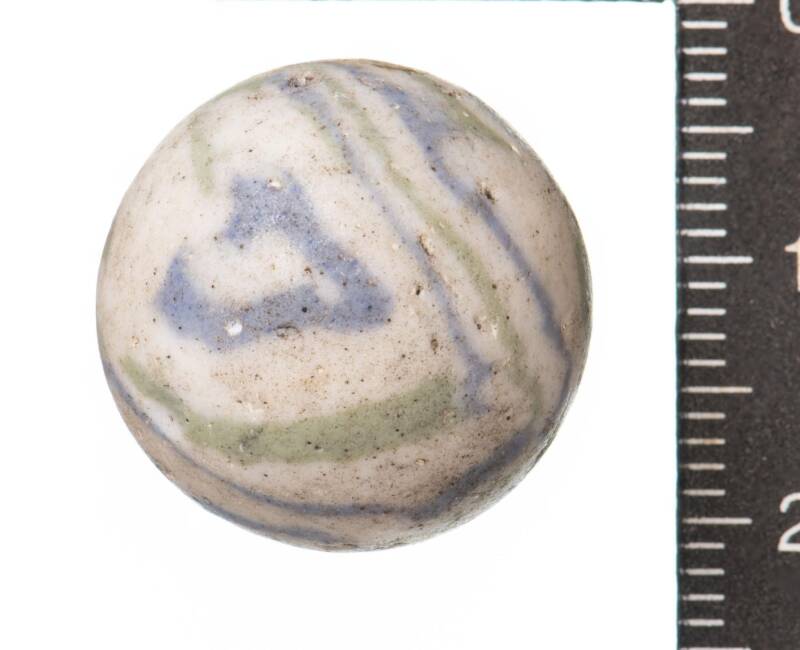
MOLA/Andy ChoppingOne of the ceramic alley marbles that was found in a drain and had perhaps been lost by schoolboys during a game.
Meanwhile, archaeologists also found chunks of slate as well as a slate pencil that Victorian children would have used during class.
“Children would have used chalk or slate pencils to copy down from the blackboard or practice their handwriting and rubbed them clean for the next lesson,” the Museum of London Archaeology explained.
There even appears to be faint handwriting left on the slate chunks, though it’s difficult to make out what it says.

MOLA/Andy ChoppingThe slate still had faint writing on it that had been left there by a Victorian schoolchild.
Furthermore, the site once encompassed far more than just a school. At various points in its long history, it was part of a larger complex that included an almshouse and a chapel that were meant to aid some of London’s most vulnerable citizens.
The Almshouse Found Alongside The School At SEGRO Park Wapping
Both the school and the almshouse first appear in the historical record in a 1598 survey of London. They were described as places meant for “the instruction of sixty poor men’s children, a schoolmaster and usher with fifty pounds… also… alms houses for fourteen poor aged persons, each of them to receive quarterly six shillings and eight pence the piece for ever.”
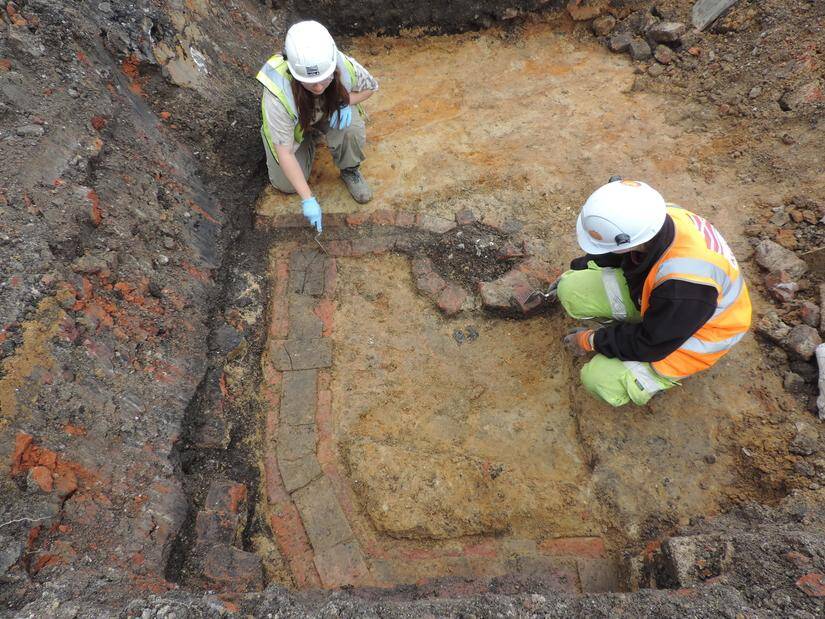
Museum of London ArchaeologyDuring the excavations in London, archaeologists uncovered the foundations of several buildings, including the almshouse and school.
The school and the almshouses were ultimately supported by the Worshipful Company of Coopers. Coopers were people who made barrels, and because barrels were exceedingly important from the 16th century on, the cooper industry had become very profitable. Indeed, many of the people living in the almshouse likely also had some connection to coopers.
According to records of the site, there were 20 people living in the almshouses by 1720: 14 women and six men. The women would have received an allowance of 20 shillings, four times a year, whereas the men received 25 shillings. Though this was a small allowance, even by today’s standards, they would have also each had a room, a cellar, and a small garden. Most, like resident Mary Alexander, had a connection to coopers: her husband and sons were all coopers.

Rhythm Superfoods Cripsy Beet Chips, Salted, Organic and Non-GMO, Vegan/Gluten-Free Superfood Snacks, 1.4 Oz (Pack of 4)
(as of March 3, 2026 16:43 GMT +00:00 - More infoProduct prices and availability are accurate as of the date/time indicated and are subject to change. Any price and availability information displayed on [relevant Amazon Site(s), as applicable] at the time of purchase will apply to the purchase of this product.)
RIVER OF GOODS Alabaster LED Mesh Caged Ceiling Fan - 52" L X 52" W - White/Oak Wood-Grain Blades
(as of March 3, 2026 16:43 GMT +00:00 - More infoProduct prices and availability are accurate as of the date/time indicated and are subject to change. Any price and availability information displayed on [relevant Amazon Site(s), as applicable] at the time of purchase will apply to the purchase of this product.)
RIVER OF GOODS Mid-Century Modern Transitional LED Bronze Chrome Ceiling Fan - 52" L x 52" W - Rich Barnwood/Light Driftwood Fan Blades - Metallic Ceiling Fan with Light and Fabric Shade
(as of March 3, 2026 16:43 GMT +00:00 - More infoProduct prices and availability are accurate as of the date/time indicated and are subject to change. Any price and availability information displayed on [relevant Amazon Site(s), as applicable] at the time of purchase will apply to the purchase of this product.)
Fire Blanket - 1500F CE Certified Emergency Fire Blanket for Home and Kitchen. 500GSM Fabric & 0.5mm Thick - 100% Fiberglass Fire Extinguisher for Car,Warehouse Office - 2pc (47x47 inches) by Supa Ant
$53.45 (as of March 3, 2026 16:43 GMT +00:00 - More infoProduct prices and availability are accurate as of the date/time indicated and are subject to change. Any price and availability information displayed on [relevant Amazon Site(s), as applicable] at the time of purchase will apply to the purchase of this product.)