13,000-Year-Old Artifacts Unearthed in Alaska Reveal Secrets of Earth’s Earliest North American Settlers
Who knew that 13,000 years ago, some crafty ancestors of Native Americans were setting up shop in Alaska, not just with stone tools but also bird beaks sharpened like tiny spears and what might be the great-great-grandpups of today’s dogs chilling nearby? Yeah, these folks at Shég’ Xdaltth’i’ clearly weren’t just hanging around waiting for the ice age to end—they were innovating like pros. Imagine stumbling upon a prehistoric campsite packed with over 80,000 relics showing off everything from bone needles (talk about early fashion statements to battle the cold!) to tools that wink at Asian designs—proof that culture hitchhiked across the Bering Land Bridge along with these first settlers. It’s like uncovering a time capsule that finally fills in the blanks about how humanity made North America home, long before history took notes. So, what secrets does this ancient Alaskan base camp hold about our roots, and could the oddly familiar “wolf-like” creatures be what started the doggy dynasty? Hold onto your hats—this isn’t your typical dig. LEARN MORE
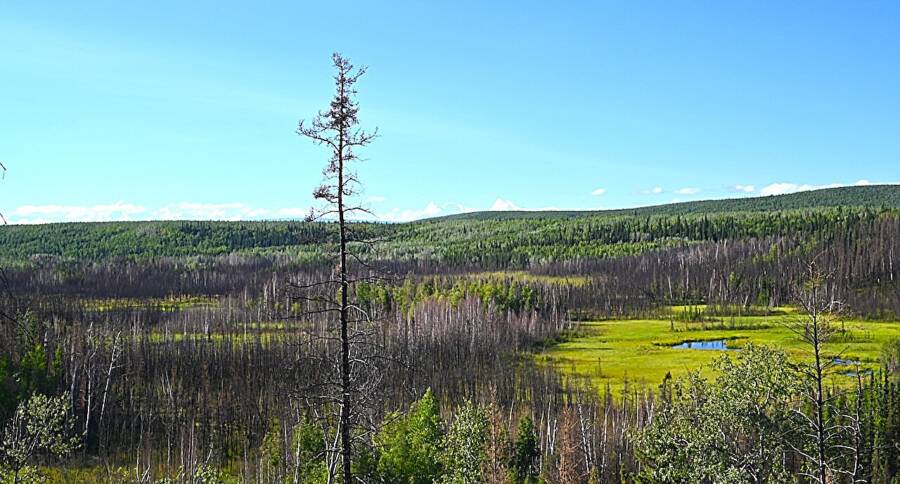
Researchers exploring these settlements, known as Shég’ Xdaltth’i’, unearthed everything from the remains of domesticated dogs to bird beaks that had been sharpened into weapons.

Kelly GrafArchaeologists excavating Shég’ Xdaltth’i’ found more than 80,000 relics that demonstrate how ancestral Native Americans lived some 13,000 years ago.
Archaeologists excavating a prehistoric site in Alaska known as Shég’ Xdaltth’i’ discovered a wealth of remains from a 13,000-year-old base camp built by some of the first ancestral Native Americans to settle the continent.
The site was near the Bering Land Bridge, a stretch of terrain connecting Asia and North America that formed 35,000 years ago, but has been underwater for the last 12,000 years. Although researchers know that people from Asia crossed this bridge in order to first settle the Americas, the archaeological record for the region is lackluster.
Now, archaeologists hope that this camp will fill in the record and shed more light than ever before on how early humans originally settled in North America before the dawn of recorded history.
The 13,000-Year-Old Artifacts Found At Shég’ Xdaltth’i’
Excavations at Shég’ Xdaltth’i’, located around 30 miles southeast of Fairbanks, have resulted in the discovery of more than 80,000 artifacts, according to a statement on the discovery from the University of Kansas. Shég’ Xdaltth’i’ (meaning “they were there” in the Native Alaskan language of Athabascan) was occupied on and off for more than 1,000 years, allowing researchers to now uncover a wide variety of relics.

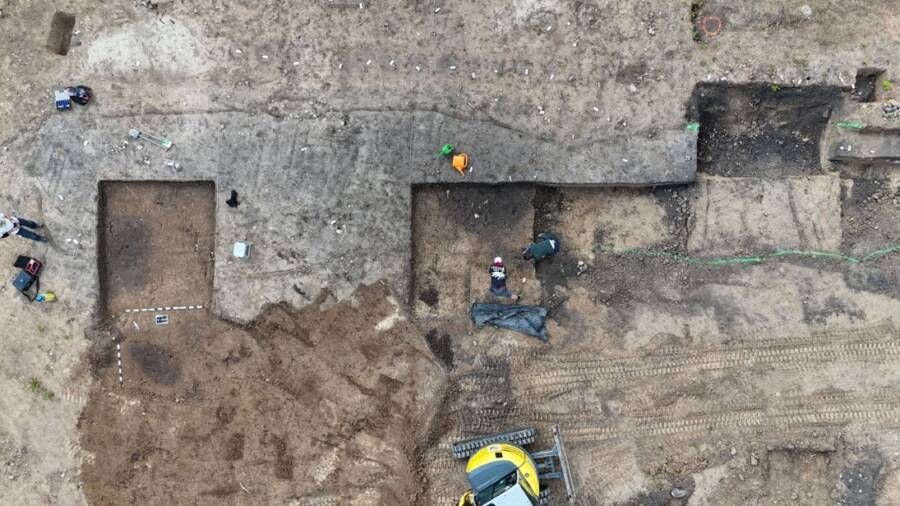
Kelly GrafThese discoveries add a wealth of new material to the previously-meager archaeological record of the Beringia region.
Researchers led by Dr. Kelly Graf of the University of Kansas were studying the site’s oldest areas of occupation, which date back to around 13,800 years ago, during the Late Pleistocene. As described in a new study published in Science Advances, researchers uncovered a hearth, a small pit, and the impression of a wooden post, which suggested that these ancestors of Indigenous Americans built shelters on the site that would have been tent-like structures. If this theory is confirmed, these would be some of the first dwellings ever constructed in not only North America, but the Western Hemisphere as a whole.
Near this possible shelter, the team identified a pit oven in the ground with remnants of charcoal and animal bones.
The archaeologists also uncovered remains belonging to more than a dozen wolf-like animals. Analysis of one of the jawbones determined that the animal was neither the now-extinct dire wolf, the Beringian wolf, nor the modern gray wolf. Instead, it appears to be some sort of other, unknown relative of the wolves we know today.

Kelly E. Graf et al., Sci. Adv. 12, eaeh0802 (2026).The team discovered fragments of bone needles, which were likely used to sew clothing.
Previous studies have found that Siberian wolves were the ancestors of early domesticated dogs in North America, which opened up questions for the new study’s researchers about whether the wolf-like canids found at Shég’ Xdaltth’i’ were domesticated as well.
In addition to animal remains, archaeologists uncovered eight pieces of bone needles, the oldest-known tools of their kind ever found in the Western Hemisphere. These needles were likely used for sewing warm clothes designed to combat the frigid temperatures of Late Pleistocene Alaska.
What These Discoveries Reveal About Some Of Beringia’s Very First Settlers
These finds greatly contribute to the archaeological record of prehistoric Alaska and show how certain cultural practices crossed over the Bering Land Bridge right along with the original settlers.
For instance, archaeologists discovered stone tools in diamond-shaped forms, which share characteristics with objects found farther west in Asia, including in northern Siberia.
Tools made from obsidian were also discovered, with geological analysis showing that the stone in question originated hundreds of miles northwest of Shég’ Xdaltth’i’. This means that certain techniques and materials moved across great distances along with the ancestral Native Americans who came to Alaska from Asia during the Late Pleistocene.

KiddyCare Diaper Caddy Organizer Cart for Nursery Baby Basket Gift for Boy/Girl | Diaper Caddy for Changing Table Basket Organizer with Dividers | Caddy for Baby Stuff Breast Pump Caddy - Regular
$9.99 (as of October 23, 2026 01:01 GMT +00:00 - More infoProduct prices and availability are accurate as of the date/time indicated and are subject to change. Any price and availability information displayed on [relevant Amazon Site(s), as applicable] at the time of purchase will apply to the purchase of this product.)
Joking Hazard Enlarged Box Empty Box for Card Storage
$12.00 (as of October 23, 2026 01:01 GMT +00:00 - More infoProduct prices and availability are accurate as of the date/time indicated and are subject to change. Any price and availability information displayed on [relevant Amazon Site(s), as applicable] at the time of purchase will apply to the purchase of this product.)
The Door Balancer Eliminates The Need for Door Props, Door Stops and Door Wedges
(as of October 23, 2026 01:01 GMT +00:00 - More infoProduct prices and availability are accurate as of the date/time indicated and are subject to change. Any price and availability information displayed on [relevant Amazon Site(s), as applicable] at the time of purchase will apply to the purchase of this product.)
RIVER OF GOODS Coastal 52 Inch Wooden Bead LED Ceiling Fan, Brown
(as of October 23, 2026 01:01 GMT +00:00 - More infoProduct prices and availability are accurate as of the date/time indicated and are subject to change. Any price and availability information displayed on [relevant Amazon Site(s), as applicable] at the time of purchase will apply to the purchase of this product.)




















Post Comment