California’s San Andreas Fault Reaches Unprecedented Stress—Is a Devastating Quake Imminent?
Okay, Southern California, here’s the million-dollar question nobody wants to ask out loud while clutching their avocado toast: what if that big, bad earthquake everyone’s been whispering about isn’t just some distant nightmare, but a real-deal ticking time bomb? According to Liliane Burkhard—the lead brainiac behind a jaw-dropping new study—the San Andreas and San Jacinto fault lines are now more stressed than at any point in the last millennium. Yep, you read that right, a THOUSAND years. It’s like Mother Nature is cranking up the pressure cooker right under LA, and the time to prep isn’t after the rumble, it’s right freaking now. So, should you stop that casual matcha sip and start planning your escape route? Well, buckle up, because this isn’t just another seismic scare story—there’s real science behind this trembling drama, and it just might redefine what “earthquake season” means for millions of Californians. Ready to find out why this “earthquake gate” at Cajon Pass could change everything? Let’s dive in.
In the words of Liliane Burkhard, the lead author behind the new study, “Southern California faces a significant and growing seismic risk, and the time to prepare is now and not after the next earthquake.”

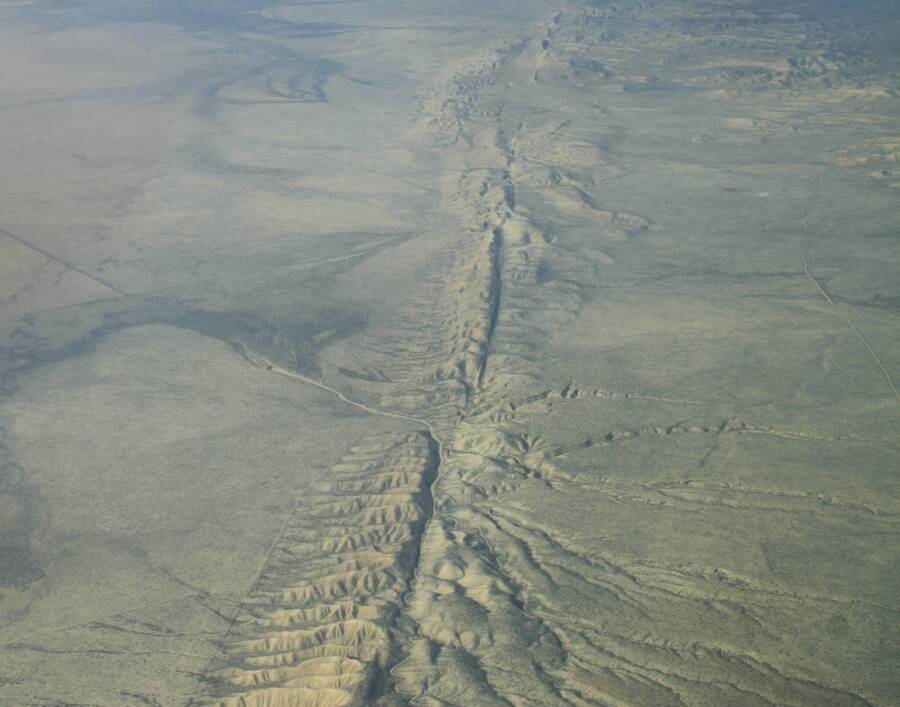
Wikimedia CommonsThe San Andreas Fault, as seen from above in San Luis Obispo County, California.
A recent study says that the San Andreas and San Jacinto fault lines are under more stress than at any point in the past 1,000 years. Here’s what that means.
It’s been a long-held fear for many Californians. This time, it might actually be real.
Anyone who has lived in Southern California knows the reality of existing in a place with many earthquakes. The first time you experience an earthquake, you panic — after the 50th, you barely stop sipping your matcha.
However, there’s a longtime fear in the minds of many Californians that, one day, there’s going to be another big earthquake. The last major earthquake experienced by residents of Los Angeles was in 1994, when the magnitude-6.7 Northridge earthquake claimed the lives of at least 57 people.
Now, some evidence suggests that another earthquake of at least that size could be around the corner.
What Did Scientists Recently Discover About The San Andreas And San Jacinto Faults?
“Scientists have just found that the San Andreas fault line is under the most pressure that it’s ever been in — and it is now lined up with a second fault line right next to LA that could rip open at the exact same time,” popular TikTok user Nick Jackson (@niickjackson) says in a recent video summarizing the recent study.

@niickjackson/TikTokPopular TikToker @niickjackson brought attention to a recent, concerning study about the San Andreas and San Jacinto fault lines.
While Jackson is slightly exaggerating — the study says it’s under the most pressure it’s been in over the past 1,000 years, not forever — the findings are still dramatic.
One of the major findings of this study was about an area called Cajon Pass, where two fault lines meet. This place can, according to researchers, act as an “earthquake gate.”
“They’re saying that whenever both fault lines are stressed to the same level, that gate can open and let a rupture jump from one fault line straight onto the other,” Jackson summarizes.
If this occurs, the outcome will likely be dramatic and devastating.

@niickjackson TikTokA map of Southern California’s fault system shows pressure building along the San Andreas Fault.
“They’re saying that both fault lines are loaded to almost the exact same point, so they could rip together or even all at once across three different branches,” Jackson explains.
“The last big one that happened in 1857 tore over 200 miles, but it stopped right at that gate,” he adds. “This time, if it were to happen again, the area it would hit is packed with millions of people.”
Jackson closes by noting that scientists still cannot predict if or when such an earthquake would occur.
How High Is California’s Risk Of An Earthquake In The Near Future?
As outlandishly frightening as this news may sound, it is indeed real — though there are some important caveats.
The study comes from the University of Hawaiʻi at Mānoa and was published in the Journal of Geophysical Research: Solid Earth.
By modeling 1,000 years of earthquake data, researchers were able to determine that “stress levels on multiple fault segments are now at or above the highest values seen in the past millennium and that the region may be capable of a large through-going rupture involving both fault systems,” according to the study’s lead author Liliane Burkhard.
Importantly, the study does not say that these faults being at a “critically loaded state” means that an earthquake is imminent — or that any resulting earthquake would be as devastating as the one that occurred in 1994.

National ArchivesSome of the devastation following the great earthquake of 1906 in San Francisco.
Instead, the study simply uses modeling to show that, historically, it has been possible for Cajon Pass to act as a sort of “gate” and link two fault events. When this happens, the outcome can be devastating — though it is not guaranteed to happen at all, let alone in the near future.
Joking Hazard by Cyanide & Happiness - 360+ Funny & Inappropriate Comic Cards, Hilarious Party Games | Includes Add-Your-Own-Words Cards
$24.95 (as of October 26, 2026 01:02 GMT +00:00 - More infoProduct prices and availability are accurate as of the date/time indicated and are subject to change. Any price and availability information displayed on [relevant Amazon Site(s), as applicable] at the time of purchase will apply to the purchase of this product.)
1MORE Triple Driver In-Ear Headphones - Silver - Wired - Adult - In Ear - 18 grams - 90 days limited warranty
(as of October 26, 2026 01:02 GMT +00:00 - More infoProduct prices and availability are accurate as of the date/time indicated and are subject to change. Any price and availability information displayed on [relevant Amazon Site(s), as applicable] at the time of purchase will apply to the purchase of this product.)
Rhythm Superfoods Kale Chips, Zesty Nacho, Organic and Non-GMO, 2.0 Oz (Pack of 4), Vegan/Gluten-Free Superfood Snacks
(as of October 26, 2026 01:02 GMT +00:00 - More infoProduct prices and availability are accurate as of the date/time indicated and are subject to change. Any price and availability information displayed on [relevant Amazon Site(s), as applicable] at the time of purchase will apply to the purchase of this product.)
1MORE Triple Driver in-Ear Earphones Hi-Res Headphones with High Resolution, Bass Driven Sound, MEMS Mic, in-Line Remote, High Fidelity for Smartphones/PC/Tablet - Silver
$69.99 (as of October 26, 2026 01:02 GMT +00:00 - More infoProduct prices and availability are accurate as of the date/time indicated and are subject to change. Any price and availability information displayed on [relevant Amazon Site(s), as applicable] at the time of purchase will apply to the purchase of this product.)