Ancient Mystery Unveiled: 2,000-Year-Old Scottish Skeleton Reveals Dark Rituals Behind Bone Tools and Missing Brain

Ever wonder what happens when Iron Age funerary practices get a bit… avant-garde? Picture this: a woman from 2,000 years ago whose bones were not just carefully preserved, but literally sharpened into tools. And hold onto your hats—her brain? Experts are torn between thinking it might’ve been casually snacked on or carefully removed to clean and preserve her skull. Talk about a head-scratcher, huh? Found near Loch Borralie in Scotland alongside a teenage boy, these well-preserved remains are rewriting what we thought we knew about ancient rituals. It’s a chilling mystery wrapped in respect and reverence—a story of connection, care, and a community that treated their dead with surprising, if somewhat macabre, tenderness. Ready to dive deeper into this Iron Age enigma? LEARN MORE
Experts suspect that her brain may have been cannibalized, or perhaps removed in an attempt to clean and preserve the skull — but the truth remains shrouded in mystery.

Hugh PowellThe skull of the boy that was found alongside the woman near Loch Borralie.
When two ancient skeletons were found in Scotland in 2000, archaeologists were shocked and delighted by how well-preserved they were, a rare occurrence for bodies that date back to the Iron Age.
The two sets of remains — one belonging to a teenage boy and the other belonging to a woman of about 30 — were found near Loch Borralie in northwestern Scotland, and it was determined that the pair likely died between 50 B.C.E. and 70 C.E.
At the time, archaeologists reported that the woman’s bones had been chewed and gnawed at by rodents or other animals. Now, in a new study published in Antiquity, researchers say that this manipulation of the woman’s bones was carried out intentionally by other members of her community. This is perhaps evidence of a previously undiscovered Iron Age funerary practice — one that also involved removing her brain.
The Ancient Woman Who Had Her Bones Sharpened Into Tools And Her Brain Removed
The archaeologists noted that, indeed, four of the woman’s longer bones — the femur (or thigh bone), ulna (from the forearm), and both humeri (from the upper arms) — had been altered after her death, but not by rodents or other animals.
“What we are seeing is an actual polishing of the remains. We think that what happened was that [the bones] may have been snapped in half, and then they had been whittled to a very sharp edge,” lead study author and archaeologist Laura Castells Navarro told CNN.
The fact that the bones were tapered to a pointed edge suggested to the researchers that they were used as tools prior to the woman’s burial.

University of YorkResearchers found that four of the woman’s bones were whittled down and possibly used as tools.
In addition to the modification of her bones, the researchers discovered cuts on the inside of the woman’s skull near where ligaments attach it to the brain. The incisions were straight and organized, which led them to believe that this was “deliberate scratching or cutting” with a “sharp implement.”
They also found that the base of her skull was broken in an “unusual” method that indicated a purposeful target for impact. Based on these findings, the archaeologists determined that the woman’s brain was deliberately removed after her death.
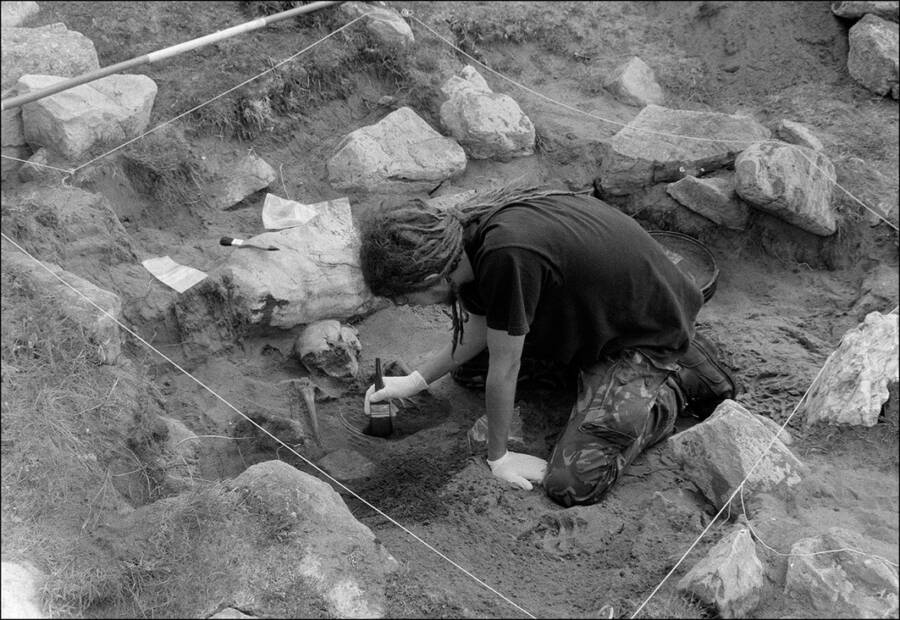
SC 1061426 © Crown Copyright: HES. Excavation photograph by GUARDArchaeologists excavated and performed DNA analysis on the woman found near Loch Borralie.
What This Macabre Discovery Could Reveal About Funerary Practices In The Iron Age
Discovering any information about 2,000-year-old burial practices in the British Isles is usually difficult because most of the skeletons fail to hold up over the centuries, which makes this find all the more enlightening.
“To find bodies of this age so well-preserved is rare, but to discover evidence of a funeral ritual we previously knew nothing about was such a surprise, and very exciting,” Navarro said in a statement from the University of York.

Rebecca Ellis-HakenThe scratch marks on the woman’s skull that were made when her brain was being removed.
The find also opens up new avenues for understanding how the dead were treated in the Iron Age, and how family groups were connected in prehistoric Britain.
While it’s impossible to say for certain, the archaeologists suspect that the bone modification and brain removal could have been done out of respect for the woman. The bones, after being tapered, were placed carefully in their correct spots in the skeleton, which suggests “she commanded a level of reverence and respect by her community,” Navarro said. Meanwhile, the brain may have been removed in an attempt to clean and preserve the skull.
Although archaeologists have not found another exact occurrence of this funerary practice, Navarro said that “the dead were curated and treated carefully in Iron Age Britain, so our understanding is that this bone modification is within that same tradition of care.”
After conducting DNA analysis on the remains, the researchers discovered that the woman and the boy were closely related, likely maternal second cousins. The genetic analysis also revealed that the bodies had DNA connections to bodies buried in prehistoric sites more than 100 miles across the ocean in the Orkney Islands and Applecross.

The Door Balancer Eliminates The Need for Door Props, Door Stops and Door Wedges
(as of October 26, 2026 01:02 GMT +00:00 - More infoProduct prices and availability are accurate as of the date/time indicated and are subject to change. Any price and availability information displayed on [relevant Amazon Site(s), as applicable] at the time of purchase will apply to the purchase of this product.)
RIVER OF GOODS Mid-Century Modern Transitional LED Bronze Chrome Ceiling Fan - 52" L x 52" W - Rich Barnwood/Light Driftwood Fan Blades - Metallic Ceiling Fan with Light and Fabric Shade
(as of October 26, 2026 01:02 GMT +00:00 - More infoProduct prices and availability are accurate as of the date/time indicated and are subject to change. Any price and availability information displayed on [relevant Amazon Site(s), as applicable] at the time of purchase will apply to the purchase of this product.)
RIVER OF GOODS Coastal 52 Inch Wooden Bead LED Ceiling Fan, Brown
(as of October 26, 2026 01:02 GMT +00:00 - More infoProduct prices and availability are accurate as of the date/time indicated and are subject to change. Any price and availability information displayed on [relevant Amazon Site(s), as applicable] at the time of purchase will apply to the purchase of this product.)
PROMIXX FORM Sports Water Bottle - Premium BPA Free Water Bottle for Fitness Sports & Outdoors - Sustainable Drinks Bottle with Measurement Markers and Leakproof Lid - 760ml / 26oz (Midnight Blue)
$18.42 (as of October 26, 2026 01:02 GMT +00:00 - More infoProduct prices and availability are accurate as of the date/time indicated and are subject to change. Any price and availability information displayed on [relevant Amazon Site(s), as applicable] at the time of purchase will apply to the purchase of this product.)