Ancient Secrets Unearthed: Mysterious 40,000-Year-Old Bird Carvings Revealed in German Cave

Imagine stumbling upon a tiny Ice Age bird figurine, crafted with such delicate precision that you can almost see it fluttering its wings or gently brooding its eggs. That’s exactly what archaeologists found in Germany’s Hohle Fels Cave—two minuscule bird sculptures, less than an inch long, carved from mammoth ivory and dating back a staggering 40,000 years. Now, here’s the kicker: researchers reckon these little feathered friends are most likely ptarmigans, caught forever in a moment of prehistoric life—one sitting tenderly on eggs, the other stretching its wings like it’s ready to take flight. It’s wild to think that tens of thousands of years ago, someone chose to immortalize these specific bird behaviors rather than just a static pose. What were they trying to say? Were these carvings mere art or did they hold deeper meanings about nature and survival in an Ice Age world? Either way, these delicate relics open a quirky, tender window into our ancestors’ minds, reminding us that even in the harshest conditions, creativity and observation of life found a way to take flight.
Researchers were even able to determine that they’re most likely ptarmigans, with one brooding over its eggs and the other spreading its wings in flight.
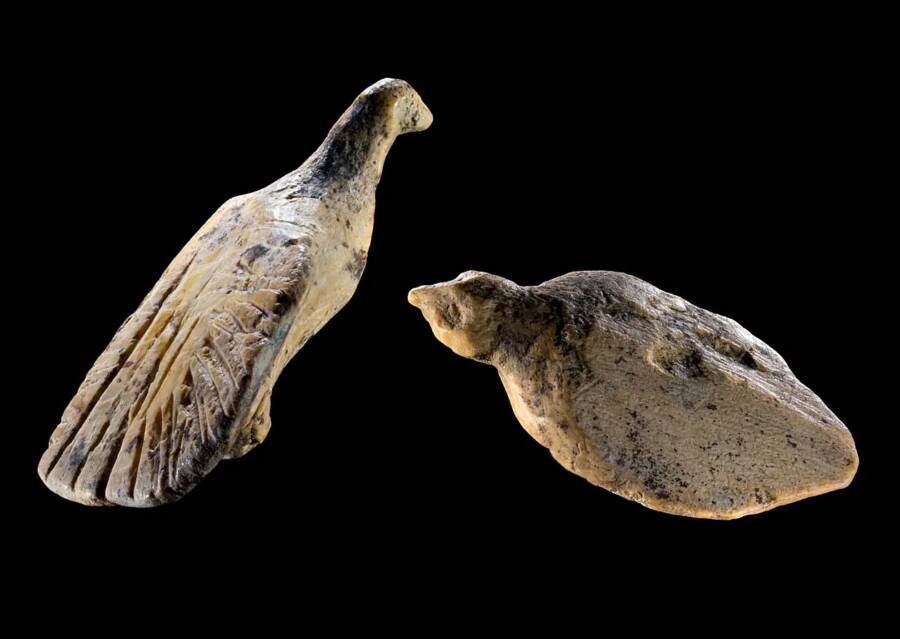
Ralf Ehmann/University of TübingenResearchers excavating Germany’s Hohle Fels Cave discovered two prehistoric bird figurines that are each less than an inch long.
Archaeologists excavating Hohle Fels Cave in southwestern Germany just found two bird figurines made from mammoth ivory that date back 40,000 years — making these relics some of the oldest known figurative art in world history.
The cave, a UNESCO World Heritage site, has been excavated and explored for more than a century. Previous digs have unearthed prehistoric mammoth and reindeer bones, as well as stone tools, but these extremely tiny yet highly detailed bird carvings stand out among the many finds made at this storied site.
The Two Tiny Bird Sculptures Found In Hohle Fels Cave
A team of archaeologists from the University of Tübingen made the discovery of the two figurines in the lower layers of the cave. They’re believed to have been carved by members of the Aurignacian culture, which flourished in the region during the Upper Paleolithic period.
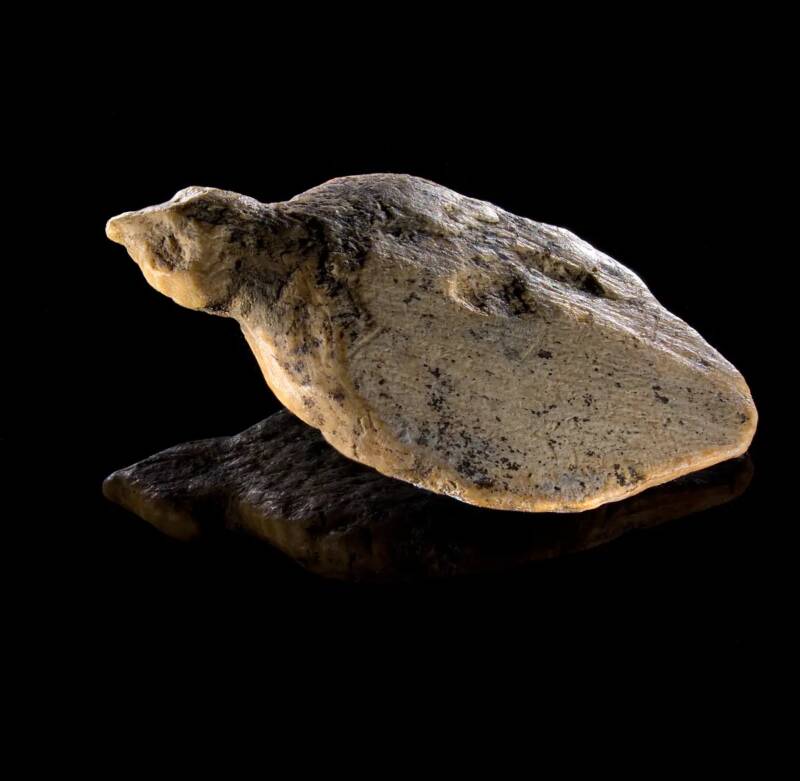
Ralf Ehmann/University of TübingenOne figurine depicted a bird at rest, possibly brooding.
One bird figurine, still almost completely intact, is depicted resting or perhaps brooding. The other bird figurine has outstretched wings, although the left wing is broken off. It is unclear whether the sculptures were carved by the same person and at the same time, but they were found only about five feet apart in the same layer of the cave.
With one weighing 1.3 grams, the other weighing 0.7 grams, and both less than an inch long, the two sculptures are exceptionally small — barely larger than thumbnails. The bird with outstretched wings is two centimeters long, one centimeter wide, and half a centimeter high, making it the smallest of all the known Ice Age artworks ever found in this region.
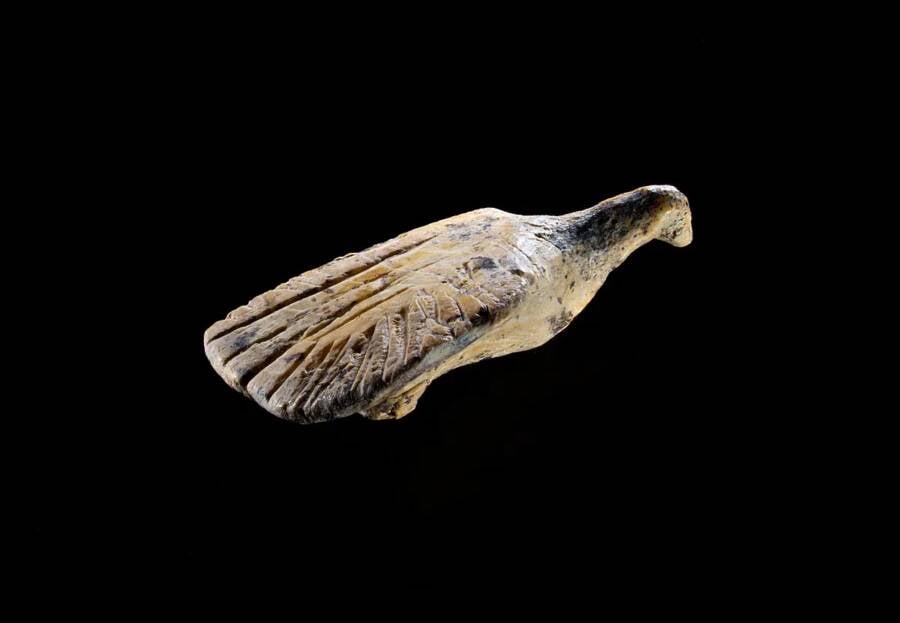
Ralf Ehmann/University of TübingenThe other bird figurine had parallel lines on its wing, depicting feathers.
Although the birds are small, they are intricately crafted. The resting bird has distinctly round eyes, and the bird with outstretched wings has a prominent beak as well as parallel lines on its wings to mark its feathers.
“Here, the mammoth tusk wasn’t simply used to create some simplified form of a bird’s body,” Nicholas Conard, an archaeologist at the University of Tübingen and lead excavator, said in a statement. “Precise observations of nature were translated into figures whose wealth of detail even allows for an examination of which bird species is depicted and what it is doing.”
These sculptures are also unique in that they represent the birds doing specific behaviors, whereas the majority of Ice Age animal figurines are depicted in a static pose.
The resting bird, who is outstretched and lying flat, might be brooding, or sitting on its eggs. The bird with widespread wings and elongated neck might be displaying courtship behavior, flying, or landing on water.

Mohsen Zeidi/University of TübingenHohle Fels Cave in southwestern Germany has been excavated on and off for more than a century.
The archaeologists are unsure about the exact behaviors the birds are displaying, as well as their species. The birds could be ptarmigan, whose bones have been discovered often in the region, but they could also be pheasant-like birds, such as the capercaillie.
What The Finds In Hohle Fels Cave Could Reveal About Ice Age Art
This find leaves researchers with a wealth of questions, both about the general significance of figurines for the hunter-gatherers who lived in Hohle Fels 40,000 years ago, and about the specific symbolism of birds.
Conard’s team has been excavating the cave since 1997, and has found mammoth-ivory figurines of a horse, an otter, a 2.5-cm “little lion man,” in addition to nine fragments of a Venus figure.

RIVER OF GOODS LED Boho Ceiling Fan with Hand Woven Brown/Natural Rope - Macrame Knot Work and Hemp Rope Style Eclectic Cottage Decor - 52" L x 52" W - Rich Barnwood/Light Driftwood Fan Blades
(as of October 4, 2026 00:55 GMT +00:00 - More infoProduct prices and availability are accurate as of the date/time indicated and are subject to change. Any price and availability information displayed on [relevant Amazon Site(s), as applicable] at the time of purchase will apply to the purchase of this product.)
RIVER OF GOODS Coastal 52 Inch Wooden Bead LED Ceiling Fan, Cream
(as of October 4, 2026 00:55 GMT +00:00 - More infoProduct prices and availability are accurate as of the date/time indicated and are subject to change. Any price and availability information displayed on [relevant Amazon Site(s), as applicable] at the time of purchase will apply to the purchase of this product.)
The Door Balancer Eliminates The Need for Door Props, Door Stops and Door Wedges
(as of October 4, 2026 00:55 GMT +00:00 - More infoProduct prices and availability are accurate as of the date/time indicated and are subject to change. Any price and availability information displayed on [relevant Amazon Site(s), as applicable] at the time of purchase will apply to the purchase of this product.)
1MORE Triple Driver In-Ear Headphones - Silver - Wired - Adult - In Ear - 18 grams - 90 days limited warranty
(as of October 4, 2026 00:55 GMT +00:00 - More infoProduct prices and availability are accurate as of the date/time indicated and are subject to change. Any price and availability information displayed on [relevant Amazon Site(s), as applicable] at the time of purchase will apply to the purchase of this product.)