Unveiling the Giant’s Path: North Dakota Yields First-Ever Full-Grown T. Rex Footprints
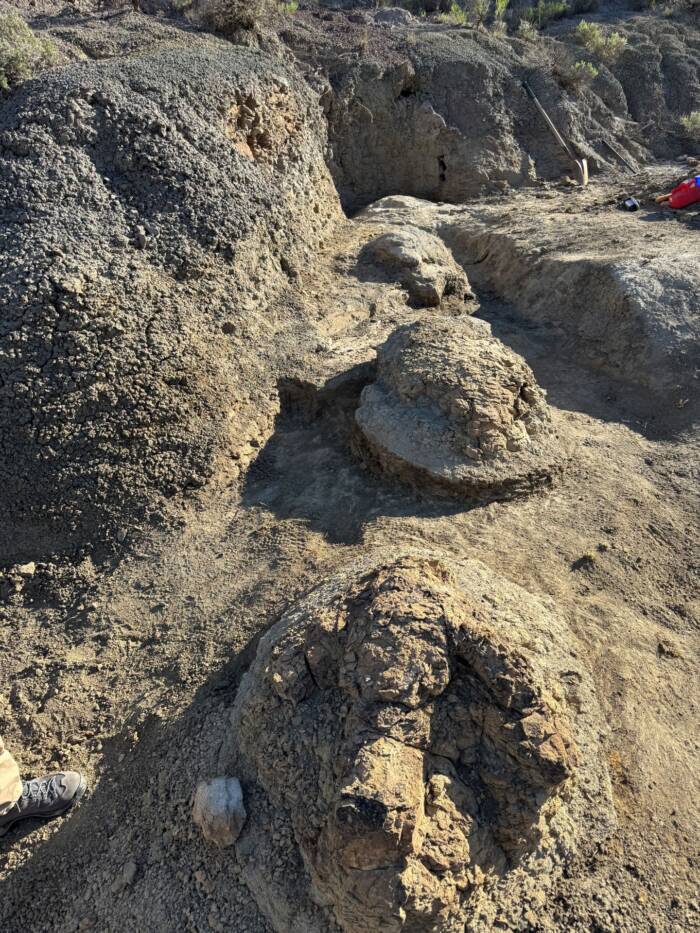
Imagine stumbling upon a 66.5-million-year-old billboard left by none other than a towering, three-ton T. rex — except this “billboard” is a 23-foot-long trackway of footprints carved in stone, each as big as a small kiddie pool. That’s precisely what Kent Hups, a fossil-hunting high school teacher with a keen eye, discovered digging around the Hell Creek Formation in North Dakota’s Badlands. Now, before you ask, no, it’s not just one giant footprint or some random giant chicken tracks—this is the first-ever identified trackway of an adult Tyrannosaurus rex, a near-perfect breadcrumb trail that lets us follow the movements of the Cretaceous period’s most infamous predator. It’s as if ol’ T. rex himself decided to take a leisurely 3.5 to 4.5 mph stroll through what was once a swampy floodplain, leaving behind the rarest fossilized ‘toesies’ known to science. So, what tales could these colossal footprints tell us about the king of dinosaurs—beyond just “yeah, this guy was huge”? Read on and prepare to walk in the giant footsteps of a legend.
Found in the Hell Creek Formation of southwestern North Dakota, this 66.5-million-year-old trackway spans 23 feet and includes four three-foot-long prints, two from the left foot and two from the right.
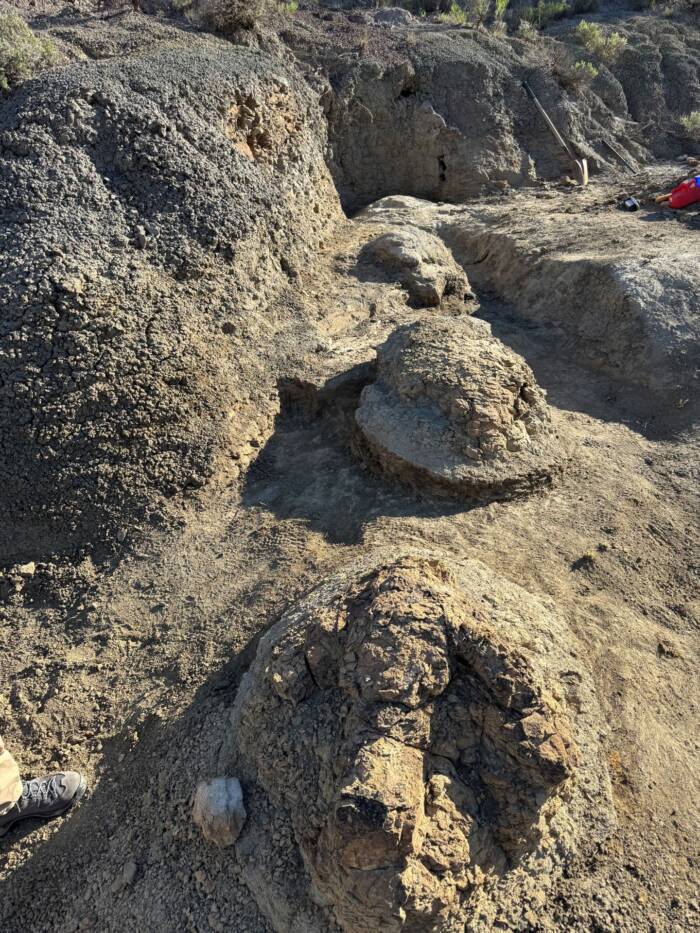
Denver Museum of Nature & SciencePaleontologists in the North Dakota Badlands identified the first-known trackway of an adult T. rex that’s ever been found.
Kent Hups, a high school teacher in Colorado, has been hunting for fossils as a hobby for decades. Recently, while exploring in the North Dakota Badlands, he noticed something out of the ordinary.
“I saw something sticking up out of the ground, and it looked really peculiar, like nothing I’d ever seen before,” Hups told National Geographic. Soon enough, Hups would realize that he had stumbled upon the very first series of footprints belonging to an adult Tyrannosaurus rex that’s ever been found.
The Discovery Of The First Footprints Of An Adult T. Rex That Have Ever Been Found
Hups co-authored the study on the discovery, which was published in the Journal of Vertebrate Paleontology earlier this month, alongside Tyler Lyson and other scientists from the Denver Museum of Nature & Science.
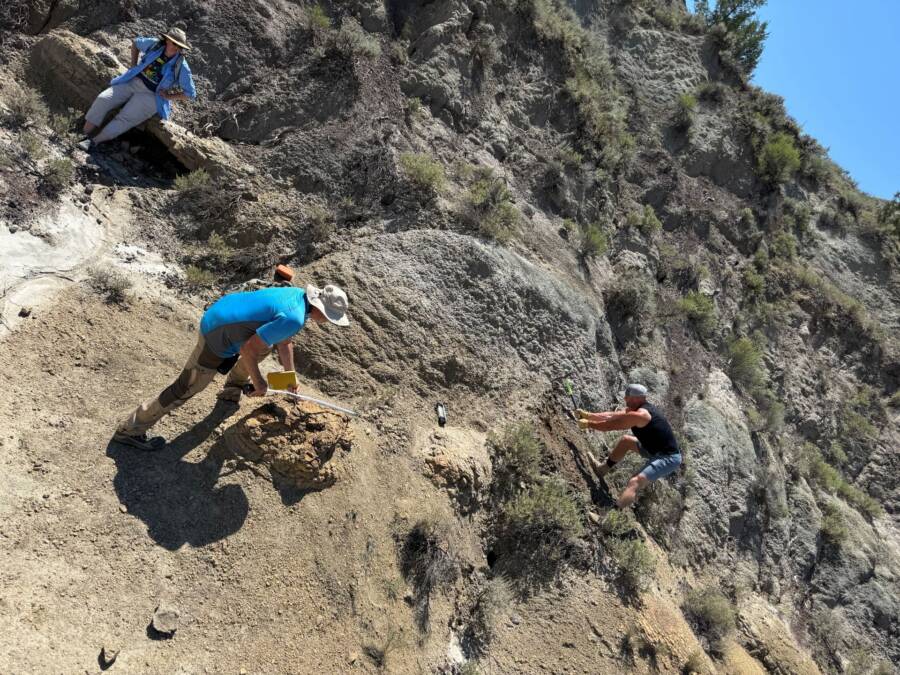
Denver Museum of Nature & ScienceBefore this discovery, paleontologists had only ever identified two adult T. rex footprints in the entire world, one in New Mexico and one in Montana.
The team determined that the footprints date back to 66.5 million years ago. The discovery of the T. rex footprints is extremely rare, as paleontologists have only ever identified two adult T. rex footprints in the entire world, one in New Mexico and one in Montana.
The new find, however, is the first time that a series of prints from one specific creature (also known as a trackway) has ever been identified.
This recent discovery spans 23 feet, and consists of four footprints, two from the right foot and two from the left, with each one measuring about three feet long.
After using high-resolution 3D surface scanning, researchers estimated that the dinosaur was moving at around 3.5-4.5 m.p.h.
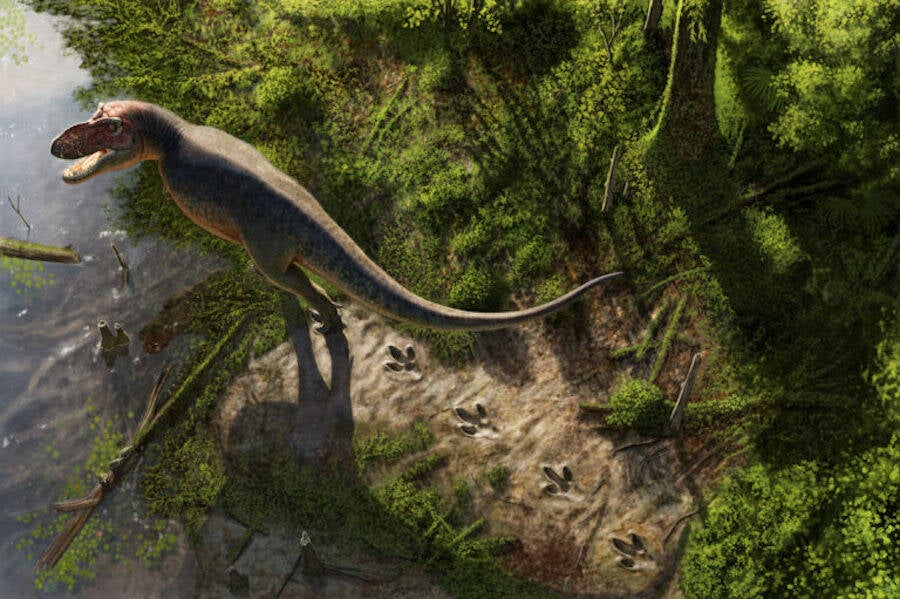
Andrey Atuchin/Denver Museum of Nature & ScienceScientists estimate that the T. rex was moving at about the pace of a briskly walking human.
The footprints were identified in the region known as Hell Creek Formation, famous for its dinosaur fossils.
Hell Creek, which used to be a forested floodplain populated by streams and swamps, contains well-preserved bones due to its soft sediment. However, other remnants of dinosaurs, like their footprints, are usually lost due to the area’s watery terrain.
Researchers have frequently unearthed Triceratops bones in the region, and they even excavated a fully intact Triceratops head, neck, and chest in 2025.
However, the newly-found T. rex trackway may very well stand as the region’s most astonishing prehistoric find for decades to come.
This Discovery’s Place Among The Most Important T. Rex Finds Ever Made
According to fossil evidence, T. rex lived around 66 to 68 million years ago, during the Cretaceous period. Often regarded as the most fearsome of all dinosaurs, T. rex measured up to 20 feet tall and 40 feet long, making it among the most imposing of the prehistoric carnivores. But their reign didn’t last long, as they were among the last non-flying dinosaur species to roam the planet before a mass extinction wiped all of them out.
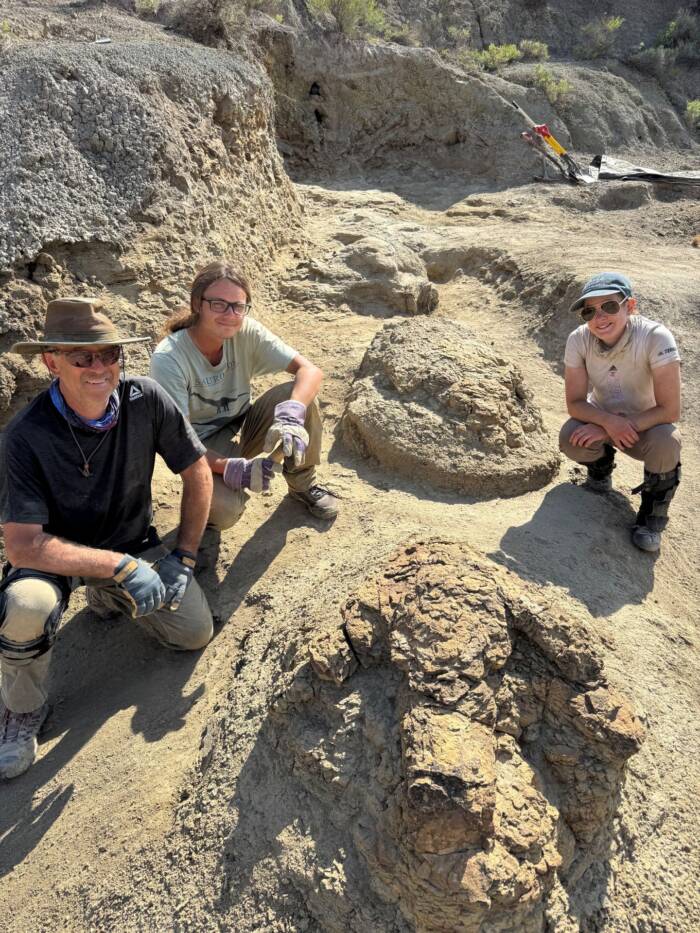
Denver Museum of Nature & ScienceT. rex fossils have been discovered in the Hell Creek Formation before, including the most complete T. rex skeleton ever unearthed, known as “Sue.”
T. rex fossils had already been found in this area. The famous fossil collector Barnum Brown found one of the first T. rex skeletons in 1902 in eastern Montana, in the Hell Creek Formation. The legendary “Sue,” the most complete T. rex skeleton ever found, was also uncovered in the region, as well as two other skeletons known as “Stan” and “Gus.”
Around 10 miles from the recently-discovered trackway, researchers discovered a “Teen Rex,” or juvenile T. rex, that is now housed in the Denver Museum of Nature & Science.

Kinsa Smart,Fever, Digital Medical Baby, Kid and Adult Termometro - Accurate, Fast, FDA Cleared Thermometer for Oral, Armpit or Rectal Temperature Reading - QuickCare
$29.39 (as of September 15, 2026 00:41 GMT +00:00 - More infoProduct prices and availability are accurate as of the date/time indicated and are subject to change. Any price and availability information displayed on [relevant Amazon Site(s), as applicable] at the time of purchase will apply to the purchase of this product.)
PROMIXX FORM Sports Water Bottle - Premium BPA Free Water Bottle for Fitness Sports & Outdoors - Sustainable Drinks Bottle with Measurement Markers and Leakproof Lid - 760ml / 26oz (Midnight Blue)
$18.27 (as of September 15, 2026 00:41 GMT +00:00 - More infoProduct prices and availability are accurate as of the date/time indicated and are subject to change. Any price and availability information displayed on [relevant Amazon Site(s), as applicable] at the time of purchase will apply to the purchase of this product.)
Supa Ant Fire Blanket -Certified 1200F Extra Thick, Glow in The Dark | Glow in The Dark Emergency Supplies 500gsm, 0.5mm Thick Wearable Fire Blankets for Home. Emergency Blanket with Cape & Hood
$83.99 (as of September 15, 2026 00:41 GMT +00:00 - More infoProduct prices and availability are accurate as of the date/time indicated and are subject to change. Any price and availability information displayed on [relevant Amazon Site(s), as applicable] at the time of purchase will apply to the purchase of this product.)
KiddyCare Diaper Caddy Organizer for Baby Nursery Basket with Handle Lid Nursing Caddy with Changing Table Organizer Cart Newborn Caddy Rosy (Floral Print) X-Large
$16.50 (as of September 15, 2026 00:41 GMT +00:00 - More infoProduct prices and availability are accurate as of the date/time indicated and are subject to change. Any price and availability information displayed on [relevant Amazon Site(s), as applicable] at the time of purchase will apply to the purchase of this product.)




















Post Comment