Ancient Bronze Leg Found in Scottish Bog Reveals Lost Statue of Mysterious Roman Emperor Beyond Hadrian’s Wall
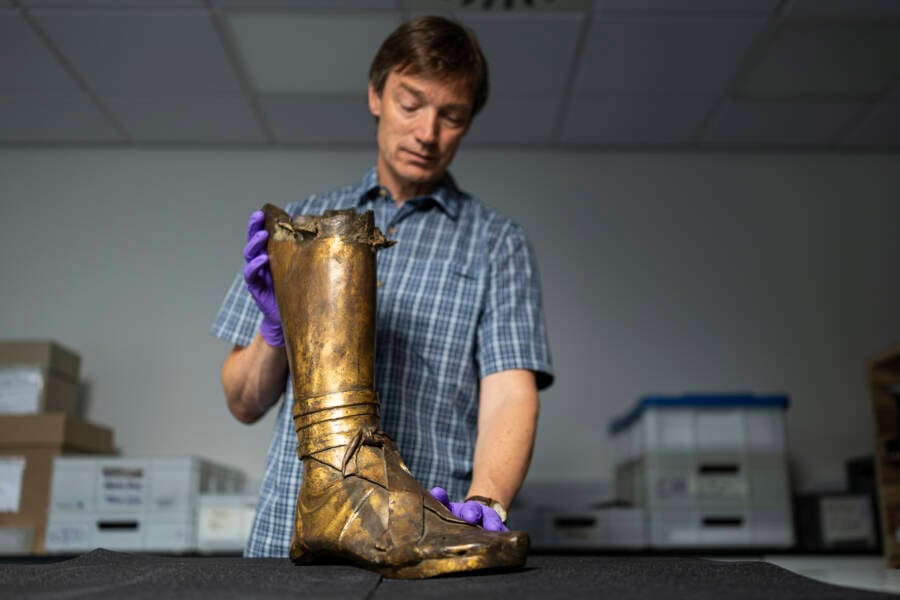
So, imagine this: a giant bronze leg, gold-gilded no less, just chilling in a Scottish bog for centuries, sparking decades of “Wait, where did this come from?” drama among historians. For the longest time, folks figured this fancy leg had been chopped off a Roman statue all the way down in England, hauled north as a trophy of rebellion. But hold onto your togas, because new research flips that story upside down like a Roman soldier doing backflips—turns out, the Romans themselves might have carefully taken apart this colossal statue of Emperor Antoninus Pius before making their hasty exit from Scotland around 160 C.E., determined not to let it fall into the wrong hands. Talk about a Roman mic drop! How often do you get to peek behind the curtain of an ancient empire’s retreat strategy through a sparkly leg? There’s more mystery here than at a celebrity’s secret afterparty. Ready to step into history’s muddy shoes?
Researchers believe that the Romans themselves carefully dismantled this statue as they retreated out of Scotland, rather than have it fall into enemy hands.

Duncan McGlynnResearchers believe that the bronze leg belonged to a second century C.E. statue that was erected in Scotland to celebrate Rome’s victorious conquest.
More than two centuries ago, an ancient statue’s foot and lower leg were pulled from a big in Milsington, Scotland. Since its discovery in 1820, this stunning find was assumed to have been chopped off of a Roman statue that had originally stood in England before being felled by rebellious locals and brought north to Scotland as an act of revenge against the Roman conquerors.
Now, however, researchers believe that this centuries-old theory is wrong. Instead, experts hypothesize that the bronze leg may have belonged to a larger-than-life statue of Emperor Antoninus Pius that once stood in Scotland before being dismantled by the Romans themselves as they retreated from the region following their defeat in the second century C.E.
The Discovery Of An Ancient Bronze Foot In A Bog In Milsington, Scotland
This gold-gilded bronze foot and lower leg, also referred to as the “Milsington leg,” was dated to around 140 C.E., according to a statement from National Museums Scotland.
It was discovered in 1820 and spent around 100 years in Dalkeith Palace near Edinburgh.
Around the time of its discovery in February 1820, Scottish writer Sir Walter Scott wrote to Lord Montagu asking to see the leg for himself.

Stewart AttwoodA reconstruction of the larger-than-life statue of Antoninus Pius on horseback.
“I wish your lordship would … allow me, if it shall seem really curious, to make search for the rest of the statue,” Scott wrote, adding “that a Roman statue, for such it seems, of that size should be found in so wild a place, has something very irritating to the curiosity.”
Experts at the time believed that the leg had been hacked off of a Roman-era statue from York, England, a town that was founded by the Romans as Eboracum in 71 C.E.
However, researchers now believe that it belonged to a statue of Antoninus Pius that had been erected in Roman Scotland. Furthermore, they believe that the statue portrayed the emperor on horseback.

National Museums ScotlandNew analysis of the leg shows that it was carefully removed from the statue, rather than being clumsily sawed or hacked off.
The fact that the knee lacks any gilding indicates that it was likely covered by a cloak or tunic, which researchers found was a common characteristic of Roman equestrian statues. Recent research has also provided additional evidence showing that equestrian statues were often built along the northern frontier of the Roman Empire.
But the frontier could often be harsh territory, especially if territory was changing hands. And when the Romans were being pushed back south around 160 C.E., they likely dismantled the statue themselves in order to keep it from falling into the hands of angry locals.
The new analysis indeed showed that the upper edge of the leg was carefully removed from the rest of the statue, rather than being hastily removed with a saw or axe.
“Such careful removal and burial is found widely in Roman Scotland when the Antonine conquests were abandoned, such as the careful burial of Antonine Wall inscriptions and of the Inveresk Mithras altars,” the museum explained.
How This Possible Antoninus Pius Statue Fits Into The History Of Roman Scotland
Roman campaigns into Scotland initially began in the 70s C.E., years after Rome successfully took over Britain. The limit of the Roman Empire in Britain was marked by Hadrian’s Wall in northern England, named after Emperor Hadrian, who ruled from 117 C.E. to 138 C.E.
Antoninus Pius was Hadrian’s successor, and, in the early 140s C.E., he built a wall around 100 miles north of Hadrian’s, known as the Antonine Wall. But, after Antoninus Pius died in 161 C.E., the Roman armies withdrew back to Hadrian’s Wall.

Wikimedia CommonsRemnants of the Antonine Wall in southern Scotland.
“This really turns on its head our understanding of Rome’s second attempt at conquering Scotland,” Fraser Hunter, principal curator of prehistoric and Roman archaeology at the museum, said in the statement.

SUPA ANT Canning Supplies Starter Kit (Food Grade) - Canning Kits Set for Beginners - 3 Pcs. Including Wide Mouth Jar Funnel, Magnetic Lid Lifter, Stainless Steel Jar Lifter (Assembled in USA) Blue
$9.99 (as of November 17, 2026 01:11 GMT +00:00 - More infoProduct prices and availability are accurate as of the date/time indicated and are subject to change. Any price and availability information displayed on [relevant Amazon Site(s), as applicable] at the time of purchase will apply to the purchase of this product.)
Joking Hazard by Cyanide & Happiness - 360+ Funny & Inappropriate Comic Cards, Hilarious Party Games | Includes Add-Your-Own-Words Cards
$24.95 (as of November 17, 2026 01:11 GMT +00:00 - More infoProduct prices and availability are accurate as of the date/time indicated and are subject to change. Any price and availability information displayed on [relevant Amazon Site(s), as applicable] at the time of purchase will apply to the purchase of this product.)
RIVER OF GOODS Alabaster LED Mesh Caged Ceiling Fan - 52" L X 52" W - White/Oak Wood-Grain Blades
(as of November 17, 2026 01:11 GMT +00:00 - More infoProduct prices and availability are accurate as of the date/time indicated and are subject to change. Any price and availability information displayed on [relevant Amazon Site(s), as applicable] at the time of purchase will apply to the purchase of this product.)
Fire Cloak - 1500F CE Certified Emergency Fire Blanket for Home & Kitchen | 500GSM Fabric & 0.5mm Thick - Silicon Coated 100% Fiberglass Essentials in House, Warehouse Office - 55"L x 70"W by Supa Ant
$83.99 (as of November 17, 2026 01:11 GMT +00:00 - More infoProduct prices and availability are accurate as of the date/time indicated and are subject to change. Any price and availability information displayed on [relevant Amazon Site(s), as applicable] at the time of purchase will apply to the purchase of this product.)



















Post Comment