Ancient Clay Brick Bearing Mysterious Canine Paw Print Discovered in Turkey – What Secret Does It Hold?
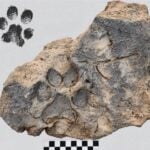
Ever accidentally stepped on fresh cement and immediately regretted it? Well, imagine a curious dog doing just that 4,000 years ago — stamping its pawprint onto a mud brick as it baked under the Anatolian sun. This isn’t some ancient canine faux pas lost to time; archaeologists just unearthed this very paw print among the charred remnants of a Bronze Age house in western Turkey, a house destroyed in a fiery attack around 1700 B.C.E. It’s a tiny, unexpected snapshot of daily life that’s survived millennia — a whimsical reminder that even thousands of years ago, dogs were sneaking into our human story in the most adorable way. How often do you get a direct, tangible connection to a moment frozen in time thanks to an accidentally printed paw? Trust me, this paw print isn’t just a cute relic; it’s a testament to the longstanding, complex bond between humans and their four-legged companions. Ready to dig deeper into this prehistoric paw-sitive story? LEARN MORE
The brick, likely stepped on by the dog when it was first drying and solidifying, was found among the ruins of a house that was destroyed sometime around 1700 B.C.E.

Bilecik Şeyh Edebali UniversityArchaeologists in Tavşanlı Höyük discovered a dog’s paw print that had been embedded in a clay brick 4,000 years ago.
Walking down the sidewalks of today’s towns and cities, you’ll often come across some endearing little bird tracks or dog prints left in the cement from when it was first installed — much to the dismay, perhaps, of the contractors who laid it.
However, this is not just a modern phenomenon. Archaeologists in Turkey just discovered a paw print from a dog that was left on a mud brick some 4,000 years ago. Researchers believes that this remarkable discovery will shed light on the close relationships between dogs and humans in Bronze Age Anatolia.
The Discovery Of An Ancient Paw Print Made By A Dog In Western Turkey
The mud brick featuring this paw print was found during excavations of Tavşanlı Höyük, a prominent Bronze Age settlement in western Turkey. The excavations, which have been ongoing since 2021, were led by Dr. Erkan Fidan of Bilecik Şeyh Edebali University.
Tavşanlı Höyük first became inhabited around 8,000 years ago. However, floods eventually wiped away the earliest settlements and made the land inhabitable until around 3200 B.C.E., near the start of the Bronze Age.

Turkish Ministry of Culture and TourismTavşanlı Höyük was a thriving Bronze Age settlement until it was burned in an attack around 1700 B.C.E.
The settlement then thrived continuously for around 1,500 years — but in 1700 B.C.E., unknown attackers burned the settlement to the ground.
Recent excavations have uncovered spearheads, arrowheads, and daggers that date to this period of unrest, as well as the well-preserved brain and skin remnants of two individuals who archaeologists believed were victims of this deadly attack.
Now, in addition to these more grisly finds, archaeologists have found the brick with the paw print of a dog among the ruins of a burned-down house.
“The paw print preserves a small moment from everyday life 4,000 years ago,” Mehmet Nuri Ersoy, Turkey’s minister of culture and tourism, said in a social media post about the discovery.

Bilecik Şeyh Edebali UniversityThe dog likely stepped in the wet brick as it was laid out in the sun to dry and harden.
According to a statement from Bilecik Şeyh Edebali University, mud bricks were made in ancient Anatolia by combining soil, water, and, straw, and leaving the material in the sun to dry and harden.
This means that the dog must have stepped on the wet brick before it dried, causing the imprint of its toes to be perfectly preserved 4,000 years later.
Then, that mud brick was used to build one of the Bronze Age houses that turned to rubble following the fiery attack on the settlement circa 1700 B.C.E.
How This Find Sheds Light On The Lives Of Dogs In Ancient Anatolia
Fidan, the director of the excavations, told IFLScience that dogs and humans often shared close relationships in ancient Anatolia.
“Dogs have a very long history in Anatolia,” Fidan said. “By the Bronze Age, dogs were already a familiar part of everyday life in Anatolian settlements. The approximately 4,000-year-old paw prints discovered at Tavşanlı Höyük provide a particularly direct and touching glimpse of this relationship.”

Turkish Ministry of Culture and TourismThe archaeological record has shown that dogs and humans had a particularly close relationship in ancient Anatolia.
Scientists have been trying to solve the question of how dogs were domesticated for a long time.
Researchers have not pinned down an exact date or location of the first dogs that were domesticated. For now, the world’s oldest confirmed domesticated dogs were found at an ancient Turkish site Pınarbaşı, according to a study published in the journal Nature in March of this year. That research dated the oldest domesticated dogs to 15,800 years ago in modern-day Turkey.
The find shows the particularly strong and storied connection between dogs and people in this ancient part of the world.

RIVER OF GOODS Mid-Century Modern Transitional LED Bronze Chrome Ceiling Fan - 52" L x 52" W - Rich Barnwood/Light Driftwood Fan Blades - Metallic Ceiling Fan with Light and Fabric Shade
(as of November 4, 2026 01:06 GMT +00:00 - More infoProduct prices and availability are accurate as of the date/time indicated and are subject to change. Any price and availability information displayed on [relevant Amazon Site(s), as applicable] at the time of purchase will apply to the purchase of this product.)
RIVER OF GOODS LED Boho Ceiling Fan with Hand Woven Brown/Natural Rope - Macrame Knot Work and Hemp Rope Style Eclectic Cottage Decor - 52" L x 52" W - Rich Barnwood/Light Driftwood Fan Blades
(as of November 4, 2026 01:06 GMT +00:00 - More infoProduct prices and availability are accurate as of the date/time indicated and are subject to change. Any price and availability information displayed on [relevant Amazon Site(s), as applicable] at the time of purchase will apply to the purchase of this product.)
Supa Ant 6x8ft. Welding Blanket Fireproof (Pack of 2) - Heavy Duty Weld Fire Blanket Tools - Welders Cover for Men Curtain with Gloves - Large Welding Gear for Welder Accessories
(as of November 4, 2026 01:06 GMT +00:00 - More infoProduct prices and availability are accurate as of the date/time indicated and are subject to change. Any price and availability information displayed on [relevant Amazon Site(s), as applicable] at the time of purchase will apply to the purchase of this product.)
RIVER OF GOODS Coastal 52 Inch Wooden Bead LED Ceiling Fan, Brown
(as of November 4, 2026 01:06 GMT +00:00 - More infoProduct prices and availability are accurate as of the date/time indicated and are subject to change. Any price and availability information displayed on [relevant Amazon Site(s), as applicable] at the time of purchase will apply to the purchase of this product.)




















Post Comment