Ancient Mystery Unearthed: 5,000-Year-Old Skeleton Found in Kiln Suggests Chilling Human Sacrifice in Germany
Imagine stumbling upon a 5,000-year-old kiln in the German countryside and finding a young man’s skeleton lying inside—with a distinct skull injury to boot. This isn’t your everyday archaeological mystery; it’s a riddle wrapped in a burial practice belonging to the enigmatic Corded Ware culture, which spanned northern Europe during the Late Neolithic and Bronze Ages. Now, why was this roughly 25-year-old laid to rest inside a kiln, a space usually meant to bake pottery? Was he hidden there as a grim cover-up for violence? Or tossed in hastily after a fierce battle? Or—hold onto your hats—could this be the eerie remnant of a human sacrifice ritual? This peculiar find in Gerstewitz not only challenges what we thought about the Corded Ware’s rituals but also opens a door to the darker corners of prehistoric spirituality. Ready to dive headfirst into one of the most macabre discoveries shaping ancient history?
A member of the Corded Ware culture that flourished in northern Europe during the Late Neolithic period and the Bronze Age, the man was about 25 years old when he died and had sustained a skull injury not long beforehand.

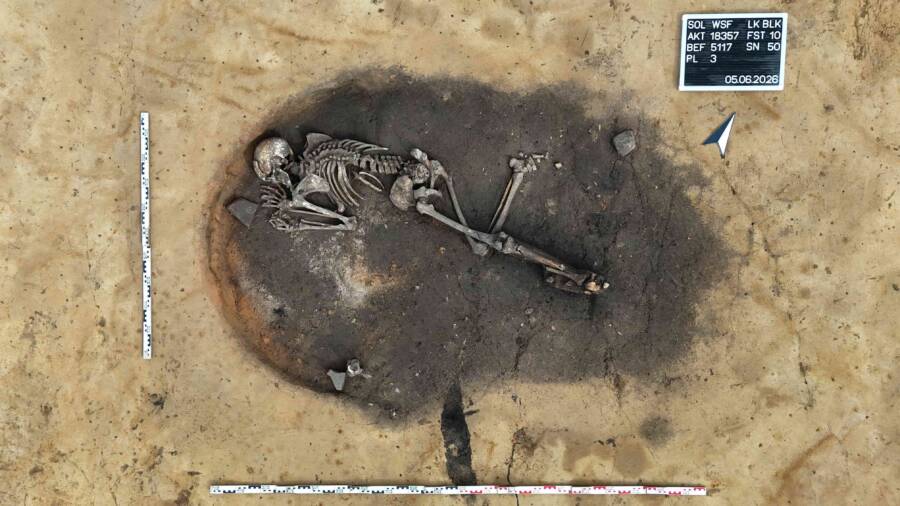
State Office for Heritage Management and Archaeology Saxony-AnhaltThis 5,000-year-old skeleton of a man with an injured skull was discovered in a Corded Ware kiln pit in Gerstewitz.
For members of the Corded Ware culture, an archaeological category that spans several European civilizations from the Late Neolithic Age to the Early Bronze Age, a kiln was more than just a tool for firing household pottery.
Archaeologists have seen evidence of ritual practice involving these kilns. And while such evidence rarely involves human remains, researchers in Germany recently discovered the 5,000-year-old skeleton of an injured man inside a Corded Ware kiln pit.
This find is so unusual and macabre, in fact, that experts think the man could have been the victim of a human sacrifice.
The Neolithic Skeleton Found Inside A Kiln In Central Germany
Before constructing an important power line that will run underground through central Germany, archaeologists are investigating along the route for historical discoveries that would require preservation.
While excavating near the village of Gerstewitz, archaeologists unearthed the Neolithic skeleton at a newly-discovered Corded Ware kiln grave, according to a statement from Germany’s Science Information Service.
Experts have dated the site to somewhere between 2900 and 2050 B.C.E. The team also determined the man to be around 25 years old when he died.

dpa Picture-AllianceThe man suffered a skull injury that may or may not have been related to his cause of death.
The kiln pit in which the man was buried had two connected underground chambers. He was laid to rest lying on his right side in a crouched position while facing south, a position that the team said is typical for male burials in the Corded Ware culture.
The man’s upper body also looked as though it had been moved from his original position, which indicates to the researchers that he may have been buried upon a layer of some sort of organic matter, such as plant or animal remains which then decayed some time after the burial.
The man’s skull also showed visible evidence of an injury that clearly damaged the bone. But experts remain unsure whether this had something to do with his cause of death.
What The Discovery Of This Possible Human Sacrifice Victim Could Reveal About The Corded Ware Culture
This discovery comes after archaeologists excavated another site near Gerstewitz in 2025 and found 12 sacrificial pits. These pits contained the remains of burnt houses, animal bones, human skulls, and intact pottery that had likely been placed there as a ritualistic offering. The team also found a burial of two bodies in a converted oven pit, which suggested that all of this was evidence of some sort of complex funerary ritual.
Although that find is similar to the new one, the team attributed the prior discovery to an earlier group, the Salzmünde culture, which is a regional variant of the Funnelbeaker culture that dates to somewhere between 3400 and 3050 B.C.E.
With little precedent for the discovery made in Gerstewitz, this skeleton is now opening up new questions about Corded Ware burial rites and potential sacrificial practices.
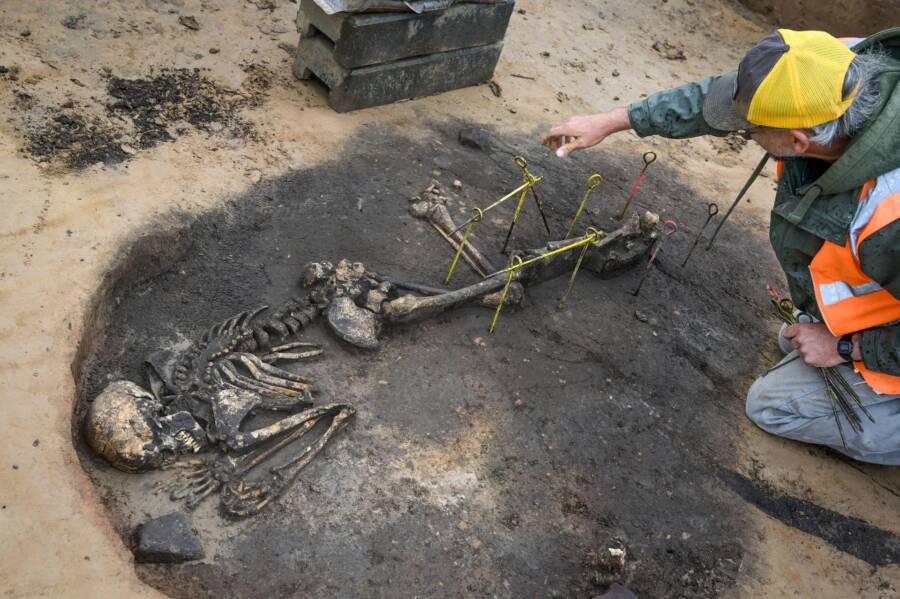
dpa Picture-AllianceArchaeologists said the man buried in the kiln pit may have been a human sacrifice.
The Corded Ware culture is named for the cord-like designs and impressions found on its pottery. Although the culture spread across wide swaths of Northern Europe, its archaeological sites are always easy to spot because this group had very distinctive graves and burial practices.
Almost always, women were buried lying down on their left side, while men were buried on their right, and every person was buried in a crouched position. These specific rules have even led some to refer to the Corded Ware culture as the Single Grave culture.
The man found in Gerstewitz mostly conforms to this pattern, but the fact that he had an injured skull is unusual, as is the fact that he was buried in a kiln pit.

White Leaf Baby Food Pouches, Toddler Snack, Mango + Carrot + Banana + Pear | 24 Pack, Organic No Added Sugar, Non-GMO, BPA-Free Regeneratively Farmed, Squeeze Puree Smoothie Pouch for Adults & Children
$69.95 (as of October 26, 2026 01:02 GMT +00:00 - More infoProduct prices and availability are accurate as of the date/time indicated and are subject to change. Any price and availability information displayed on [relevant Amazon Site(s), as applicable] at the time of purchase will apply to the purchase of this product.)
Supa Ant Canning Supplies Starter Kit (Food Grade) - Canning Kits Set for Beginners - 3 Pcs. Including Wide Mouth Jar Funnel, Magnetic Lid Lifter, Stainless Steel Jar Lifter (Assembled in USA) Blue
$9.99 (as of October 26, 2026 01:02 GMT +00:00 - More infoProduct prices and availability are accurate as of the date/time indicated and are subject to change. Any price and availability information displayed on [relevant Amazon Site(s), as applicable] at the time of purchase will apply to the purchase of this product.)
1MORE Triple Driver In-Ear Headphones - Silver - Wired - Adult - In Ear - 18 grams - 90 days limited warranty
(as of October 26, 2026 01:02 GMT +00:00 - More infoProduct prices and availability are accurate as of the date/time indicated and are subject to change. Any price and availability information displayed on [relevant Amazon Site(s), as applicable] at the time of purchase will apply to the purchase of this product.)
RIVER OF GOODS Stained Glass Bird Accent Lamp - 8" W x 13.5" H - Tiffany Style Table Lamps for Home, Office Desk, Bedroom, Nightstand - Blue Jay Decor
(as of October 26, 2026 01:02 GMT +00:00 - More infoProduct prices and availability are accurate as of the date/time indicated and are subject to change. Any price and availability information displayed on [relevant Amazon Site(s), as applicable] at the time of purchase will apply to the purchase of this product.)