Ancient Poisoned Weapons Unearthed in Saudi Arabia Could Rewrite Human History—What Secrets Do They Hold?
Imagine if Stone Age hunters were the original poison dart enthusiasts—only their lethal weapons weren’t toys but sharp stone points laced with toxins from the deadly arrow-poison tree. Yup, long before Safari or camo gear, our ancestors in what’s now Saudi Arabia were crafting poisoned tools to bring down everything from hippos and buffalo to camels and gazelles. It’s mind-boggling—125,000 years ago, in the heart of the “Empty Quarter,” people didn’t just wander through; they settled, thrived, and perfected a hunting technique that could rival a blockbuster thriller. I can’t help but wonder—did these ancient hunters have any idea they were pioneers of chemical warfare? Talk about killing with style and substance! Dive into this jaw-dropping discovery that rewrites the Stone Age playbook and reveals just how crafty early humans really were. LEARN MORE
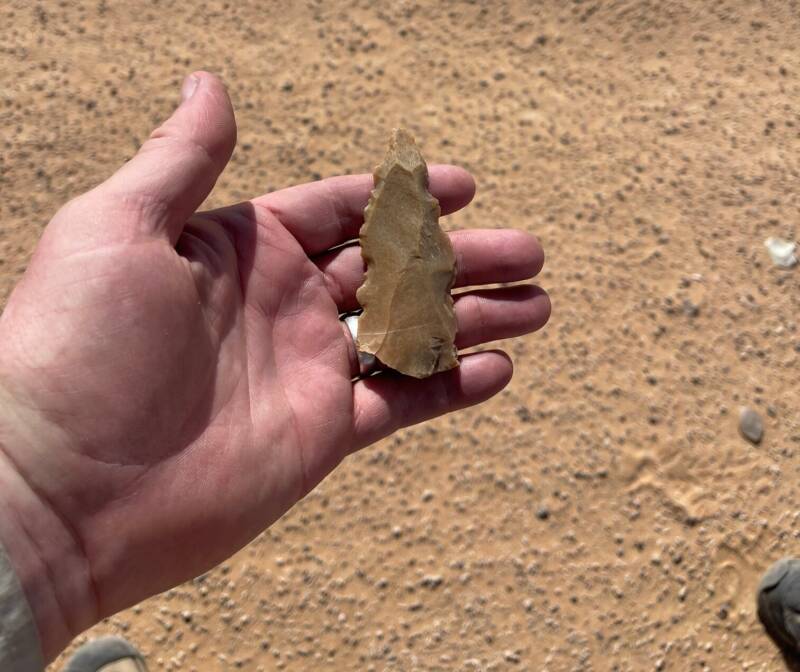
Spiked with the toxin of the arrow-poison tree, these stone points were likely once used to hunt everything from hippos and buffalo to camels and gazelles.

Chris ClarksonArchaeologists excavating ‘Uruq Aljelibah in the Saudi Arabian desert discovered remnants of toxins on the tips of several prehistoric stone points.
Archaeologists in Saudi Arabia have unearthed what could be the oldest poison weapons ever found. While excavating the remains of a human settlement that dates back 125,000 years, researchers discovered stone points with remnants of toxins likely taken from a poisonous tree native to the region.
This discovery has now shed light on the complex technologies used by prehistoric humans to assist in hunting. At the same time, it proves that Stone Age people did not merely pass through Arabia, but instead settled the area enough to make use of the freshwater lake that once sat here, as well as the region’s other resources.
The Discovery Of Prehistoric Poison Weapons In Saudi Arabia’s “Empty Quarter”
The research, co-led by Griffith University, King Abdullah University of Science and Technology (KAUST), and the Saudi Heritage Commission, Ministry of Culture, was recently published in Science.

Chris ClarksonHundreds of thousands of years ago, the ‘Uruq Aljelibah site featured a freshwater lake, but the area is now one of the driest deserts in the world.
The team excavated ‘Uruq Aljelibah, a 125,000-year-old archaeological site in Saudi Arabia. Study co-author Frans van Buchem told Live Science that the name means “sand dunes of a watering hole,” as the site used to feature a large freshwater lake.
Though the area is located within the “Empty Quarter,” one of the driest deserts on Earth, a 130-square-mile lake indeed once sat here. Up to 95 feet deep, this vast lake allowed the region to support a host of wildlife, including hippopotamuses, buffalo, ostriches, and many varieties of plants.
Likewise, such resources also allowed the area to support a sizable human settlement.
Researchers discovered more than 5,500 stone artifacts from this settlement, alongside well-preserved remains of human-harvested plant materials like fibers and wood, as well as the fossilized bones of animals that were presumably hunted for food.

Gilbert PriceAlongside the hunting tools, archaeologists also discovered evidence of animal life, like this hippopotamus tooth.
Several of the stone artifacts were shaped into sharp points and showed evidence of impact damage associated with hunting large animals. Furthermore, microscopic analysis revealed that the tips of these points still carried remnants of prehistoric animal tissue.
Researchers also found that several of the stone points had residue that matched the plant fibers of the toxic arrow-poison tree, Acokanthera schimperi, which is native to eastern and central Africa and southern Arabia.
Hunters may have dipped their stone weapons into extracts from the tree in order to kill or paralyze their game.

Chris ClarksonThe stone points may have been poisoned with extract from the arrow-poison tree.
“At 125,000 years old, these would be substantially older than the poisoned arrowheads recently identified in South Africa, which date to around 60,000 years ago,” study co-author Chris Clarkson told Live Science.
Indeed, researchers detected traces of toxic compounds on tiny quartz arrow tips excavated from the Umhlatuzana Rock Shelter in South Africa’s KwaZulu-Natal Province in January 2026. But these recently-discovered stone weapons, if in fact dated to 125,000 years ago, would be much older.
Rare Insights Into Early Human Life In Prehistoric Arabia
Although archaeologists did not find any human remains, their discoveries should provide major insight into early human life — with Homo sapiens likely the group in question — in the Arabia Desert during the Stone Age.
“We know that H. sapiens had already expanded out of Africa and were present in Southwest Asia during this period,” Clarkson told Live Science. “The age of the site fits with those early movements.”

Chris ClarksonThe artifacts show how early humans occupied Arabia in settlements, as opposed to only passing through.
Furthermore, the recent discovery of the poison weapons shows that prehistoric humans migrating through Arabia to get between Africa and Asia did not treat the region only as a transit corridor. Instead, they occupied the area on a permanent basis and used the many resources surrounding its freshwater lake in surprisingly sophisticated ways.

RIVER OF GOODS Stained Glass Bird Accent Lamp - 8" W x 13.5" H - Tiffany Style Table Lamps for Home, Office Desk, Bedroom, Nightstand - Blue Jay Decor
(as of November 14, 2026 01:10 GMT +00:00 - More infoProduct prices and availability are accurate as of the date/time indicated and are subject to change. Any price and availability information displayed on [relevant Amazon Site(s), as applicable] at the time of purchase will apply to the purchase of this product.)
The Door Balancer Eliminates The Need for Door Props, Door Stops and Door Wedges
(as of November 14, 2026 01:10 GMT +00:00 - More infoProduct prices and availability are accurate as of the date/time indicated and are subject to change. Any price and availability information displayed on [relevant Amazon Site(s), as applicable] at the time of purchase will apply to the purchase of this product.)
SUPA ANT Canning Supplies Starter Kit (Food Grade) - Canning Kits Set for Beginners - 3 Pcs. Including Wide Mouth Jar Funnel, Magnetic Lid Lifter, Stainless Steel Jar Lifter (Assembled in USA) Blue
$9.99 (as of November 14, 2026 01:10 GMT +00:00 - More infoProduct prices and availability are accurate as of the date/time indicated and are subject to change. Any price and availability information displayed on [relevant Amazon Site(s), as applicable] at the time of purchase will apply to the purchase of this product.)
RIVER OF GOODS Alabaster LED Mesh Caged Ceiling Fan - 52" L X 52" W - White/Oak Wood-Grain Blades
(as of November 14, 2026 01:10 GMT +00:00 - More infoProduct prices and availability are accurate as of the date/time indicated and are subject to change. Any price and availability information displayed on [relevant Amazon Site(s), as applicable] at the time of purchase will apply to the purchase of this product.)




















Post Comment