Ancient Roman Cup Unearthed—But Its Mysterious Inscription Changes Everything
Ever wonder what a Roman soldier packed when he was shipped off from the chilly, cloudy outpost of Hadrian’s Wall in northern England all the way down to sunny Spain? No, it wasn’t just his swords or his sandals—turns out, he took a seriously fancy cup with him. This isn’t your run-of-the-mill drinking vessel; we’re talking about the “Berlanga Cup,” a 2nd-century treasure inscribed with the names of eastern forts along Hadrian’s Wall and decked out with colorful enamels that likely meant more than just practical use. Was it a souvenir? A trophy? Or maybe a custom honor for battle? Either way, this cup tells a story of memory, pride, and the surprising journeys of Roman soldiers—highlighting how even ancient militaries loved a good keepsake. Curious how a cup made by English hands ended up tucked away on Spanish farmland? Strap in, because this little relic reveals big secrets about Roman life on the empire’s edge. LEARN MORE.
Researchers believe that the cup belonged to a soldier who served at the wall, located at the border of the Roman Empire in northern England, then took it with him to Spain when his unit was shipped out.

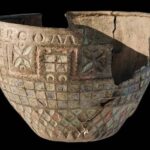
BritanniaA rendering of what the “Berlanga Cup” would look like reassembled.
Archaeologists recently announced the discovery of a 2nd-century C.E. cup found on farmland in La Cerrada de Arroyo, near Berlanga de Duero, Spain. This artifact is the latest in a series from around the same time period known to make references to Hadrian’s Wall, the Roman border wall in northern England.
What makes the “Berlanga Cup” different, however, is the fact that it features inscriptions mentioning the wall’s eastern forts and military camps (whereas other similar relics do not mention these forts specifically) — and that it was found in Spain, not England.
According to researchers, this means that the cup likely did not have a wholly practical purpose. Rather, its materials and craftsmanship show that this cup was likely a “prestige” object — in other words, a possible souvenir or memento allowing a soldier to remember his time serving on Hadrian’s Wall.
What’s So Special About The Berlanga Cup?
Hadrian’s Wall was a massive, Roman border wall built across northern England during the reign of Emperor Hadrian. Along the wall were several forts, at which Roman soldiers were stationed.

Wikimedia CommonsA partially reconstructed section of Hadrian’s Wall.
Given the size and prominence of this wall, it’s no surprise that it was often depicted in artifacts of the period. Prior to the discovery of the Berlanga Cup, archaeologists found a variety of similar vessels decorated with colorful enamel showing what researchers believed to be parts of Hadrian’s Wall. One of the most prominent examples of this is the Rudge Cup, which lists five of the wall’s forts.
In looking at these artifacts, researchers determined that they were likely not solely designed for practical purposes. Instead, an item like these cups and pans appeared to be crafted as something resembling a souvenir.
The discovery of the Berlanga Cup both solidifies this idea and expands upon it. According to the new study published in Britannia, the cup is believed to have belonged to a member of the Cohors I Celtiberorum. This was a Roman auxiliary regiment recruited from modern-day Spain.
Even though the object was made in Spain and seemingly carried by a Spanish soldier, scientists believe it was manufactured in England, closer to Hadrian’s Wall itself. This could be determined in part due to the composition of the cup, as the qualities of its metal indicate it likely came from mines in the north of England or Wales.
Why This Ancient Roman Cup Is More Than Just A Souvenir
The Britannia study notes that the idea of soldiers taking home souvenirs is nothing new.

BritanniaThe Berlanga Cup is believed to date back approximately 1,900 years.
What makes this cup different, however, is that it does not seem to simply be a memento. For one thing, the Berlanga Cup is an especially impressive and unique piece. It appears to have the names of four different forts: Cilurnum, Onno, Vindobala, and Condercom. It also has intricate decorations, bearing red, green, turquoise, and blue enamel arranged in geometric patterns resembling fish scales and tower motifs.
Furthermore, it’s larger than a simple charm or medal. Researchers estimated its mouth diameter at around 11.34 cm, its base diameter at about 4.95 cm, and its height at about 7.89 cm, after digital reconstruction.
Researchers speculate that, if this were to simply belong to a tourist or someone with no personal connection to the wall, a souvenir of this kind would simply mention the wall itself — not specific forts that were likely not well-known outside of England.
According to the researchers, this could mean that the soldier ordered this custom piece to commemorate his time in the area. Alternatively, the piece could have been a commendation or distinction for the soldier in response to something he did during his service. This supports prior research speculating that similar-looking pieces found previously were not widely-produced sets, but instead one-off commissions or pieces with very limited production.
1MORE Triple Driver In-Ear Headphones - Silver - Wired - Adult - In Ear - 18 grams - 90 days limited warranty
(as of October 24, 2026 01:02 GMT +00:00 - More infoProduct prices and availability are accurate as of the date/time indicated and are subject to change. Any price and availability information displayed on [relevant Amazon Site(s), as applicable] at the time of purchase will apply to the purchase of this product.)
KiddyCare Diaper Caddy Organizer Cart for Nursery Baby Basket Gift for Boy/Girl | Diaper Caddy for Changing Table Basket Organizer with Dividers | Caddy for Baby Stuff Breast Pump Caddy - Regular
$9.99 (as of October 24, 2026 01:02 GMT +00:00 - More infoProduct prices and availability are accurate as of the date/time indicated and are subject to change. Any price and availability information displayed on [relevant Amazon Site(s), as applicable] at the time of purchase will apply to the purchase of this product.)
RIVER OF GOODS Coastal 52 Inch Wooden Bead LED Ceiling Fan, Brown
(as of October 24, 2026 01:02 GMT +00:00 - More infoProduct prices and availability are accurate as of the date/time indicated and are subject to change. Any price and availability information displayed on [relevant Amazon Site(s), as applicable] at the time of purchase will apply to the purchase of this product.)
Rhythm Superfoods Kale Chips, Zesty Nacho, Organic and Non-GMO, 2.0 Oz (Pack of 4), Vegan/Gluten-Free Superfood Snacks
(as of October 24, 2026 01:02 GMT +00:00 - More infoProduct prices and availability are accurate as of the date/time indicated and are subject to change. Any price and availability information displayed on [relevant Amazon Site(s), as applicable] at the time of purchase will apply to the purchase of this product.)