California Geologist’s Routine Fieldwork Uncovers Astonishing Mastodon Tooth, Sparking Excitement and Mystery
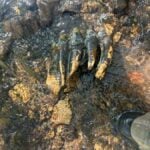
Ever stumbled upon what looks like just another weirdly shaped rock and thought, “Hmm, should I give this a closer look?” Well, that’s exactly how a team of unsuspecting geologists in the San Francisco Bay Area found themselves face-to-face with a prehistoric giant—an immaculately preserved Pacific mastodon molar tipping the scales at over three pounds! Imagine holding a tooth that’s at least 11,000 years old, a relic from a hairy cousin of modern elephants that roamed the western terrains during the last Ice Age. This isn’t just any fossil; it’s like having a direct line to a chapter of Earth’s forgotten past, a tantalizing puzzle piece that could rewrite what we know about these colossal browsers. The discovery came as a complete surprise during a routine frog habitat survey—talk about unexpected treasures! What secrets could this ancient molar unlock about coexistence with mammoths and extinct camels or about an era when such magnificent creatures grazed the Californian wilds? The intrigue is real, and the story is just beginning to surface. LEARN MORE
Weighing in at more than three pounds, this enormous tooth belonging to a Pacific Mastodon is at least 11,000 years old, though more study is needed to unlock the full story behind this “immaculate” specimen.

Balance HydrologicsGeologists surveying a forest in the San Francisco Bay Area recently stumbled upon a molar belonging to a prehistoric Pacific mastodon.
As recently as 11,700 years ago, Pacific mastodons were roaming the terrain in what’s now California, Oregon, and elsewhere in the American West. These giant herbivores — hairy relatives of today’s elephants — are now extinct, but humans are still finding fossils that shed light on their fascinating story.
Now, geologists near San Fransisco just made an exciting chance discovery of a fossilized mastodon molar, one that they hope will provide more insight into the life of this little-understood mastodon species, which was only officially identified in 2019.
The Accidental Discovery Of A Fossilized Mastodon Tooth Just South Of San Francisco
Brigid Lynch, a geomorphologist with the hydrology consulting firm Balance Hydrologics, discovered the molar earlier this year during a field survey of a creek in a San Mateo County nature preserve in the Santa Cruz Mountains.

MidpenResearchers discovered the tooth after taking a closer look at what they thought was only an “oddly shaped rock.”
Lynch and her colleagues were surveying the creek as a part of a habitat enhancement project for the threatened California red-legged frog.
That’s when Lynch stumbled upon what looked like an “oddly shaped rock,” according to a statement about the discovery from Midpeninsula Regional Open Space (Midpen), which runs the preserve.
But after closer examination, it was clear that the rock was in fact a fossilized mastodon tooth dating back to the last Ice Age.
“As a geologist, I’ve gone out and seen stuff in the field, but definitely nothing as exciting as this,” Lynch said.

MidpenLynch only realized that the mystery object she’d found was a mastodon tooth when she performed a reverse Google image search on a photo she’d taken of it.
Wayne Thompson, CEO of the paleontology consulting firm that carried out a preliminary analysis, said in the statement that the tooth is in “immaculate condition,” and is the “most complete mastodon molar from our area.”
In addition to this recent find, a foot-long Pacific mastodon molar was discovered by a woman on a Santa Cruz beach in 2023. She posted a photo of the fossil on Facebook, asking for inquiries about identifying it.
Thompson was the one who actually came across that photo and identified the object as a Pacific mastodon molar, which was then given to the Santa Cruz Museum.
At the time, Thompson reported to the Los Angeles Times that it was only the third time a Pacific mastodon tooth had ever been found in the region.
Now, with another mastodon tooth in hand, Thompson and his colleagues are delighted. Upon this most recent discovery, Thompson “had chills and shivers up and down [his] spine.”
How This Mastodon Molar Could Shed New Light On Life During The Last Ice Age
Closely related to the American mastodon species, the Pacific mastodon was first recognized in 2019. Although both of these elephant-like species roamed North America during the Pleistocene epoch (2.6 million to 11,700 years ago), the Pacific mastodon’s habitat stretched farther west.

Haley GrunlohThe Pacific mastodon is the most recently-discovered mastodon species, only officially recognized in 2019.
Fossils from the two distinct species have revealed further differences, such as a narrower third molar, wider hind-legs, and sometimes-absent lower-jaw tusks among the Pacific mastodon.
According to the statement, although mastodons were herbivores like mammoths, they did not only feed on grasses, but also used their trunks to strip leaves, soft shoots, and foots of tall, woody plants. This animal behavior is called “browsing” and is seen in modern-day animals like giraffes and various deer.

Kinsa Smart,Fever, Digital Medical Baby, Kid and Adult Termometro - Accurate, Fast, FDA Cleared Thermometer for Oral, Armpit or Rectal Temperature Reading - QuickCare
$18.94 (as of October 7, 2026 00:56 GMT +00:00 - More infoProduct prices and availability are accurate as of the date/time indicated and are subject to change. Any price and availability information displayed on [relevant Amazon Site(s), as applicable] at the time of purchase will apply to the purchase of this product.)
1MORE Triple Driver In-Ear Headphones - Silver - Wired - Adult - In Ear - 18 grams - 90 days limited warranty
(as of October 7, 2026 00:56 GMT +00:00 - More infoProduct prices and availability are accurate as of the date/time indicated and are subject to change. Any price and availability information displayed on [relevant Amazon Site(s), as applicable] at the time of purchase will apply to the purchase of this product.)
1MORE Triple Driver in-Ear Earphones Hi-Res Headphones with High Resolution, Bass Driven Sound, MEMS Mic, in-Line Remote, High Fidelity for Smartphones/PC/Tablet - Silver
$69.99 (as of October 7, 2026 00:56 GMT +00:00 - More infoProduct prices and availability are accurate as of the date/time indicated and are subject to change. Any price and availability information displayed on [relevant Amazon Site(s), as applicable] at the time of purchase will apply to the purchase of this product.)
Supa Ant Fire Blanket -Certified 1500F Extra Thick, Glow in The Dark | Fireproof Emergency Supplies. 500gsm, 0.5mm Thick Fire Blankets Emergency For Home. 5pc Fire Safety Emergency Blanket 40"x40"
$92.95 (as of October 7, 2026 00:56 GMT +00:00 - More infoProduct prices and availability are accurate as of the date/time indicated and are subject to change. Any price and availability information displayed on [relevant Amazon Site(s), as applicable] at the time of purchase will apply to the purchase of this product.)



















Post Comment