Decades of Inbreeding Unveil Mysterious Blue Skin Phenomenon in US Family—Scientists Stunned

Ever wondered what happens when a family tree looks more like a family vine — weaving tightly over centuries — and the inbreeding isn’t just a rumor but the literal reason their skin turns blue? No, this isn’t a wizarding world magic trick or a rare comic book origin story. Meet the Fugate family from Troublesome Creek, Kentucky—a lineage so entwined that not only did generations marry cousins (and in some cases, aunts), but their genetic quirk painted them blue. It all started back in 1820, when Martin Fugate and Elizabeth Smart, seemingly ordinary folks from Appalachia, passed down a recessive gene causing methemoglobinemia—a rare blood disorder—that turned their descendants’ skin a shocking shade of blue. You might think this colorful trait would be a one-off, but thanks to their isolated lifestyle and interfamily marriages, this blue hue became a family hallmark, puzzling medical experts for decades until a surprising treatment emerged. So, how exactly did blue skin become a genetic heirloom? And more importantly, can science paint them back to ‘normal’? Let’s dive into this curious case of blue-blooded Appalachians who baffled both history and medicine. LEARN MORE
An incestuous family ended up turning blue after generations of members kept having children with one another.
Now, this isn’t talking about the ‘most inbred family in America’, which is the title of the Whittaker family in West Virginia.
This is the family that has been well-documented online for inbreeding over a course of a century, with many family members having disabilities as a result.
Instead, the blue skin Fugate family are those who lived in a rural community in Troublesome Creek, Kentucky, and regularly inbred for decades – starting in 1820.
The family lived in Appalachia, and the blue all started with its patriarch, Martin Fugate.
Fugate married Elizabeth Smart and reportedly had seven children together.

It all came down to a recessive gene (YouTube)
However, as reported in the Mirror, Fugate had a very rare and unusual genetic defect which turned him blue.
The condition is called methemoglobinemia, which the Cleveland Clinic says only impacts a tiny number of the global population in either hereditary or contamination cases.
It states it’s ‘a rare blood disorder that affects hemoglobin, the protein that helps red blood cells deliver oxygen throughout your body.’
This then ’causes cyanosis, when your skin, lips, nailbeds and tongue turn light blue, purple or gray’, but can also carry ‘life-threatening complications’.
For Fugate and his wife, they saw the genetic disorder impact four of their seven kids because it was a recessive gene carried by their father.
But here’s the kicker. Because it’s recessive, had they not inbred with their own family, they wouldn’t have kept passing it down the line.
It was only because they were so isolated and only mingled amongst themselves and married cousins, that the gene was so common in the line.
If you were to travel to the community, you’d probably only come into contact with a handful of different surnames, such as Fugate, Smith, Combs, Ritchie, and Stacy, because they all intermingled.
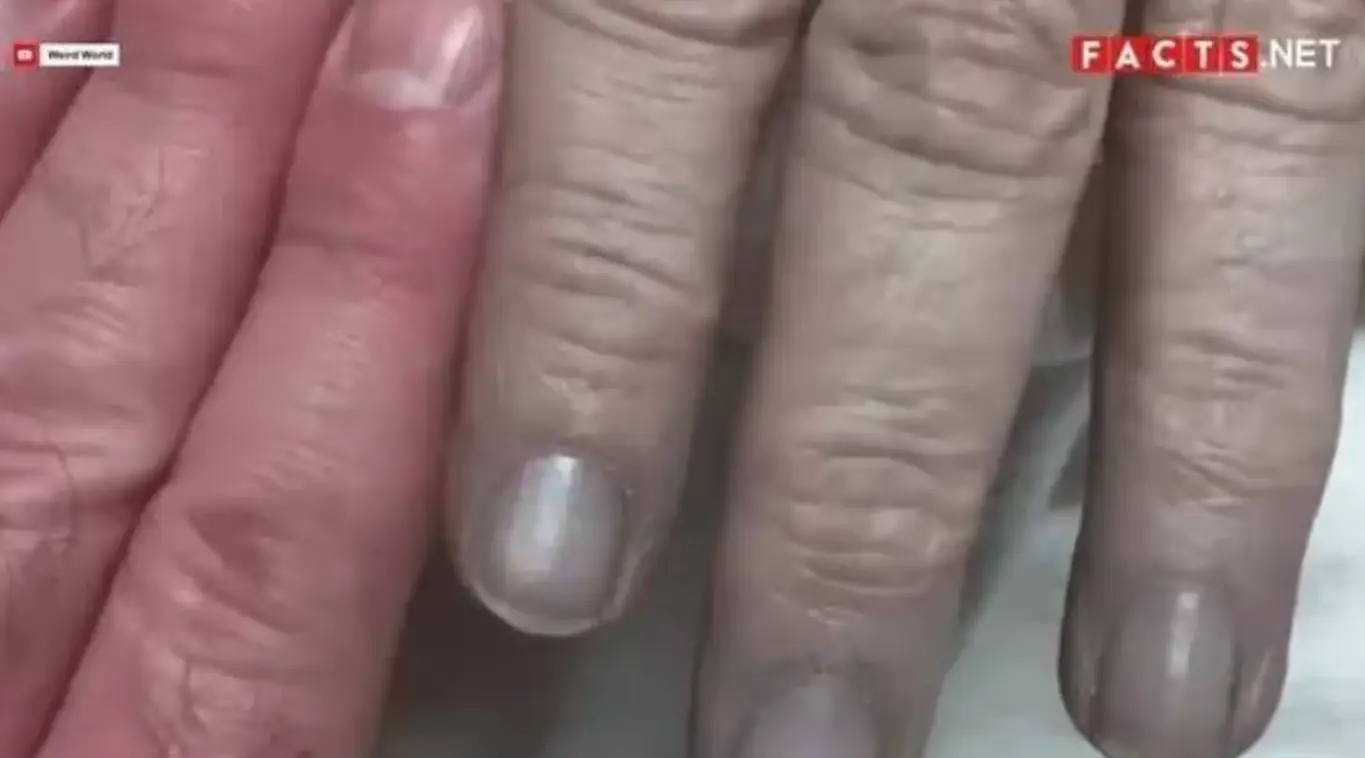
The family were blue (YouTube)
In one instance, Zacharia, one of the seven children, even married his own aunt.
Another wedded their cousin and produced the bluest of them all, Luna Fugate.
Per the Daily Record, she was described as having ‘lips as dark as a bruise’.
She married a man named John Stacy in the19th century, birthed 13 children and again, passed down the blue.
Blood expert Dr Madison Cawein at the University of Kentucky was miffed by their condition, per History Extra, which allegedly didn’t impact their health besides the coloring.
So, in the 1960s, he tracked down some surviving members of the clan and tested some blood sampling.
This found that they were missing a key enzyme, which led him to theorize that injecting them with blue dye called methylene, could help.
Shockingly…it did actually work.
While blue plus blue doesn’t equal pink, when it comes to the science of the human body, it’s a lot more complex than simple color theory.
What he found was that the injection would remove the blue tint from their skin for a few days, but if they were to take daily methylene tablets, it would become a permanent solution.

RIVER OF GOODS LED Boho Ceiling Fan with Hand Woven Brown/Natural Rope - Macrame Knot Work and Hemp Rope Style Eclectic Cottage Decor - 52" L x 52" W - Rich Barnwood/Light Driftwood Fan Blades
(as of October 25, 2026 01:02 GMT +00:00 - More infoProduct prices and availability are accurate as of the date/time indicated and are subject to change. Any price and availability information displayed on [relevant Amazon Site(s), as applicable] at the time of purchase will apply to the purchase of this product.)
1MORE Triple Driver In-Ear Headphones - Silver - Wired - Adult - In Ear - 18 grams - 90 days limited warranty
(as of October 25, 2026 01:02 GMT +00:00 - More infoProduct prices and availability are accurate as of the date/time indicated and are subject to change. Any price and availability information displayed on [relevant Amazon Site(s), as applicable] at the time of purchase will apply to the purchase of this product.)
Kinsa Smart,Fever, Digital Medical Baby, Kid and Adult Termometro - Accurate, Fast, FDA Cleared Thermometer for Oral, Armpit or Rectal Temperature Reading - QuickCare
$18.94 (as of October 25, 2026 01:02 GMT +00:00 - More infoProduct prices and availability are accurate as of the date/time indicated and are subject to change. Any price and availability information displayed on [relevant Amazon Site(s), as applicable] at the time of purchase will apply to the purchase of this product.)
Supa Ant Canning Supplies Starter Kit (Food Grade) - Canning Kits Set for Beginners - 3 Pcs. Including Wide Mouth Jar Funnel, Magnetic Lid Lifter, Stainless Steel Jar Lifter (Assembled in USA) Blue
$9.99 (as of October 25, 2026 01:02 GMT +00:00 - More infoProduct prices and availability are accurate as of the date/time indicated and are subject to change. Any price and availability information displayed on [relevant Amazon Site(s), as applicable] at the time of purchase will apply to the purchase of this product.)