Father and Son Unearth Stunning Megalodon Tooth Hidden Beneath New Jersey Sand for Millions of Years

Ever wonder what it would be like to bump into teeth as big as your hand while strolling the beach? No, it’s not the start of a bad joke—it’s exactly what happened when the Bowers family chanced upon a fossilized megalodon tooth during a routine getaway to New Jersey’s Shore. Imagine a shark the size of a school bus cruising the oceans, sporting a grin filled with teeth that could crush a car—crazy, right? These prehistoric giants ruled the seas until about 3.5 million years ago, and finding a piece of that colossal past washed up amid a beach rehab project is nothing short of miraculous. It makes you wonder: if such monsters once prowled these waters, what else might be lurking just beneath the waves, waiting for the right tide to reveal their secrets? Dive into this jaw-dropping discovery that’s rewriting our understanding of Earth’s most enormous predator, right here on the Jersey Shore.
Up until 3.5 million years ago, these enormous sharks measuring up to 60 feet long swam throughout Earth’s oceans while sporting teeth as large as human hands.

Cape May Whale Watch and Research Center/FacebookMichael Bowers and his son, Bo, stumbled upon a four-inch megalodon tooth while vacationing on the Jersey Shore.
The Bowers family was enjoying an otherwise normal vacation in Sea Isle City, New Jersey, when they stumbled upon an unexpected souvenir: a fossilized megalodon tooth dating back millions of years.
This four-inch tooth belonged to a prehistoric variety of 60-foot shark that went extinct around 3.6 million years ago — leaving behind only a few other teeth that have ever been found in the area.
The Chance Discovery Of A Prehistoric Megalodon Tooth On The Jersey Shore
Michael Bowers of Pennsylvania was exploring a jetty with his 11-year-old son, Bo, on the beach near Townsends Inlet when he spotted something peculiar among the rocks.
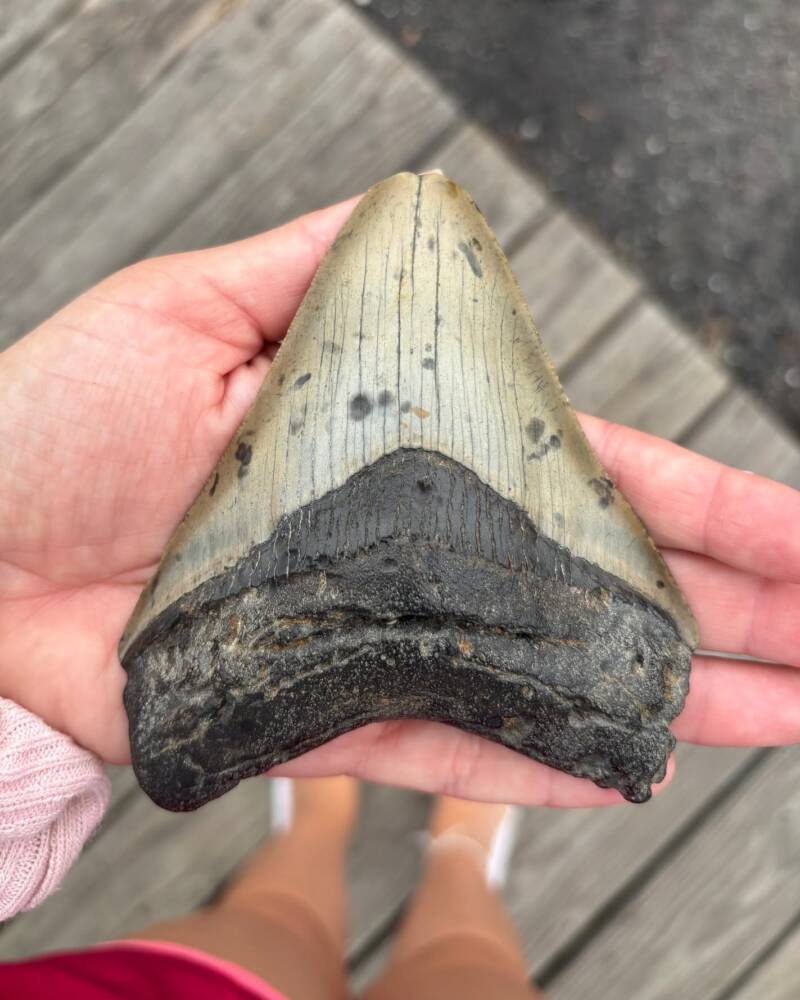
Cape May Whale Watch and Research Center/FacebookAn experienced scuba diver, Michael Bowers said it was a longtime goal of his to find one of these massive fossilized teeth.
His hand couldn’t fit in the opening to reach the object, so he asked Bo to give it a shot. When Bo pulled his hand out, they couldn’t believe what they had found.
“I looked down in there, and I couldn’t believe myself. It’s on my bucket list of stuff to find. My knees were shaking,” Bowers told NJ.com.
Bowers is an experienced scuba diver, and finding one of these massive teeth had been one of his goals for a long time. He was even planning on soon heading down to North Carolina for a scuba dive in search of megalodon teeth hidden on the seafloor just off the coast — a known spot to discover these fossils.
“I never in a million years would have guessed that we would have found something like this. My son was speechless,” Bowers said.
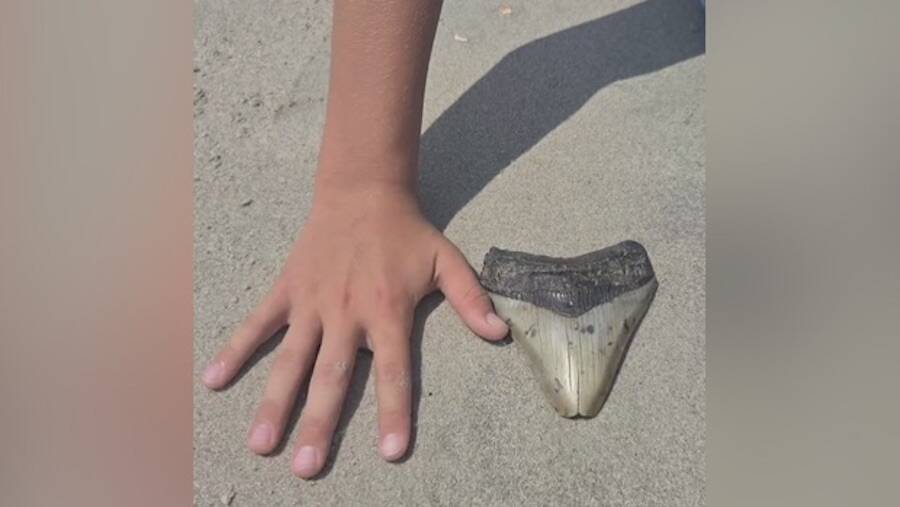
Mike BowersThe tooth was likely deposited on the jetty during offshore sand dredges that are part of a beach rehabilitation project.
Once father and son took their discovery to the authorities, they presented the find to the Cape May Whale Watch and Research Center, which confirmed that the tooth was indeed from a megalodon.
How This Rare Find Adds To Our Knowledge About The Massive Megalodon
Scientists consider megalodons to be the largest-known sharks to ever swim the oceans of planet Earth. This species has been extinct for 3.6 million years, and most of what is known about them today has come from the study of their fossilized teeth.
Many megalodons reached up to 60 feet in length, and weighed up to 50 tons. Their astonishing 10-foot jaws were capable of biting down with enough force to crush a car. They could also swim up to 16.5 feet per second — about twice the speed of a great white shark — making them the undeniable apex predators of Earth’s prehistoric oceans for millions of years.
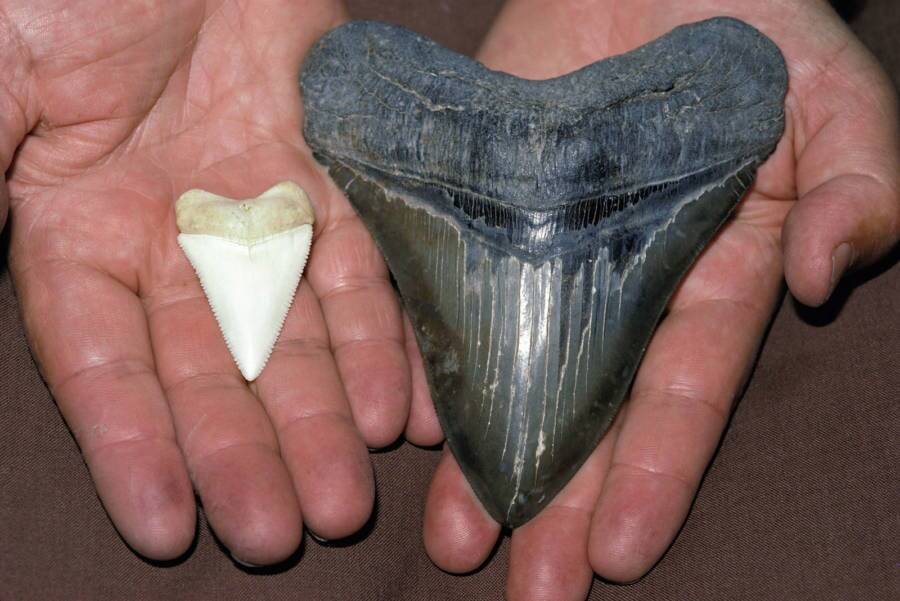
Jeff Rotman/AlamyThe megalodon tooth (right) is significantly larger than the tooth of a modern great white shark (left).
This megalodon tooth recently found in New Jersey had a chip on one end, which, Bowers told CBS, might have been the result of the shark biting into something hard enough that it harmed the bone. What that could be, however, remains unclear.
What is slightly more certain is how the tooth likely ended up on the jetty. Melissa Laurino, the Cape May Whale Watch and Research Center’s research director and naturalist, said that offshore sand being dredged and pumped as a part of an ongoing beach replenishment project in Cape May likely deposited the prehistoric tooth on the shore along with sand.
The section of the project along Sea Isle City was completed in July.
“If the sand came from a few miles offshore, it is very possible the tooth came with it,” Laurino said to NJ.com. “It is a once-in-a-lifetime beach find that the Bowers family will treasure for a lifetime.”
While finding common shark teeth at the beach isn’t rare, a four-inch megalodon tooth is notable — especially in New Jersey.
Dana Ehert, the curator of natural history at the New Jersey State Museum, told NJ.com that there have only ever been four other discoveries of megalodon teeth in the state.

RIVER OF GOODS Stained Glass Bird Accent Lamp - 8" W x 13.5" H - Tiffany Style Table Lamps for Home, Office Desk, Bedroom, Nightstand - Blue Jay Decor
(as of October 26, 2026 01:02 GMT +00:00 - More infoProduct prices and availability are accurate as of the date/time indicated and are subject to change. Any price and availability information displayed on [relevant Amazon Site(s), as applicable] at the time of purchase will apply to the purchase of this product.)
RIVER OF GOODS Alabaster LED Mesh Caged Ceiling Fan - 52" L X 52" W - White/Oak Wood-Grain Blades
(as of October 26, 2026 01:02 GMT +00:00 - More infoProduct prices and availability are accurate as of the date/time indicated and are subject to change. Any price and availability information displayed on [relevant Amazon Site(s), as applicable] at the time of purchase will apply to the purchase of this product.)
RIVER OF GOODS Coastal 52 Inch Wooden Bead LED Ceiling Fan, Cream
(as of October 26, 2026 01:02 GMT +00:00 - More infoProduct prices and availability are accurate as of the date/time indicated and are subject to change. Any price and availability information displayed on [relevant Amazon Site(s), as applicable] at the time of purchase will apply to the purchase of this product.)
1MORE Triple Driver In-Ear Headphones - Silver - Wired - Adult - In Ear - 18 grams - 90 days limited warranty
(as of October 26, 2026 01:02 GMT +00:00 - More infoProduct prices and availability are accurate as of the date/time indicated and are subject to change. Any price and availability information displayed on [relevant Amazon Site(s), as applicable] at the time of purchase will apply to the purchase of this product.)