Nobel Laureate Challenges Cosmic Consensus After Shocking New Discovery Turns Universe Map Upside Down
For decades, scientists have been like cosmic detectives, using not one, but two completely different yardsticks to measure the universe’s expansion — and guess what? Their rulers don’t agree on the size of the cosmic pie! Imagine showing up to a dinner party with two friends, each swearing their slice is the biggest. Turns out, this universe-sized disagreement isn’t just a casual spat; it’s shaking the foundations of cosmology itself. One of the very pioneers behind these measurements is now throwing serious shade on the models once thought untouchable — suggesting dark energy, that mysterious cosmic engine, might be changing its tune. So, how fast is our universe really expanding? And is dark energy playing us like a cosmic fiddle? Buckle up, because the universe might be way weirder than we ever imagined.
For decades, scientists have used two different measurements to analyze the behavior of the universe. Now, the meaning of these models is being thrown into question — by one of their pioneers.
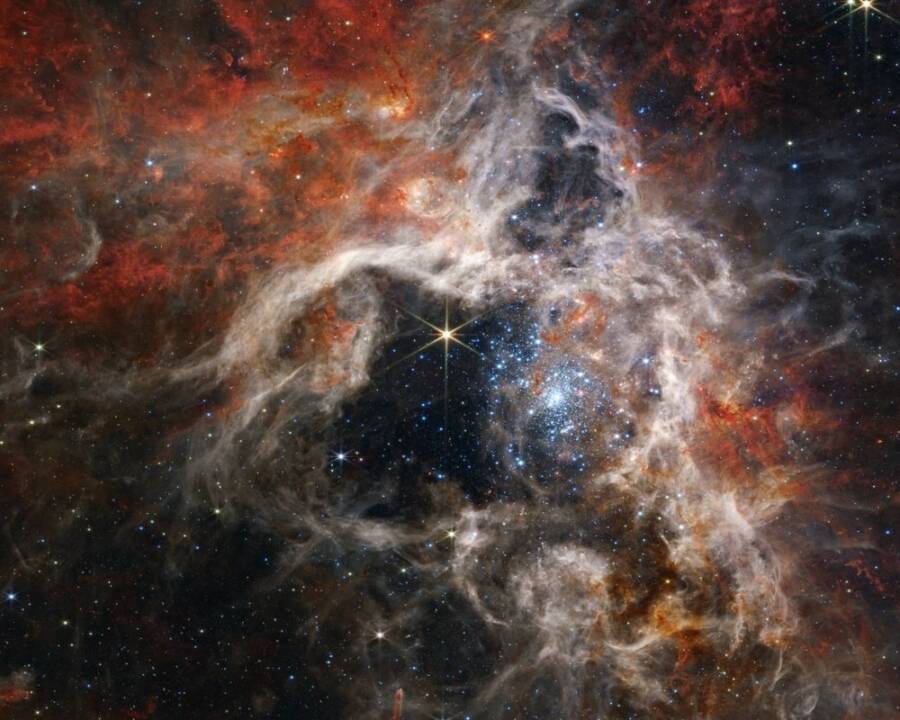
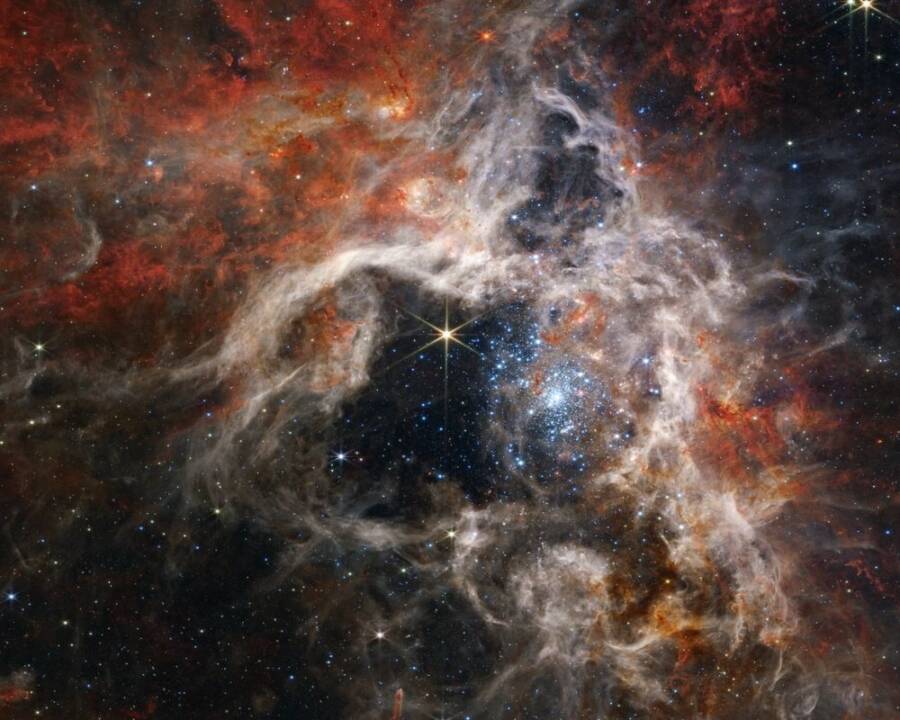
NASAThe Tarantula Nebula, a section of the universe where new stars are forming.
Historically, experts have used two separate approaches to measure how the universe is expanding. While the measurements have produced two different results, they were both generally thought to be reliable, with the variance explained away by the imprecision that comes with analyzing such a complicated matter. Over time, it was thought, instruments would get more accurate, and this discrepancy would disappear.
However, this has not been the case. Instead, increasingly precise measurements have kept landing near the same incompatible values, making the discrepancy harder to dismiss as an error. Now, some of the scientists involved in pioneering these measurements are sounding the alarm.
But what was the inciting incident that caused this chaos? The answer lies in the changing state of dark energy itself.
How Fast Is The Universe Really Expanding?
In the late 1990s, one team featuring astrophysicist Adam Riess and another led by Saul Perlmutter studied distant exploding stars called Type Ia supernovae. Models at the time predicted that the gravitational pull of all the matter in the universe would slow the expansion of the universe, which would be reflected in their measurements of the exploding stars.
But these teams noticed that, strangely, the opposite was occurring. Rather than slowing down, the universe’s expansion appeared to be accelerating.
This discovery earned Riess, Perlmutter, and another researcher named Brian Schmidt the 2011 Nobel Prize in Physics. Their research would eventually be incorporated into calculations through the “Lambda cold dark matter” model, or ΛCDM, with Λ representing the cosmological constant of dark energy that, somehow, was causing the universe’s expansion to accelerate.
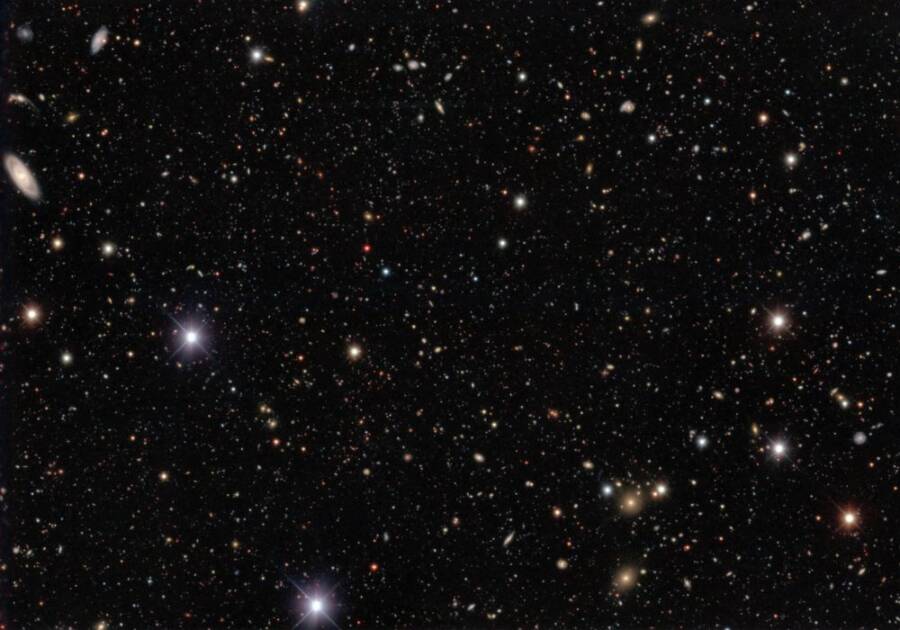
National Optical-Infrared Astronomy Research LaboratoryDark energy is a mysterious force that drives the expansion of the universe.
The problem was that scientists could not agree on exactly how fast the universe is expanding. The Planck satellite used ΛCDM and cosmic microwave background radiation — light left over from early in the universe’s history — to estimate the expansion speed at 67 kilometers per second per megaparsec. Riess’ SH0ES team, in contrast, measured distances between nearby galaxies to determine that the expansion was closer to 73 kilometers per second per megaparsec. This discrepancy became known as the “Hubble tension.”
While it was believed that these numbers would one day align as measurements became more exact, the opposite has occurred. There’s also another problem: the findings of the Dark Energy Spectroscopic Instrument.
Is Dark Energy Changing?
The Dark Energy Spectroscopic Instrument, or DESI, maps millions of galaxies and quasars to reconstruct how the universe has expanded over billions of years.
Taken by themselves, DESI’s measurements appeared to be compatible with ΛCDM. But in March 2025, researchers announced that, when they combined them with the observations of the cosmic microwave background and supernovae, they determined that dark energy might not be as constant as they thought. Instead, the very nature of dark energy may itself be evolving over time.
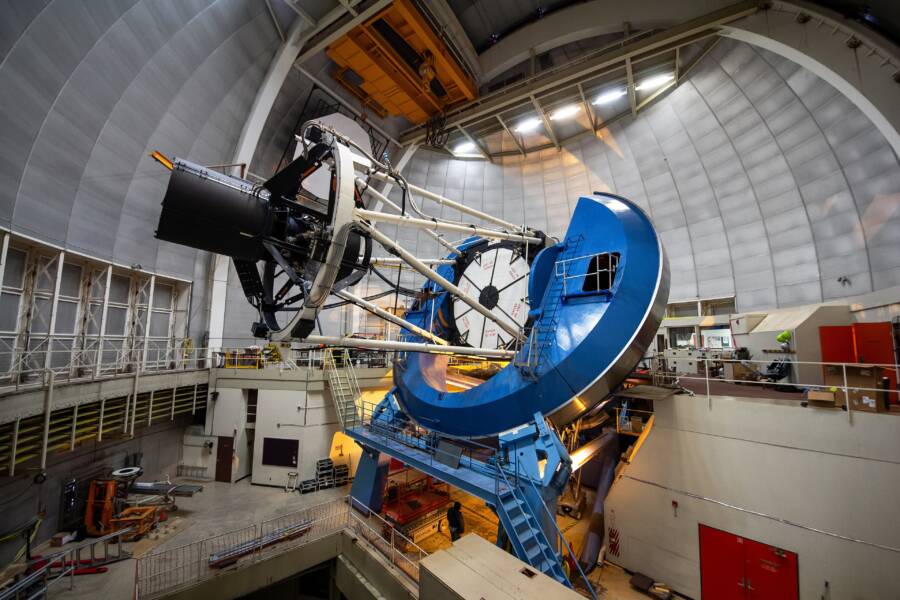
NOIRLab/KPNO/NSF/AURA/P. MarenfeldThe Dark Energy Spectroscopic Instrument at Kitt Peak National Observatory near Tucson, Arizona.
This is striking because, in the old model of ΛCDM, the “Λ” was to be treated as a constant. By demonstrating that this might not actually be the case, the researchers revealed that the simplest version of the standard cosmological model may not tell the whole story.
Riess himself has noted the remarkability of this finding. In a paper published in August 2025, he and fellow astronomer Alexie Leauthaud wrote, “Widening cracks are appearing in the Λ cold dark matter (ΛCDM) model.”
“It is becoming increasingly clear that the standard cosmological model struggles to describe the full expansion history of the Universe as revealed by the cosmic microwave background, baryon acoustic oscillation measurements, and locally calibrated type Ia supernovae,” the paper reads.

Rhythm Superfoods Kale Chips, Zesty Nacho, Organic and Non-GMO, 2.0 Oz (Pack of 4), Vegan/Gluten-Free Superfood Snacks
(as of October 22, 2026 01:01 GMT +00:00 - More infoProduct prices and availability are accurate as of the date/time indicated and are subject to change. Any price and availability information displayed on [relevant Amazon Site(s), as applicable] at the time of purchase will apply to the purchase of this product.)
RIVER OF GOODS Coastal 52 Inch Wooden Bead LED Ceiling Fan, Brown
(as of October 22, 2026 01:01 GMT +00:00 - More infoProduct prices and availability are accurate as of the date/time indicated and are subject to change. Any price and availability information displayed on [relevant Amazon Site(s), as applicable] at the time of purchase will apply to the purchase of this product.)
RIVER OF GOODS Stained Glass Magna Carta LED Ceiling Fan - 52" L x 52" W - Tiffany Style - Flush Mount Ceiling Fan with Remote - Teal
(as of October 22, 2026 01:01 GMT +00:00 - More infoProduct prices and availability are accurate as of the date/time indicated and are subject to change. Any price and availability information displayed on [relevant Amazon Site(s), as applicable] at the time of purchase will apply to the purchase of this product.)
1MORE Triple Driver In-Ear Headphones - Silver - Wired - Adult - In Ear - 18 grams - 90 days limited warranty
(as of October 22, 2026 01:01 GMT +00:00 - More infoProduct prices and availability are accurate as of the date/time indicated and are subject to change. Any price and availability information displayed on [relevant Amazon Site(s), as applicable] at the time of purchase will apply to the purchase of this product.)