Scientists Stumble Upon Shocking Discovery: Could This Be The First Ever Dinosaur Blood?
Ever wonder if a dinosaur could’ve been your distant party buddy, sharing a soda and chatting about the Mesozoic weather? Well, hold that thought—because researchers just might have found remnants of actual dinosaur blood inside a 115-million-year-old Aratasaurus museunacionali fossil. Yep, paleontologists slicing into an ancient hind leg uncovered structures that look suspiciously like red blood cells, complete with heme—the iron-packed molecule that’s basically the oxygen delivery guy in our blood. Now, before you start picturing Jurassic-sized blood donors, know that proving this kind of fossil find is like trying to catch smoke with your bare hands—decades of false alarms and dusty mysteries have made scientists skeptical at best. Still, this discovery, if true, would be a real game-changer in how we peek into dinosaur biology—and it’s got me wondering, could these prehistoric blood leftovers finally crack open secrets long buried beneath our feet? Buckle up, because this isn’t your average fossil tale. LEARN MORE
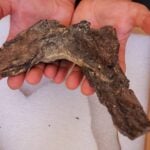
Researchers analyzing a 115-million-year-old Aratasaurus museunacionali fossil discovered structures that resembled red blood cells, as well as the presence of heme, an iron-containing compound that helps those cells carry oxygen.

Curtin UniversityResearchers believe that they’ve found remnants of blood in the 115-million-year-old hind leg of an Aratasaurus museunacionali.
Like other soft tissue, red blood cells deteriorate relatively quickly after death. This is precisely why researchers have been struggling for decades to finally uncover a confirmed sample of dinosaur blood preserved within a fossil.
Oftentimes, researchers are faced with false positives, fooled by things that simply look like red blood cells. Or perhaps researchers encounter issues related to a contaminated sample. But now, researchers in Australia have analyzed a 115 million-year-old fossil and they believe they’ve made the first bonafide discovery of remnants of dinosaur blood in history.
The Possible Discovery Of Dinosaur Blood Inside A 115-Million-Year-Old Fossil
The possible blood sample comes from a Aratasaurus museunacionali fossil that was discovered in a Brazilian mine in 2008. Small and bipedal, this species was a carnivore that lived during the Cretaceous period.
Researchers estimate that this particular Aratasaurus was about four years old when it died, weighing in at 75 pounds and measuring 10 feet long, though it wasn’t yet fully grown. After it died, the dinosaur’s carcass remained very well preserved thanks largely to a wealth of microbes in the area.

Victor O. LeshykThis could be both the first confirmed case of dinosaur blood as well as the oldest of all the potential past cases on record.
Now, researchers studying a fossil from one of the creature’s hind legs believe they’ve identified elements of its red blood cells. The team published their findings in the journal Proceedings of the National Academy of Sciences on November 2.
When scientists sliced the hind leg fossil into pieces and studied them under a microscope, they spotted several blob-like structures with sunken centers and measuring about 23 micrometers long by 20 micrometers wide that looked like red blood cells. Furthermore, these structures were found inside vascular canals, the pathways in which blood vessels sit.
In order to determine whether these structures came from the dinosaur’s blood, researchers performed almost 30 tests, including one where they shot ground-up bone samples with a laser. This test revealed remnants of heme, a molecule in hemoglobin, the critical protein that aids in the transportation of oxygen by red blood cells.

Victor O. LeshykResearchers discovered both heme and numerous structures that resembled red blood cells.
What’s more, this was a degraded sample of heme, indicating that it was of prehistoric origins and had deteriorated significantly over time.
In an attempt to rule out the possibility of sample contamination, scientists performed similar tests on the sediment surrounding the fossil — and got very different results, suggesting that the samples were indeed uncontaminated.
Why Some Experts Remain Skeptical That This Is Actually Dinosaur Blood
Researchers have been attempting to find dinosaur blood for decades, especially because analysis of their blood cells could help reveal more than ever before about how dinosaurs adapted to their environments.
According to Science, there have been at least 14 other studies that attempted to irrefutably identify red blood cells in dinosaur fossils, but none have broadly convinced experts in the field. But this latest research may be the most convincing attempt yet.
“It’s probably the most comprehensive effort that’s been done so far,” Maria McNamara, a paleobiologist at University College Cork who was not involved in the new study said to Science. But, she added, “I would be very cautious about interpreting those necessarily as red blood cells.”

Victor O. LeshykSome experts remain skeptical of the new announcement, arguing that, for one thing, the sample could have been contaminated in any number of ways.
McNamara told Science that she wished the researchers had done more tests to rule out other possible sources of heme that could have contaminated the sample.

Kinsa Smart,Fever, Digital Medical Baby, Kid and Adult Termometro - Accurate, Fast, FDA Cleared Thermometer for Oral, Armpit or Rectal Temperature Reading - QuickCare
$18.94 (as of November 19, 2026 01:13 GMT +00:00 - More infoProduct prices and availability are accurate as of the date/time indicated and are subject to change. Any price and availability information displayed on [relevant Amazon Site(s), as applicable] at the time of purchase will apply to the purchase of this product.)
KiddyCare Diaper Caddy Organizer Cart for Nursery Baby Basket Gift for Boy/Girl | Diaper Caddy for Changing Table Basket Organizer with Dividers | Caddy for Baby Stuff Breast Pump Caddy - Regular
$9.99 (as of November 19, 2026 01:13 GMT +00:00 - More infoProduct prices and availability are accurate as of the date/time indicated and are subject to change. Any price and availability information displayed on [relevant Amazon Site(s), as applicable] at the time of purchase will apply to the purchase of this product.)
RIVER OF GOODS Stained Glass Bird Accent Lamp - 8" W x 13.5" H - Tiffany Style Table Lamps for Home, Office Desk, Bedroom, Nightstand - Blue Jay Decor
(as of November 19, 2026 01:13 GMT +00:00 - More infoProduct prices and availability are accurate as of the date/time indicated and are subject to change. Any price and availability information displayed on [relevant Amazon Site(s), as applicable] at the time of purchase will apply to the purchase of this product.)
Fire Cloak - 1500F CE Certified Emergency Fire Blanket for Home & Kitchen | 500GSM Fabric & 0.5mm Thick - Silicon Coated 100% Fiberglass Essentials in House, Warehouse Office - 55"L x 70"W by Supa Ant
$83.99 (as of November 19, 2026 01:13 GMT +00:00 - More infoProduct prices and availability are accurate as of the date/time indicated and are subject to change. Any price and availability information displayed on [relevant Amazon Site(s), as applicable] at the time of purchase will apply to the purchase of this product.)




















Post Comment