Shocking Aftermath Revealed: NASA’s High-Speed Asteroid Crash Unleashes Unseen Cosmic Impact

So NASA just whacked an asteroid at a mind-boggling 14,000 mph, leaving behind a crater the size of a stadium—yeah, you read that right, a stadium-sized crater carved by a spacecraft with a serious punch. Back in 2022, the US space agency launched its Double Asteroid Redirection Test (DART) to smack the Dimorphos asteroid and see if we could, in fact, play cosmic bumper cars to save Earth from a real-life Armageddon scenario. Spoiler alert: the hit was so intense that debris shot out over 6,000 miles and that tiny rock’s orbit got knocked down by 33 minutes! Now, Europe’s ESA is following up with its Hera mission, sending new images and mini satellites to check out the damage and figure out if humanity’s got what it takes to dodge a space bullet next time. So, would you bet the planet on this asteroid shuffle dance, or should we start prepping for Hollywood’s sequel?
Incredible footage and images have shown the ‘stadium-sized’ crater left in an asteroid after a NASA spacecraft whacked into it at 14,000mph.
The US space agency sent up its Double Asteroid Redirection Test (DART) spacecraft to hit the Dimorphos space rock back in 2022.
The mission was designed to test whether a method of planetary defence against near-Earth objects – or NEOs – and to discover whether NASA was able to send a spacecraft smashing into an asteroid to change its trajectory and avoid a potential impact with Earth.
Put simply, NASA wanted to know that if Earth was facing an incoming asteroid, like in the movie Armageddon, would it be able to save the world?
On 26 September 2022, DART reached its destination and hurtled into the asteroid and hit it so hard that a huge plume of debris was scattered 6,200 miles across space and Dimorphos’ orbit around its companion Didymos was shortened by around 33 minutes.
In the wake of the mission, the European Space Agency (ESA) has sent out its own spacecraft called Hera to embark on a six-month mission investigating the aftermath of DART’s impact.
This week, ESA shared incredible new images and footage of the asteroid revealing the huge stadium-sized crater on its surface.
Hera scientist Michael Kueppers said: “Dimorphos is now tumbling in a chaotic way. There are hundreds of boulders floating around in the system.
“The side impacted is now completely covered by a crater, with the visual impression that a piece of the asteroid was cut off by the impact,” he added.
“We do not see evidence for major changes on the site opposite to the DART impact. The combination of those two observations is surprising.”
These first-look images will be followed by higher quality ones that are set to be shared next month when Hera is around eight miles away from the asteroid.
Then, in January next year, the spacecraft will launch a couple of mini satellites – named Juventas and Milani – that’ll be able to get an even closer look.
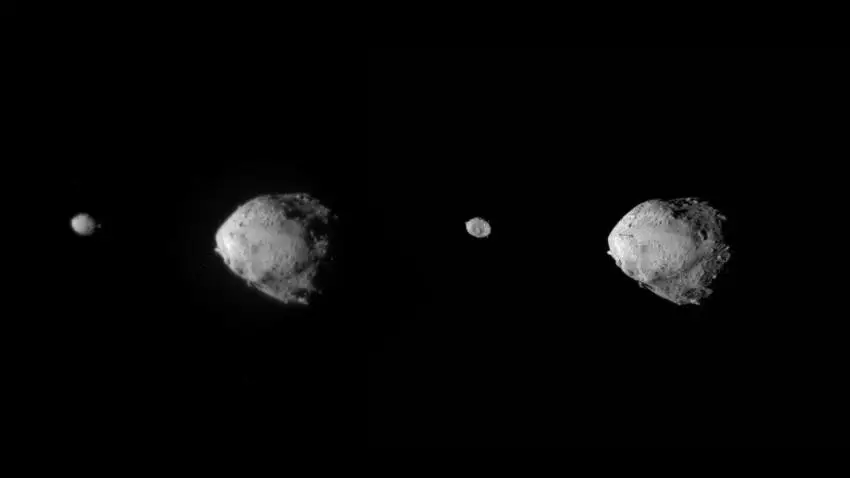
ESA has released new images showing the impact of NASA’s DART mission (ESA)
According to ESA, Juventas will use radar to see whether Dimorphos is a solid chunk of space rock or a loose pile of rubble, while Milani will check out the rock’s mineral composition and work out its overall mass.
All the data gathered will be used to determine how effective the DART mission was and if it shows that humans really would be able to deflect an approaching asteroid, if the situation arose.
Hera mission manager Ian Carnelli said: “Sixty-six million years ago, an asteroid impact changed the course of life on Earth.
“Today, for the first time in history, humanity is validating how to prevent such an event from happening again.”
Professor Simon Green, scientist on the Hera’s science team, told the BBC: “It would help us to predict what would happen if we had to hit another asteroid.
“We [could] measure its properties and say: ‘Well, we need this mass of spacecraft, travelling at this speed, this early, in order to deflect it enough so that it misses the Earth’.”

RIVER OF GOODS Alabaster LED Mesh Caged Ceiling Fan - 52" L X 52" W - White/Oak Wood-Grain Blades
(as of November 27, 2026 01:18 GMT +00:00 - More infoProduct prices and availability are accurate as of the date/time indicated and are subject to change. Any price and availability information displayed on [relevant Amazon Site(s), as applicable] at the time of purchase will apply to the purchase of this product.)
1MORE Triple Driver in-Ear Earphones Hi-Res Headphones with High Resolution, Bass Driven Sound, MEMS Mic, in-Line Remote, High Fidelity for Smartphones/PC/Tablet - Silver
(as of November 27, 2026 01:18 GMT +00:00 - More infoProduct prices and availability are accurate as of the date/time indicated and are subject to change. Any price and availability information displayed on [relevant Amazon Site(s), as applicable] at the time of purchase will apply to the purchase of this product.)
Supa Ant 6x8ft. Welding Blanket Fireproof (Pack of 2) - Heavy Duty Weld Fire Blanket Tools - Welders Cover for Men Curtain with Gloves - Large Welding Gear for Welder Accessories
(as of November 27, 2026 01:18 GMT +00:00 - More infoProduct prices and availability are accurate as of the date/time indicated and are subject to change. Any price and availability information displayed on [relevant Amazon Site(s), as applicable] at the time of purchase will apply to the purchase of this product.)
RIVER OF GOODS Mid-Century Modern Transitional LED Bronze Chrome Ceiling Fan - 52" L x 52" W - Rich Barnwood/Light Driftwood Fan Blades - Metallic Ceiling Fan with Light and Fabric Shade
(as of November 27, 2026 01:18 GMT +00:00 - More infoProduct prices and availability are accurate as of the date/time indicated and are subject to change. Any price and availability information displayed on [relevant Amazon Site(s), as applicable] at the time of purchase will apply to the purchase of this product.)
















Post Comment