Teenagers Uncover Stunning 1,800-Year-Old Roman Secret Hidden Beneath Their School Gymnasium
Ever wonder what secrets lurk just beneath your feet—especially when you’re busy dodging gym class dodgeballs? Well, some students in Italy literally stumbled upon history when they found an entire ancient Roman luxury house right under their high school’s gym floor. Yep, not just a crack in the floorboard, but intact wall paintings, exquisite mosaics, and enough artifacts to fill 48 crates. Talk about an unexpected field trip! This mid-second century domus, tucked just minutes from the Colosseum, serves up a peek into elite Roman life, complete with stuccoed ceilings and graffiti that spans centuries (even from curious high schoolers long ago). It’s like history crashing the school party—and luckily, these students had the smarts to alert the pros. Now, archaeologists are unearthing a treasure trove that might rewrite what we know about Rome’s Imperial era… all while reminding us that sometimes, the past is literally right beneath your sneakers. LEARN MORE
Archaeologists have since uncovered intact wall paintings and mosaic decorations, along with 48 crates’ worth of artifacts.

Cantieri NarrantiArchaeologists found stucco designs on the ceilings of the house.
Students in Italy have stumbled upon an ancient Roman structure — right beneath their high school’s gym. Situated just minutes from the Colosseum in Rome, the school had apparently been built right atop these ruins. After making this incredible find, the students alerted their history teacher, who then notified officials.
Following an archaeological excavation that began in September 2025, the team led by Professor Filippo Coarelli announced in late May that the students had found the ruins of a luxurious house from the mid-second century C.E.
The Elite Roman Dwelling Discovered Right Beneath A High School Gym
In January 2021, students at Liceo Scientifico Cavour (Cavour Scientific High School) protested the school’s plans to extend remote learning in order to mitigate the spread of COVID-19. The students staged a sit-in and camped out at the school — then they made their exciting discovery.
Not long after this protest, students told their history teacher, Claudia Marino, about what they had found. Upon investigating herself, Marino alerted the Special Superintendency of Rome, a branch of the government that is responsible for preserving and researching the history of the capital.
Research has shown that, in the late 19th century, the building that now houses this high school served as the headquarters of Catholic missionaries. In 1895, when digging beneath a street outside, the Via degli Annibaldi, authorities discovered the easternmost section of the house, also known as a domus — the term for a residence of a wealthy family in ancient Rome. But, until the recent discovery made by the students, the domus had gone largely forgotten by Italian authorities.
The house had clearly not gone completely forgotten by everyone, however. The recent excavation revealed graffiti on the house’s walls that dates back to the mid-20th century, when the building was still occupied by missionaries. More recent graffiti might have been left by high school students, who had been known to spread stories of an ancient structure beneath the school.
“Ten years ago, a student told me the story, but I didn’t give it much thought,” Marino told The Times.
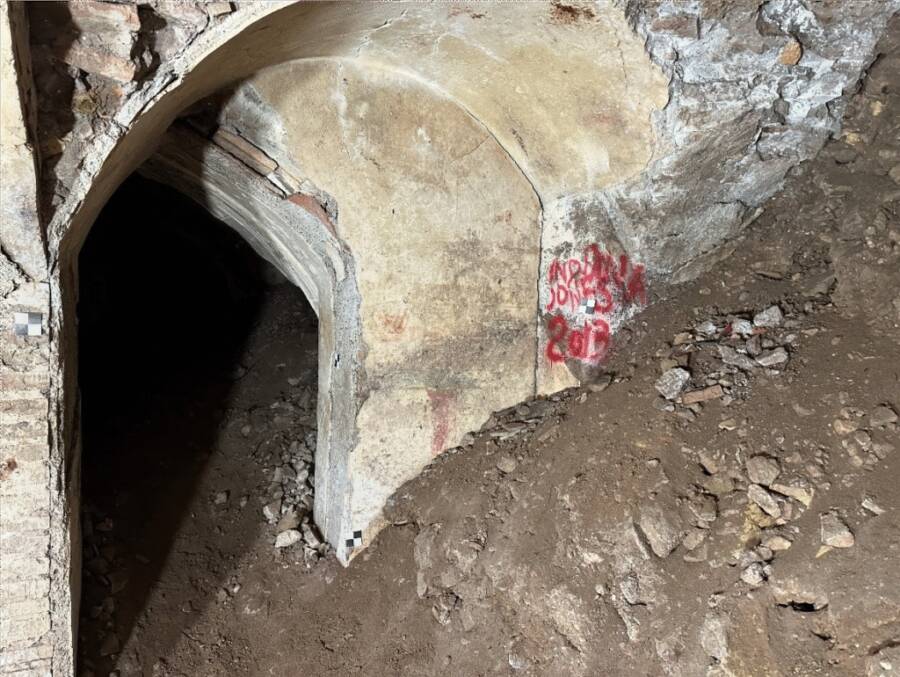
Cantieri NarrantiPrevious explorers of the house, perhaps other high schoolers, had left graffiti on the walls.
But now, following the structure’s first bona fide archaeological excavation, all of its secrets have finally come to light.
The house’s rooms remain well-preserved while its walls and vaulted ceilings still display paintings and elegant stucco decorations, according to a statement from the Special Superintendency of Rome. Archaeologists also discovered a decorative mosaic that features tiles of varying shapes arranged in a particular style that was popular during the mid-second century C.E. Researchers also found art with both floral designs and depictions of several human figures.
At the same time, archaeologists filled 48 crates with artifacts taken from the domus, including an amphora — a jar for storing oil, wine, or grain — and various cups from several historical periods.
Researchers do also have some idea of who this all belonged to.
In fact, during the 1895 discovery of a section of the house, excavators found an inscription on a lead pipe with the names of its residents: L. Fabius Gallus and Umbria Albina. While the history of the Umbrius family is poorly documented, there is evidence linking the family to Samnium, an ancient region of southern Italy not far from Mount Vesuvius.
An Important Discovery In An Historic Roman Neighborhood
The newly-uncovered ancient house is situated within an historically important neighborhood of Rome, one that was both close to the Colosseum and nestled between the elite residential districts Carinae and Esquiline Hill. Known as the Monti district, this neighborhood was home to important ancient Roman figures such as Cicero, Pompey, and Octavian, the leader who defeated Mark Antony.

RIVER OF GOODS Mid-Century Modern Transitional LED Bronze Chrome Ceiling Fan - 52" L x 52" W - Rich Barnwood/Light Driftwood Fan Blades - Metallic Ceiling Fan with Light and Fabric Shade
(as of October 24, 2026 01:02 GMT +00:00 - More infoProduct prices and availability are accurate as of the date/time indicated and are subject to change. Any price and availability information displayed on [relevant Amazon Site(s), as applicable] at the time of purchase will apply to the purchase of this product.)
1MORE Triple Driver In-Ear Headphones - Silver - Wired - Adult - In Ear - 18 grams - 90 days limited warranty
(as of October 24, 2026 01:02 GMT +00:00 - More infoProduct prices and availability are accurate as of the date/time indicated and are subject to change. Any price and availability information displayed on [relevant Amazon Site(s), as applicable] at the time of purchase will apply to the purchase of this product.)
RIVER OF GOODS LED Boho Ceiling Fan with Hand Woven Brown/Natural Rope - Macrame Knot Work and Hemp Rope Style Eclectic Cottage Decor - 52" L x 52" W - Rich Barnwood/Light Driftwood Fan Blades
(as of October 24, 2026 01:02 GMT +00:00 - More infoProduct prices and availability are accurate as of the date/time indicated and are subject to change. Any price and availability information displayed on [relevant Amazon Site(s), as applicable] at the time of purchase will apply to the purchase of this product.)
Fire Blanket - 1500F CE Certified Emergency Fire Blanket for Home & Kitchen | 500GSM Fabric & 0.5mm Thick - 100% Fiberglass Fire Extinguisher for Car,Warehouse Office - 2pc (47x47 inches) by Supa Ant
$53.45 (as of October 24, 2026 01:02 GMT +00:00 - More infoProduct prices and availability are accurate as of the date/time indicated and are subject to change. Any price and availability information displayed on [relevant Amazon Site(s), as applicable] at the time of purchase will apply to the purchase of this product.)