UK Launches Mysterious Washing Machine-Sized Satellite Promising Unseen Military Surveillance Capabilities

So, imagine this: the UK just launched a satellite roughly the size of your average washing machine, but instead of doing laundry, it’s spinning around the Earth at a dizzying 27,000 km/h, giving the military a seriously sharp new set of eyes. Meet Titania—not your grandma’s appliance, but a high-tech space sentinel launched last month to join its predecessor, Tyche, in the UK’s Space Command lineup. Now, if you’re thinking this sounds like sci-fi sprinkled with a touch of Shakespearean drama (hello, Juno and Oberon!), well, welcome to the new space age where the battlefield isn’t just on land or sea, but also way above our heads. This tiny but mighty watcher orbits Earth 16 times daily, helping the UK keep a keen eye on global goings-on, backed by billions of pounds and top-notch tech. And no, it won’t wash your socks, but it just might keep the whole country safer. Curious to know how a satellite-sized washing machine becomes a national guardian?
A new satellite launched has been described as giving the UK a ‘new pair of eyes’, even though the gizmo is about the same size as a washing machine.
While your washing machine can spin laundry around like nobody’s business this thing is military observation satellite called Titania, which will orbit the planet and allow the military to have a clearer picture of what’s going on below.
The probe was launched into space last month on a SpaceX craft and comes two years after a similar decide called Tyche was launched to make up part of the UK’s Space Command.
If this is all sounding a bit sci-fi now it’s just how our technologically advanced day and age goes, you need objects in space and therefore space itself becomes an important arena.
Yet to join the family are Juno and Oberon, making the names a reference to Greek and Roman mythology, as well as the characters of Shakespeare.
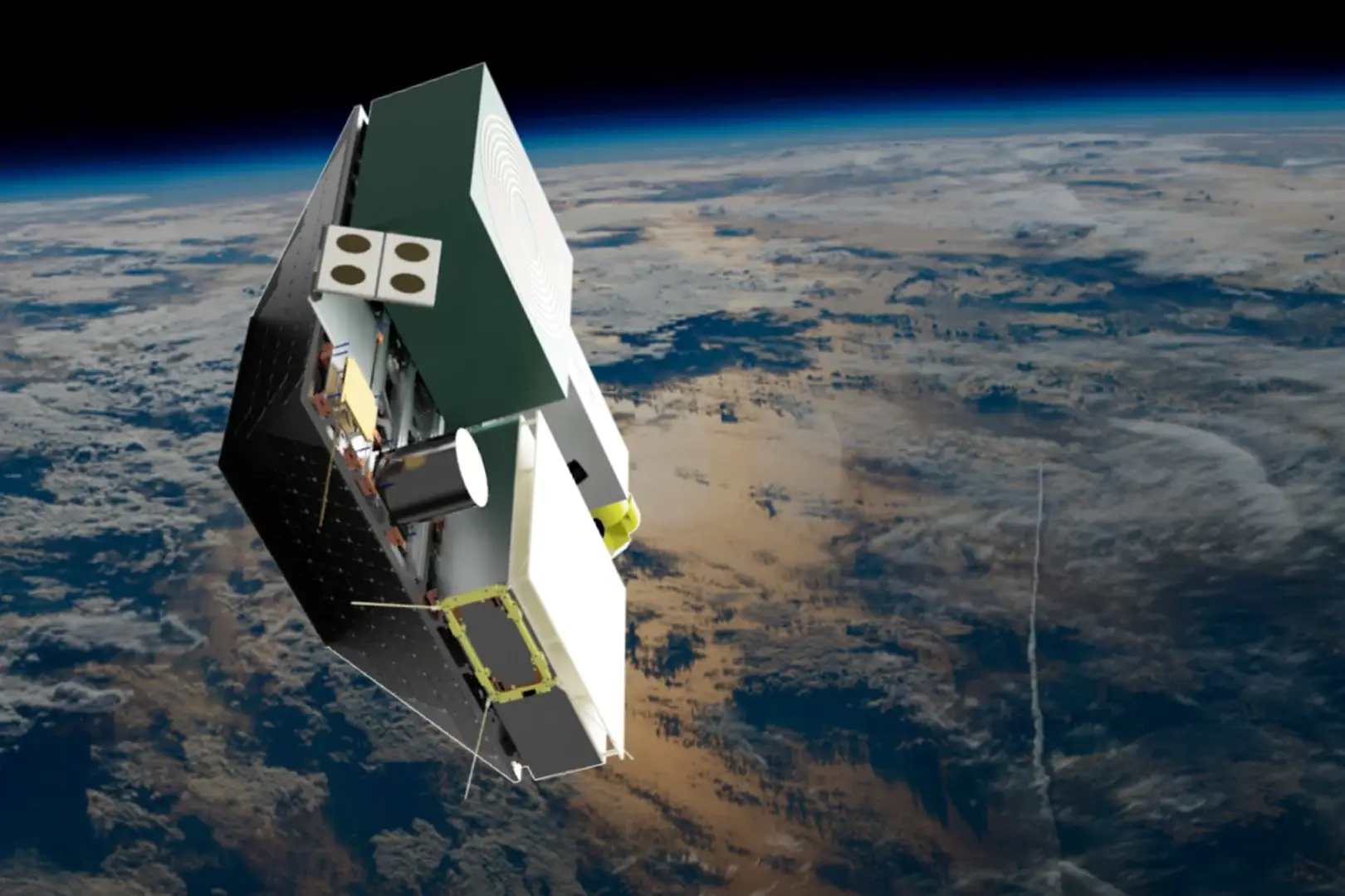
Titania is about the size of a washing machine, and its job is to monitor the Earth (BAE systems/ Ministry of Defence)
Titania will also move a lot faster than your washing machine as well, as it flies at around 27,000km/h and makes it around the Earth about once every 90 minutes.
Travelling around our planet 16 times a day, Titania will observe our planet very often.
Air Chief Marshal Sir Harv Smyth, the Chief of the Air Staff, said: “The ability to observe the Earth from space is critical to both national resilience and military advantage.
“This will be demonstrated by Tyche and Titania, alongside Juno and Oberon in the years ahead.
“We will monitor these vital satellites using state-of-the-art technology around the world, including our Inaros sensors – to ensure our Armed Forces can fight and win wherever they are.”

Air Chief Marshal Sir Harv Smyth says space is a strategically important area (Leon Neal/Getty Images)
Inaros is a project to monitor space from three places on the Earth, and Air Chief Marshal Smyth had previously said that space is ‘a warfighting domain whether we like that or not’.
He has said that part of his job is to ‘disrupt, degrade and deny hostile activity’ even outside the confines of our planet.
Defence Secretary Wes Streeting said: “The new space age is here. Space underpins everything from weather forecasts and financial transactions to sat-navs and mobile phone connections, and it is critical for our national security and military operations.
“Having Titania now in orbit and Project Inaros stepping up how we watch over our satellites means we can see threats sooner, making the UK safer.
“Titania and Inaros are British-built and British-designed, backed by more than £3 billion of investment in space capabilities. That means highly skilled jobs across the UK, a stronger industrial base, and a more secure United Kingdom.”

RIVER OF GOODS Coastal 52 Inch Wooden Bead LED Ceiling Fan, Brown
(as of November 7, 2026 01:07 GMT +00:00 - More infoProduct prices and availability are accurate as of the date/time indicated and are subject to change. Any price and availability information displayed on [relevant Amazon Site(s), as applicable] at the time of purchase will apply to the purchase of this product.)
White Leaf Baby Food Pouches, Toddler Snack, Mango + Carrot + Banana + Pear | 24 Pack, Organic No Added Sugar, Non-GMO, BPA-Free Regeneratively Farmed, Squeeze Puree Smoothie Pouch for Adults & Children
$69.95 (as of November 7, 2026 01:07 GMT +00:00 - More infoProduct prices and availability are accurate as of the date/time indicated and are subject to change. Any price and availability information displayed on [relevant Amazon Site(s), as applicable] at the time of purchase will apply to the purchase of this product.)
Kinsa Smart,Fever, Digital Medical Baby, Kid and Adult Termometro - Accurate, Fast, FDA Cleared Thermometer for Oral, Armpit or Rectal Temperature Reading - QuickCare
$18.94 (as of November 7, 2026 01:07 GMT +00:00 - More infoProduct prices and availability are accurate as of the date/time indicated and are subject to change. Any price and availability information displayed on [relevant Amazon Site(s), as applicable] at the time of purchase will apply to the purchase of this product.)
RIVER OF GOODS Mid-Century Modern Transitional LED Bronze Chrome Ceiling Fan - 52" L x 52" W - Rich Barnwood/Light Driftwood Fan Blades - Metallic Ceiling Fan with Light and Fabric Shade
(as of November 7, 2026 01:07 GMT +00:00 - More infoProduct prices and availability are accurate as of the date/time indicated and are subject to change. Any price and availability information displayed on [relevant Amazon Site(s), as applicable] at the time of purchase will apply to the purchase of this product.)




















Post Comment