Uncovering Stonehenge’s Mysteries: The Astonishing Journey of the Altar Stone Across 450 Miles of Ancient Britain
Ever wonder how ancient folks managed to haul a 13,000-pound slab of rock nearly 450 miles across prehistoric Britain without a single pick-up truck or forklift in sight? Yeah, me neither—until I stumbled upon the saga of Stonehenge’s hefty central altar stone. Picture this: 5,000 years ago, some seriously dedicated builders didn’t just plop down a few rocks—they orchestrated an epic stone migration that baffles modern minds. New research peels back the mystery, showing that this megalith’s journey from Scotland all the way to Salisbury Plain was no happy accident of glaciers but a masterclass in ancient planning, grit, and perhaps a touch of madness. So, how on earth—well, Britain—did they get it done? Let’s dig in and uncover the stone-cold truth behind one of history’s quirkiest feats.
The builders of Stonehenge were able to transport its massive central altar 450 miles across ancient Britain — even though it weighs a whopping 13,000 pounds.

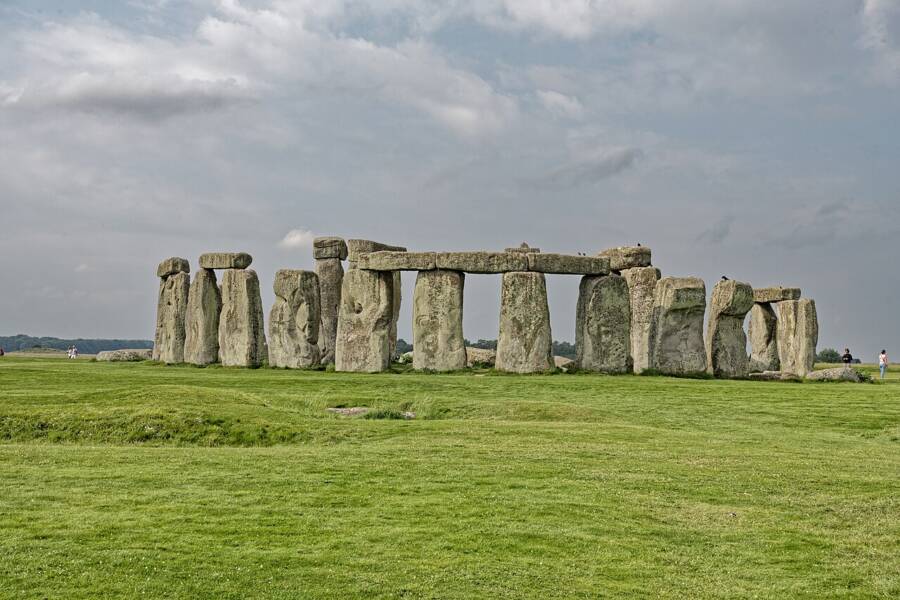
Tilman2007/Wikimedia CommonsThe Stonehenge Altar Stone is located in the middle of the circle.
Some 5,000 years ago, the first stones of Stonehenge were laid down in Salisbury Plain, England.
Since then, it’s become one of the world’s most famous and intriguing prehistoric monuments. But many questions surround Stonehenge to this day, including how it was constructed and how its builders gathered and transported its enormous pieces. Now, a new study has offered answers for at least one part of Stonehenge: its central Altar Stone.
Building on previous research, this new study has offered insights about where exactly the Altar Stone came from, as well as theories about how it was transported some 400 miles to its final resting place.
New Insights About The Stonehenge Altar Stone
As detailed in their new study published in the Journal of Quaternary Science, researchers focused their work on Stonehenge’s Altar Stone, a megalith in the center of the circle that dates to roughly 2600 B.C.E.
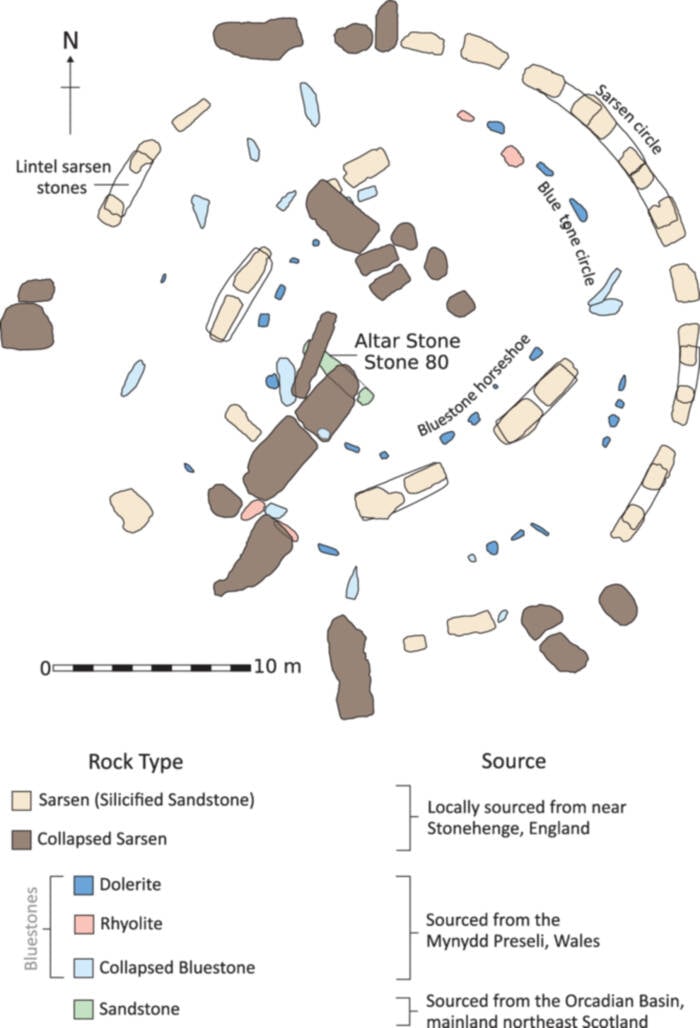
Journal of Quaternary ScienceStonehenge’s Altar Stone, seen in green, is located near the center of the stone circle.
Recent studies have suggested that the Altar Stone originated in Scotland’s Orcadian Basin, located in the northeast corner of the country. By studying zircon minerals in the sandstone, they found that the Altar Stone most closely matches deposits in Caithness, part of the basin’s mainland section. These mineral deposits are located more than 400 miles from Salisbury Plain, meaning that the Altar Stone had to somehow be transported across a great distance.
Given the speculation that glaciers helped move Stonehenge’s stones, the researchers then tried to determine whether glacial movements could have brought the Altar Stone from Caithness to Salisbury Plain. They found that while most glaciers moved towards the northeast, “a localized south-eastward pathway” also flowed toward Dogger Bank in the North Sea.
But even if the Altar Stone was transported via glacier to Dogger Bank, it would still need to travel an additional 250 miles to Stonehenge.
So how did prehistoric people do it?
How Prehistoric People Transported The Altar Stone From Scotland To England
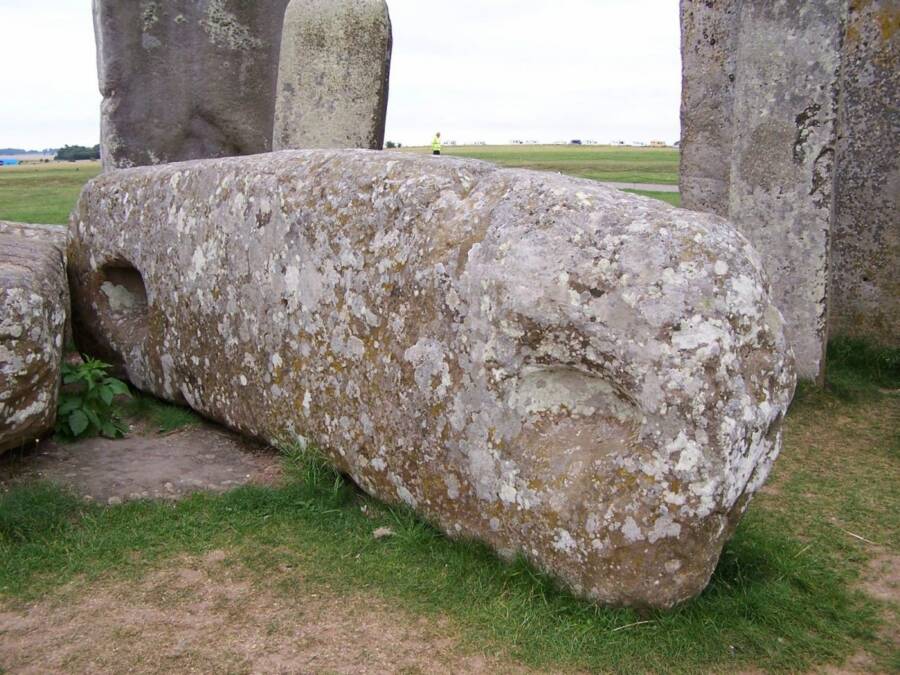
Curtin UniversityA close look at Stonehenge’s Altar Stone, which came from a site in Scotland that’s more than 400 miles away.
As study co-author Anthony Clarke noted in a statement from Curtin University, transporting the Altar Stone would have been no easy task — especially if prehistoric people did it without glacial assistance.
“Rather than being carried naturally by ice, the evidence points to a deliberate, carefully planned movement across a challenging and varied landscape,” he stated. “Our modelling shows glaciers may have transported rocks part of the way during the last Ice Age — potentially as far as Dogger Bank in the North Sea — but not into southern England, meaning the stone would still have needed to be moved hundreds of kilometres by people.”
At this point, the Altar Stone was likely moved “in stages.” Prehistoric people may have used rivers or the sea where possible, and otherwise moved the stone over great stretches of land. Such an enormous undertaking would have almost certainly required planning and coordination.
“Transporting a stone of this size over such a long distance would have required planning, coordination and a deep understanding of the landscape – not to mention tremendous determination,” Clarke remarked.
The study has thus offered new insights about Stonehenge, and demonstrated the potential of computer modeling to answer questions about this famous prehistoric monument. But many questions about Stonehenge — and the Altar Stone itself — still remain.
Further research is needed to determine where exactly in Scotland the Altar Stone came from, and researchers are eager to learn more about which transportation routes prehistoric people may have used to transport it.
Questions like these, especially when approached with modern techniques such as geological analysis and computer modeling, may be answered someday soon. But other parts of Stonehenge’s history remain elusive. Why was the monument built? What purpose did it serve? And who built it? Answers to questions like these may be lost to the ages.

RIVER OF GOODS Coastal 52 Inch Wooden Bead LED Ceiling Fan, Cream
(as of October 24, 2026 01:02 GMT +00:00 - More infoProduct prices and availability are accurate as of the date/time indicated and are subject to change. Any price and availability information displayed on [relevant Amazon Site(s), as applicable] at the time of purchase will apply to the purchase of this product.)
The Door Balancer Eliminates The Need for Door Props, Door Stops and Door Wedges
(as of October 24, 2026 01:02 GMT +00:00 - More infoProduct prices and availability are accurate as of the date/time indicated and are subject to change. Any price and availability information displayed on [relevant Amazon Site(s), as applicable] at the time of purchase will apply to the purchase of this product.)
Joking Hazard Enlarged Box Empty Box for Card Storage
$12.00 (as of October 24, 2026 01:02 GMT +00:00 - More infoProduct prices and availability are accurate as of the date/time indicated and are subject to change. Any price and availability information displayed on [relevant Amazon Site(s), as applicable] at the time of purchase will apply to the purchase of this product.)
RIVER OF GOODS Mid-Century Modern Transitional LED Bronze Chrome Ceiling Fan - 52" L x 52" W - Rich Barnwood/Light Driftwood Fan Blades - Metallic Ceiling Fan with Light and Fabric Shade
(as of October 24, 2026 01:02 GMT +00:00 - More infoProduct prices and availability are accurate as of the date/time indicated and are subject to change. Any price and availability information displayed on [relevant Amazon Site(s), as applicable] at the time of purchase will apply to the purchase of this product.)