Uncovering the Deadly Oversight: The Untold Story Behind the 1981 Hyatt Regency Collapse
Ever wonder how something as tiny as a change in a steel rod design could spiral into one of the deadliest structural disasters in American history? I mean, here’s this hotel lobby in Kansas City, buzzing with more than 1,600 guests, when bam! Two walkways, hanging high, decide to take a dive — and not just a little stumble, but a catastrophic collapse that crushed 114 lives and shattered over 200 more. It wasn’t a terrorist attack or a natural disaster but a simple engineering slip-up that trickled through the cracks — a small tweak that wasn’t double-checked, signed off on too quickly, and left unchecked by the people who should’ve known better. Imagine the chilling thought: could a forgotten calculation or a missed notation silently bear the weight of tragedy? This story isn’t just about a collapse; it’s a spine-tingling lesson in responsibility, human error, and ethics that still echoes through engineering classrooms today. Ready for the full scoop on how a single design change turned an ordinary evening into a nightmare? LEARN MORE
The walkway collapse at the Hyatt Regency in Kansas City, Missouri, in July 1981 was one of the deadliest structural failures in American history.

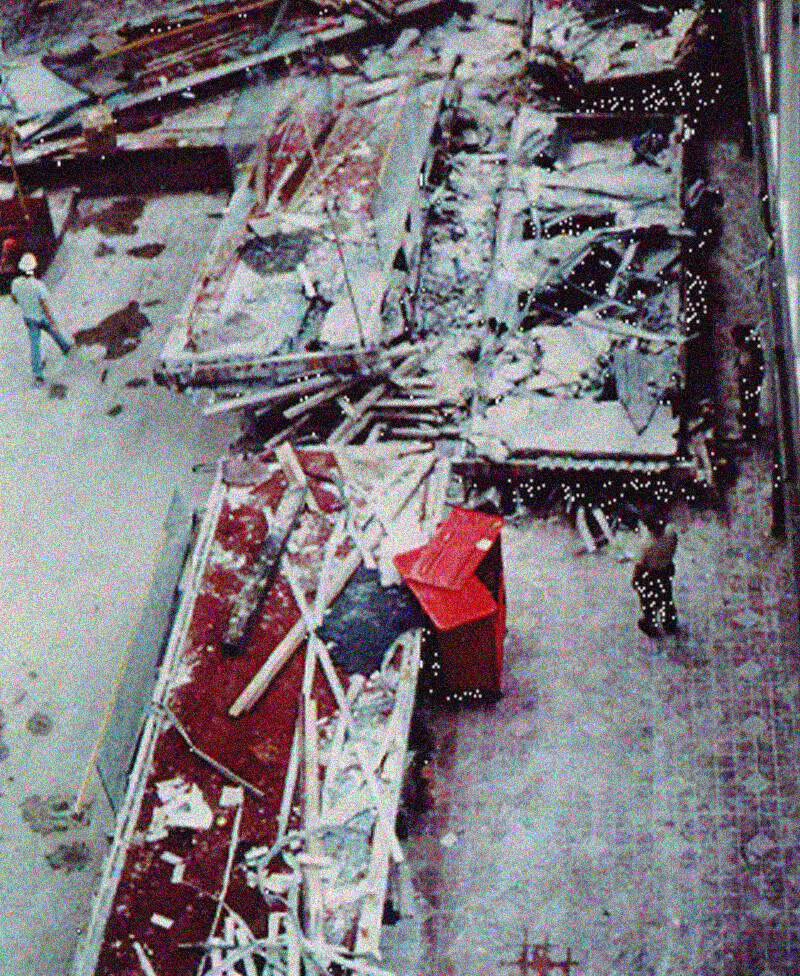
Dr. Lee Lowery Jr./Wikimedia CommonsAn aerial view showing the aftermath of the walkway collapse at the Hyatt Regency.
There’s a particular kind of horror in disasters caused by something small. Not a bomb, not a huge natural disaster, not overwhelming negligence, but a hasty decision with no follow-up from the experts who should have known better.
In an animated recreation with more than 106,000 views, content creator @plottwistdaily46 walked through what happened when two suspended walkways with a design flaw gave out at a hotel in Kansas City, killing 114 innocent people in 1981.
“One Engineering Mistake Killed 114 People,” the text overlay reads.
The Hyatt Regency Disaster Of 1981
On July 17, 1981, the Hyatt Regency Hotel in Kansas City, Missouri, opened its lobby for a tea dance, a popular event held in the hotel’s multi-story atrium.
Hundreds of people gathered that night, dancing and watching the crowds below from the suspended walkways that connected the hotel’s two wings on the second and fourth floors. More than 1,600 guests had packed into the atrium by 7:05 p.m. Roughly 40 of them were standing on the second-floor walkway, while 20 more lingered on the fourth-floor bridge. Then, without warning, the upper walkway gave out.
It fell directly onto the second-floor bridge beneath it. Both of them then came down on top of the crowd in the lobby.
The collapse killed 114 people and injured more than 200. It remains one of the deadliest structural failures in U.S. history. But what caused it?
The Mistake That Caused The Walkway Collapse
According to a 2007 report by the American Society of Civil Engineers (ASCE), the original hotel design had called for both walkways to hang from a single, continuous set of steel rods running from the atrium roof, through the fourth-floor walkway, and down to the second-floor walkway. Each walkway would have its own dedicated connection point.
But the steel fabricator found the original design impractical to construct and proposed a change. Instead of one continuous rod, they wanted to use two separate sets. One would connect the roof to the fourth-floor walkway, and the second would connect the fourth-floor walkway to the second-floor bridge.
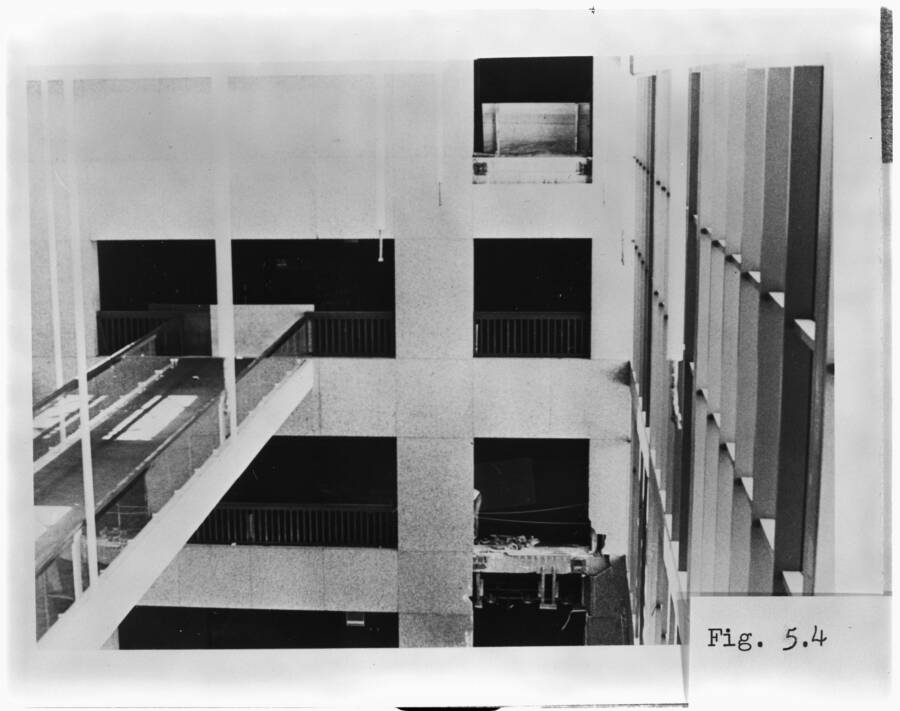
Public DomainThe empty spaces where the walkways once connected on the second and fourth floors of the hotel.
The fabricator called the structural engineer’s office and got verbal approval, with the understanding that a formal written request would follow. But it never did.
That change meant the fourth-floor walkway’s connection now had to support the weight of both walkways instead of just its own, doubling the load it was built to carry. The resulting design could withstand only about 30 percent of Kansas City’s mandated minimum load requirement.
Per the ASCE’s account, the fabricator’s detailer assumed the connection had already been engineered and never ran the calculations himself. The drawings came back to the structural engineer’s office for expedited approval, and a technician reviewed them. However, the connection details weren’t fully drawn out, so no calculations were checked there, either.
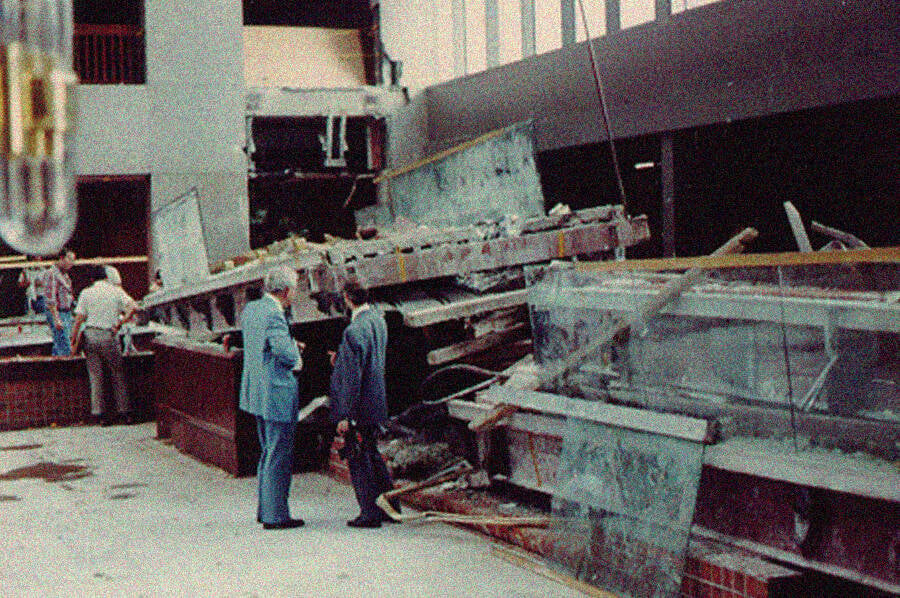
Dr. Lee Lowery Jr./Wikimedia CommonTwo men assess the damage in the aftermath of the walkway collapse.
The engineer of record performed spot checks on parts of the shop drawings, then signed off and stamped his professional seal on the whole project.
That seal was the crux of the ethics case that followed. The ASCE’s Committee on Professional Conduct found that the engineer’s seal made him responsible for the entire structural design, whether or not he personally calculated every connection. The committee initially recommended he be expelled from the society entirely. The ASCE’s Board of Direction settled on something less severe, ruling he’d been “vicariously responsible” for the disaster but not guilty of gross negligence, and suspended him for three years.

Skater Trainer Wheels - Beginners get Skateboard Tricks Fast, Safe and Fun | Viral accessory gift - Helps beginners stay excited about their new skateboard - Kids & parents love these
$25.95 (as of October 18, 2026 01:00 GMT +00:00 - More infoProduct prices and availability are accurate as of the date/time indicated and are subject to change. Any price and availability information displayed on [relevant Amazon Site(s), as applicable] at the time of purchase will apply to the purchase of this product.)
RIVER OF GOODS Coastal 52 Inch Wooden Bead LED Ceiling Fan, Cream
(as of October 18, 2026 01:00 GMT +00:00 - More infoProduct prices and availability are accurate as of the date/time indicated and are subject to change. Any price and availability information displayed on [relevant Amazon Site(s), as applicable] at the time of purchase will apply to the purchase of this product.)
Supa Ant 6x8ft. Welding Blanket Fireproof (Pack of 2) - Heavy Duty Weld Fire Blanket Tools - Welders Cover for Men Curtain with Gloves - Large Welding Gear for Welder Accessories
(as of October 18, 2026 01:00 GMT +00:00 - More infoProduct prices and availability are accurate as of the date/time indicated and are subject to change. Any price and availability information displayed on [relevant Amazon Site(s), as applicable] at the time of purchase will apply to the purchase of this product.)
RIVER OF GOODS Coastal 52 Inch Wooden Bead LED Ceiling Fan, Brown
(as of October 18, 2026 01:00 GMT +00:00 - More infoProduct prices and availability are accurate as of the date/time indicated and are subject to change. Any price and availability information displayed on [relevant Amazon Site(s), as applicable] at the time of purchase will apply to the purchase of this product.)