Unearthing Secrets: Roman-Era Pottery, Coins, and Infant Burials Discovered Beneath New Cricket Ground in England
Ever stumble upon a story so bizarre it makes you wonder if history was just messing with us? Picture this: a nine-month-old infant tucked inside an upside-down pot, buried deep in the English earth, accompanied by a chicken. Yep, you read that right—a chicken, like some ancient takeout for the afterlife! Nestled beneath a cricket pitch in Wendover, England, archaeologists have unearthed a trove of Roman-era relics that don’t just whisper but shout secrets from two thousand years ago. From coins jingling with commerce to peculiar burial customs that challenge everything we thought we knew about Roman Britain, this discovery stretches from the ordinary to the utterly extraordinary. Could this quirky infant burial hint at a forgotten cultural mashup or simply a poignant tale lost to time? Dive in, because this isn’t your typical dig—it’s a remarkable peek into ancient lives, death rituals, and maybe even a chicken dinner for the ages! LEARN MORE
The most unusual burial belonged to a nine-month-old who was interred inside a pot that was placed into the earth upside-down — along with a chicken as a funerary offering.

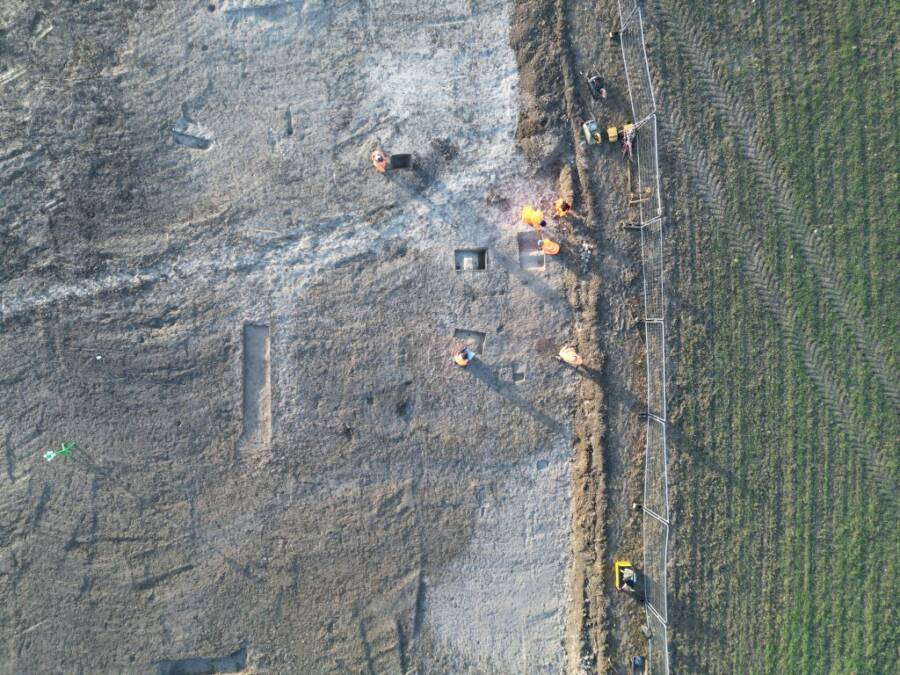
Cotswold ArchaeologyArchaeologists discovered evidence of a Roman settlement in Wendover, England that spanned some four centuries.
About 40 miles northwest of London, a cricket club in the small town of Wendover recently experienced some excitement that had nothing to do with the sport. Instead, what put Wendover on the map was the discovery of an enormous trove of Roman-era artifacts and burials just below the cricket grounds.
Archaeologists found dozens of evocative relics of Roman life dating from the first through the fourth centuries C.E. These finds, which span from coins to pottery to human burials, shed light on the everyday lives and funerary customs in Roman Britain some two millennia ago.
The Wealth Of Roman Artifacts Found During Cricket Ground Construction In Wendover
No other evidence of a Roman settlement had previously been identified near this site, save for an ancient cemetery that’d been unearthed around a mile to the northeast, according to a statement from Cotswold Archaeology, which began conducting the excavations here in 2024.
The newly-found artifacts, however, definitively confirm that a Roman settlement once stood in this area, existing during roughly the first four centuries C.E.

Cotswold ArchaeologyResearchers found the handle of a pocketknife with holes allowing it to hang off its owner’s belt.
These finds included pottery, coins, tools, and construction materials such as tile, bricks, and plaster. Archaeologists uncovered cooking and storage jars, drinking beakers, bowls, dishes, and mortaria, which are similar to mortars and pestles.
Researchers also discovered other household items like millstones and querns, likely used to make flour. Elsewhere, archaeologists unearthed what’s believed to be a handle for a folding pocketknife that’s made from antler and features two holes allowing it to hang from its owner’s belt.
Coins, meanwhile, were the most abundant type of discovery at Wendover, with the team recovering a whopping 54 coins from just one section of the site. These coins span from the mid-second to the late fourth centuries C.E., and were mostly made from a copper alloy.

Cotswold ArchaeologyArchaeologists discovered an infant who was buried inside a pottery vessel, with a hen and a songbird placed on top as votive offerings.
In addition to the many relics, archaeologists also discovered nine Roman-era burials, five of which were inhumation burials of young children and infants. Some of the remains were cremated and placed in jars, and many of the graves included grave goods like small cups.
The most unusual burial — and a possible first for England — was that of a nine-month-old infant whose body was put inside a pot, with a hen and a songbird placed on top, then turned upside down and buried. This unique burial likely dates back to somewhere between the third and fourth centuries C.E.
What These Discoveries Reveal About Daily Life And Death In Roman Britain
The wide range of finds opens a window into the history of the Roman settlement that occupied this area for four centuries.
For instance, researchers were able to trace the origins of much of the pottery found at the site. While a large amount of it was likely made locally, pottery from kilns at Oxford, St. Albans, Buckinghamshire, and Bedfordshire were also recovered. Some of the pottery was even imported from Spain and Gaul (modern-day France), pointing to the international network of commerce to which Roman Britain belonged in the early centuries C.E.

Cotswold ArchaeologyResearchers found 54 Roman coins, many of them from the third and fourth centuries C.E.
The large number of coins excavated here likewise suggests that this location must have been economically well-connected and commercially active for many decades on end. These coins may also shed light on when this site was finally abandoned.
Most of the coins came from the fourth century, with the most recent of them dated to around 383-388 C.E., which might have been when the settlement fell dormant.

Fire Blanket - 1500F CE Certified Emergency Fire Blanket for Home & Kitchen | 500GSM Fabric & 0.5mm Thick - 100% Fiberglass Fire Extinguisher for Car,Warehouse Office - 5pc (40"x40") by Supa Ant
$79.01 (as of November 25, 2026 01:17 GMT +00:00 - More infoProduct prices and availability are accurate as of the date/time indicated and are subject to change. Any price and availability information displayed on [relevant Amazon Site(s), as applicable] at the time of purchase will apply to the purchase of this product.)
RIVER OF GOODS LED Boho Ceiling Fan with Hand Woven Brown/Natural Rope - Macrame Knot Work and Hemp Rope Style Eclectic Cottage Decor - 52" L x 52" W - Rich Barnwood/Light Driftwood Fan Blades
(as of November 25, 2026 01:17 GMT +00:00 - More infoProduct prices and availability are accurate as of the date/time indicated and are subject to change. Any price and availability information displayed on [relevant Amazon Site(s), as applicable] at the time of purchase will apply to the purchase of this product.)
Skater Trainer Wheels - Beginners get Skateboard Tricks Fast, Safe and Fun | Viral accessory gift - Helps beginners stay excited about their new skateboard - Kids & parents love these
(as of November 25, 2026 01:17 GMT +00:00 - More infoProduct prices and availability are accurate as of the date/time indicated and are subject to change. Any price and availability information displayed on [relevant Amazon Site(s), as applicable] at the time of purchase will apply to the purchase of this product.)
Joking Hazard Enlarged Box Empty Box for Card Storage
$12.00 (as of November 25, 2026 01:17 GMT +00:00 - More infoProduct prices and availability are accurate as of the date/time indicated and are subject to change. Any price and availability information displayed on [relevant Amazon Site(s), as applicable] at the time of purchase will apply to the purchase of this product.)





















Post Comment