Hidden for Millennia: Turkey’s Newly Discovered Cave Reveals Over 100 Mysterious Prehistoric Paintings
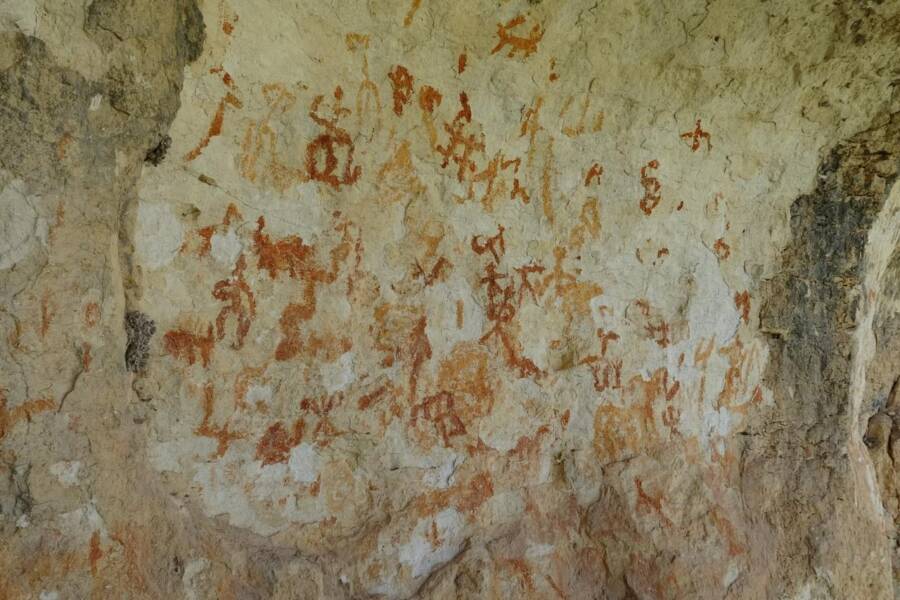
So, imagine stumbling upon a cave wall plastered with red paintings that have been accumulating over—get this—thousands of years . Humanoids, animals, and trippy geometric patterns all jumbled up in eastern Turkey’s Tohma Canyon, like some prehistoric art gallery no one knew existed until now. It makes you wonder: what were these Neolithic folks thinking? Was it just decoration, or a desperate attempt to leave a cosmic “Hey, we were here!” message scribbled in ochre? The sheer volume—nearly 100 different figures—makes this place a goldmine for piecing together the bizarre tapestry of early human life. And yeah, the handprints? They might just be ancient mic drops against the inevitability of mortality. This discovery isn’t just about old paint on rocks; it’s a direct line to the minds of people long gone, showing us how they saw the world—and maybe, how very little we’ve changed. Crazy to think, right?
Created over the course of hundreds of years starting untold millennia ago, these paintings appear to depict both humanoid and animal-like figures alongside geometric patterns.

IHA PhotoRoughly 100 prehistoric paintings made with red pigment were found inside a cave system in eastern Turkey’s Tohma Canyon region.
Archaeologists just found what could be one of the most extensive cave painting discoveries ever made in Anatolia, the storied region of Turkey that played a pivotal role in humankind’s prehistoric past.
The three-cave system found by researchers in Tohma Canyon is covered in red paintings of figures, both human and animal in appearance. These symbolic paintings could shed light on the lifestyles and beliefs of Neolithic humans in what’s now eastern Turkey.
The Neolithic Cave Paintings Of Animal And Human Figures Found In Eastern Turkey
The discovery was made by a team of researchers led by Levent İskenderoğlu of İnönü University. The team had been doing fieldwork in the area with the goal of documenting the region, which had not been thoroughly examined in the past.

IHA PhotoThe researchers tentatively dated the cave art to the Neolithic period.
Tohma Canyon lies in the eastern Turkish district of Malatya. River valleys and steep rock canyons have long characterized the region and shaped the lives of the people that have settled there.
Along the walls of the newly-uncovered three-cave system, the team found nearly 100 humanoid and animal-like figures, as well as geometric lines and shapes, all of them created with a red ochre paint.
İskenderoğlu said that the paintings were likely done with fingers, and that the styles and paints in question suggest that these works were created over the course of hundreds, if not thousands, of years, according to a report from Türkiye Today.
“Upon closer inspection, we see stylistic changes in places, and differences in paint and pigment texture indicating older and newer periods. This suggests that the area may have been used for thousands of years. This could be a dreamlike place where people repeatedly visited in different periods, attributing symbolic meaning to it,” İskenderoğlu said in a statement from İnönü University.

IHA PhotoThe paintings featured geometric shapes alongside the many humanoid and animal-like figures.
With all that in mind, it’s difficult for the team to date the cave art to a specific period, but they’ve tentatively settled on the Neolithic era as their estimate. While the wider region has produced evidence of human life dating back to the Paleolithic period of hunter-gatherers, initial assessments of the paint point to the slightly more recent Neolithic age. İskenderoğlu said that definitive results for dating the cave art will be possible after carbon-14 and Uranium-Thorium (U-Th) analyses are complete.
In addition to the geometric shapes and natural figures, the team found handprints on the wall, a discovery that may be the most interesting of all. This is because the handprints could provide insight into the intent behind these dozens of cave paintings.
“We interpreted them as a form of resistance against mortality. It’s possible that humans wanted to leave a trace of themselves by marking their hands there,” İskenderoğlu said.
However, there’s likely even more to the story behind this stunning find.
What This Discovery Could Reveal About Life In Prehistoric Anatolia
Naturally, the paintings offer a unique window into the lives of the people who made them. For instance, the paintings appear to depict both wild and domestic animals together among the human figures, suggestive of the transition to settled, agricultural life during the Neolithic era.
These paintings, when compared with those found elsewhere, could also prove crucial to understanding how life in prehistoric Anatolian was different from life in prehistoric Europe. For one, prehistoric cave paintings found in Europe tend to include more naturalistic or realistic figures, while the recent find in Anatolia involves more symbolic representations.

IHA PhotoResearchers described this find as one of the most densely-painted caves ever discovered in Anatolia.
The team has also compared this recent discovery to other painted caves and rock art in Anatolia itself, such as the examples found in Beldibi, Latmos, and the Doğu Sandal Cave in Mersin. While these finds are also valuable, İskenderoğlu said that the number of figures found at Tohma Canyon and their use of symbolism makes this find one of the most important cave art discoveries ever made in Anatolia.
Supa Ant Fire Blanket -Certified 1200F Extra Thick, Glow in The Dark | Glow in The Dark Emergency Supplies 500gsm, 0.5mm Thick Wearable Fire Blankets for Home. Emergency Blanket with Cape & Hood
$83.99 (as of September 21, 2026 00:45 GMT +00:00 - More infoProduct prices and availability are accurate as of the date/time indicated and are subject to change. Any price and availability information displayed on [relevant Amazon Site(s), as applicable] at the time of purchase will apply to the purchase of this product.)
Fire Blanket -Certified 1500F Extra Thick, Glow In The Dark Fireproof Emergency Supplies. 500gsm, 0.5mm Thick Fire Blankets Emergency For Home. 1pc Fire Safety Emergency Blanket 74"x74" By Supa Ant
$50.00 (as of September 21, 2026 00:45 GMT +00:00 - More infoProduct prices and availability are accurate as of the date/time indicated and are subject to change. Any price and availability information displayed on [relevant Amazon Site(s), as applicable] at the time of purchase will apply to the purchase of this product.)
KiddyCare Diaper Caddy Organizer for Baby Nursery Basket with Handle Lid Nursing Caddy with Changing Table Organizer Cart Newborn Caddy Rosy (Floral Print) X-Large
$16.50 (as of September 21, 2026 00:45 GMT +00:00 - More infoProduct prices and availability are accurate as of the date/time indicated and are subject to change. Any price and availability information displayed on [relevant Amazon Site(s), as applicable] at the time of purchase will apply to the purchase of this product.)
Rhythm Superfoods Kale Chips, Zesty Nacho, Organic and Non-GMO, 2.0 Oz (Pack of 4), Vegan/Gluten-Free Superfood Snacks
(as of September 21, 2026 00:45 GMT +00:00 - More infoProduct prices and availability are accurate as of the date/time indicated and are subject to change. Any price and availability information displayed on [relevant Amazon Site(s), as applicable] at the time of purchase will apply to the purchase of this product.)