Ancient Mystery Erased: Border Wall Bulldozes Carving Predating the Pyramids in Arizona
Imagine you’re strolling through Arizona’s sunbaked Sonoran Desert when suddenly, a giant 272-foot fish—etched into the earth more than 6,500 years ago—gets a brutal 50-foot gash torn right through it. Yup, you read that right. This ancient marvel, known as the Las Playas Intaglio, crafted by the Tohono O’odham people and older than both Stonehenge and the pyramids of Egypt, was carelessly slashed by heavy machinery constructing the Trump administration’s border wall expansion. Now, here’s the kicker—local Indigenous leaders warned contractors to steer clear, but the sacred site was bulldozed anyway. Makes you wonder: how does something that’s survived millennia fall victim to a construction crew’s bulldozer? Let’s dive into the story of history meeting havoc in one of America’s most desolate places.
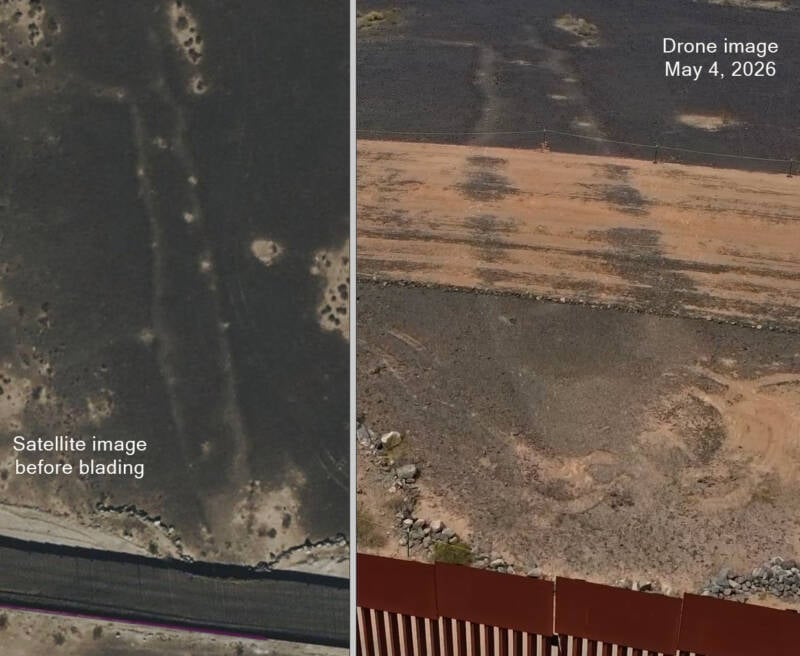
In April 2026, heavy machinery working in Arizona’s Sonoran Desert tore a 50-foot swath through the Las Playas Intaglio, a giant fish that was carved into the earth by the Tohono O’odham people at least 6,500 years ago.

Russ McSpadden/Center for Biological DiversityResearchers initially believed that the carving that was damaged by border wall construction was 1,000 years old, but they’ve since learned that it is in fact closer to 6,500 years old.
For thousands of years, an enormous fish-shaped ground carving has sat in the Sonoran Desert of Arizona, stretching 272 feet across. Researchers initially believed that this sacred Indigenous art, known as the Las Playas Intaglio, only dated back 1,000 years. However, experts recently discovered that it’s actually more than 6,500 years old, making it older than both Stonehenge and the pyramids of Egypt.
But in April 2026, construction workers building the Trump administration’s second border wall in Arizona drove equipment through the geoglyph, leaving behind a devastating 50-foot gash.
The Destruction Of The Las Playas Intaglio, The Oldest-Known Geoglyph In The Americas
As described in a new article published in The SAA Archaeological Record, researchers who studied rock samples extracted from the site determined that the ancient carving is around 7,000 years old.
Researchers dated the samples by analyzing the rocks’ natural “varnish” layers that form over time on the surface, thus indicating how long the rock has been exposed to air.

Russ McSpadden/Center for Biological DiversityLocal tribal representatives had previously told contractors that the land in question was sacred and had asked that they avoid it — but to no avail.
The resulting age estimate makes this carving the oldest-known geoglyph in the Americas.
Study authors David Whitley and Ronald Dorn wrote that the intaglios that archaeologists have found in Arizona — geoglyphs specifically etched into desert floors — were part of religious rituals for these ancient Indigenous populations.
The carving lies on the ancestral lands of the Tohono O’odham tribe, and is protected within the Cabeza Prieta National Wildlife Refuge in Arizona, which contains more than 800,000 acres of wilderness and hiking trails.

Russ McSpadden/Center for Biological DiversityAdvocates are concerned about the lack of care and caution among contractors building the border wall.
“The wildlife refuge itself is a gem of the Sonoran Desert,” Russ McSpadden, a southwest conservation advocate at the Center for Biological Diversity, the organization that documented the carving’s destruction, told Outside. “Before the border wall, it connected to this larger protected desert landscape, which is the El Pinacate and Gran Desierto de Altar Biosphere Reserve in Mexico. And that connected to the Organ Pipe Cactus National Monument.”
The Consequences Of Damaging This 6,500-Year-Old Indigenous Carving In The Sonoran Desert
According to the statement put out by the Center for Biological Diversity in April, contractors clearing the way for a second wall along the Arizona-Mexico border put a 50-foot scrape through the ancient carving.
Along with other conservation advocates, McSpadden is concerned about what the destruction of the Las Playas Intaglio means for future protection of public lands and sacred Indigenous sites.

Russ McSpadden/Center for Biological DiversityContractors tore a 50-foot gash through this stunning piece of ancient Indigenous artwork.
“They just ran right through the fish, basically severing its head from its body,” McSpadden told Outside. “About 30 percent of it was damaged. The fish was decapitated. This is a slap in the face to our shared human history.”
According to a Tuscon Sentinel report from May, Tohono O’odham leaders said that “the site was desecrated despite the fact that it previously had been identified by a cultural protection monitor as a site for the contractor to avoid.”
It is nevertheless unclear how much contractors knew about the exact location of the intaglio beforehand.
A spokesperson for U.S. Customs and Border Protection told Outside that the agency “secured the remaining portion of the site, and it is being protected in place.”

RIVER OF GOODS Stained Glass Magna Carta LED Ceiling Fan - 52" L x 52" W - Tiffany Style - Flush Mount Ceiling Fan with Remote - Teal
(as of October 16, 2026 01:00 GMT +00:00 - More infoProduct prices and availability are accurate as of the date/time indicated and are subject to change. Any price and availability information displayed on [relevant Amazon Site(s), as applicable] at the time of purchase will apply to the purchase of this product.)
Supa Ant Canning Supplies Starter Kit (Food Grade) - Canning Kits Set for Beginners - 3 Pcs. Including Wide Mouth Jar Funnel, Magnetic Lid Lifter, Stainless Steel Jar Lifter (Assembled in USA) Blue
$9.99 (as of October 16, 2026 01:00 GMT +00:00 - More infoProduct prices and availability are accurate as of the date/time indicated and are subject to change. Any price and availability information displayed on [relevant Amazon Site(s), as applicable] at the time of purchase will apply to the purchase of this product.)
RIVER OF GOODS Mid-Century Modern Transitional LED Bronze Chrome Ceiling Fan - 52" L x 52" W - Rich Barnwood/Light Driftwood Fan Blades - Metallic Ceiling Fan with Light and Fabric Shade
(as of October 16, 2026 01:00 GMT +00:00 - More infoProduct prices and availability are accurate as of the date/time indicated and are subject to change. Any price and availability information displayed on [relevant Amazon Site(s), as applicable] at the time of purchase will apply to the purchase of this product.)
Rhythm Superfoods Kale Chips, Zesty Nacho, Organic and Non-GMO, 2.0 Oz (Pack of 4), Vegan/Gluten-Free Superfood Snacks
(as of October 16, 2026 01:00 GMT +00:00 - More infoProduct prices and availability are accurate as of the date/time indicated and are subject to change. Any price and availability information displayed on [relevant Amazon Site(s), as applicable] at the time of purchase will apply to the purchase of this product.)




















Post Comment