Hidden for Centuries: Mysterious Roman Temple of the God of War Unearthed in Central Germany’s Mountain Forests
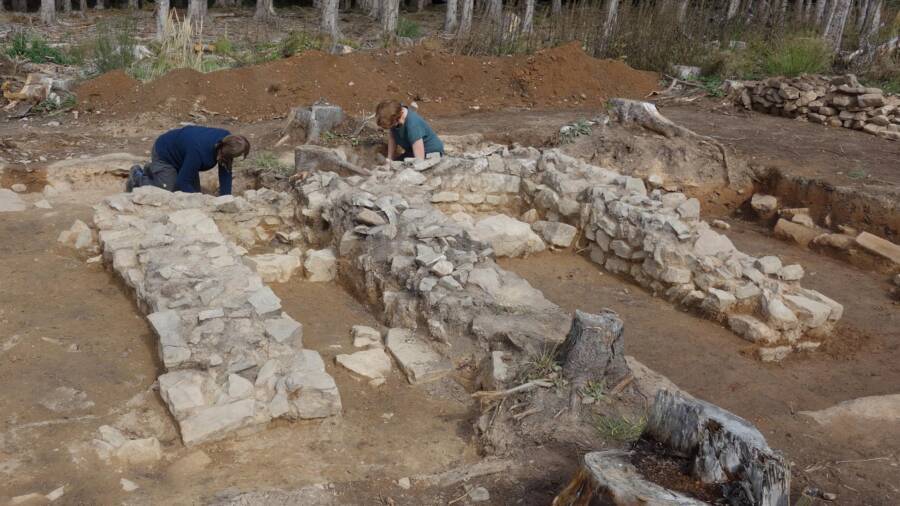
Imagine stumbling upon a massive Roman temple—16 feet long with stone walls thicker than a wrestling champion’s biceps—buried just inches beneath your feet for nearly two thousand years, quietly hiding from the world’s prying eyes. Sounds like a plot straight out of an Indiana Jones flick, right? Well, in the dense forests of Germany’s Taunus Mountains, archaeologists did just that: uncovered an ancient sanctuary dedicated to Mars, the Roman god of war. But here’s the kicker—this wasn’t just an isolated relic; it’s a treasure trove shedding light on the daily hustle, spiritual vibes, and defensive strategies of a Roman border settlement long forgotten. So, what secrets did this hidden site reveal? And how did a structure this monumental stay under wraps for so long? Buckle up—this discovery is like history’s best-kept playlist finally hitting shuffle.
Measuring 16 feet in length and featuring stone walls that are more than a foot and a half thick, this site went undiscovered for nearly two millennia while sitting only a few inches beneath the surface.

Thomas Kurella/hrArchaeologists uncovered a Roman temple dedicated to Mars, the god of war, in a German forest.
In the forests of Germany’s Taunus Mountains, near the modern-day town of Rosbach vor der Höhe, archaeologists recently found the remnants of a Roman temple dedicated to Mars, god of war. Within, they recovered a number of astonishing artifacts, including a small bronze statuette of the goddess Victoria as well as two votive stones.
Although archaeologists had long been excavating the nearby Roman fort of Kapersburg, the surrounding vicus, or civilian settlement, had remained a mystery. But now, archaeologists believe these new discoveries will shed valuable light on how Romans in the area lived, worshipped, and defended their borders some two millennia ago.
The Discovery Of A Roman Temple Dedicated To Mars In The Mountain Forests Of Central Germany
The discoveries, announced by the Hessian Archaeology Department, come from excavations of the Kapersburg vicus that have been ongoing since 2024.

Landesamt für Denkmalpflege Hessen (LfDH)The temple was found among ancient ruins located near the Roman military fort known as Kapersburg.
During the Roman era, Kapersburg was part of the Upper German-Raetian Limes, the defensive system that secured the Roman territory north of the Alps. For around 150 years, the Roman auxiliary unit known as Numerus Nidensium was stationed at this fort. This site is widely considered to be one of the most well-preserved ever found in this region of the Limes.
“Here we have layers of preservation that are unparalleled in Hesse, precisely because no agriculture has taken place here,” said Dr. Kai Mückenberger, an archaeologist who led the excavation.
The fort has been studied since the late 1800s, most significantly during excavations led by Louis Jacobi and the Imperial Limes Commission.
The civilian settlement attached to the fort, however, has remained less understood. Now, during these recent excavations, archaeologists believe they can finally shed more light on what life was like in the nearby vicus.

Lars Görze MA, LfDHThe temple likely had an ambulatory, or covered walkway, but much about its design remains unknown.
Among the most important finds, archaeologists identified a rectangle, about 16 feet long, right under the forest floor. In the middle of the structure were well-preserved walls, about a foot and a half thick, forming a small square.
Soon enough, the team realized that they had stumbled upon a temple.
“We were absolutely thrilled,” archaeologist Katharina Grießhaber told the local German news site hessenschau. “Finding such beautiful Roman walls is a real highlight.”
The archaeologists said they could not find a fourth wall that would have enclosed this prayer room, indicating that one side of it was left open, or was perhaps walled off with a wooden gate instead.
Additionally, the strong foundation surrounding the outer structure of the temple suggests that it may have also had an ambulatory, or covered walkway.

Lars Görze MA, LfDHResearchers discovered a statuette of Victoria, the Roman personification of victory.
Buried near the remnants of the temple, archaeologists also found the remains of a statue that likely depicts Mars, votive stones, and a statuette of Victoria, the Roman personification of victory.
The statuette has features commonly associated with Victoria: wings, a palm branch, and a victory laurel.
Grießhaber said that settlers of Kapersburg likely went to the temple to offer sacrifices to these gods in exchange for protection or counsel.
What This Find Reveals About Life In Ancient Kapersburg
In addition to the religious finds, archaeologists uncovered extensive remnants of craft production, including a smithy, or blacksmith workshop. Researchers believe these workspaces were later replaced with residential buildings.

Lars Görze MA, LfDHA Late Antique brooch found at the site suggests that other groups occupied the settlement after the Romans left.
Archaeologists also found remains of Roman roads, which have helped them reconstruct the organization of the civilian settlement. In all, these findings have shown archaeologists that the vicus was not just an attachment to Kapersburg, but a complex settlement with its own economic vitality.

RIVER OF GOODS Stained Glass Magna Carta LED Ceiling Fan - 52" L x 52" W - Tiffany Style - Flush Mount Ceiling Fan with Remote - Teal
(as of October 26, 2026 01:02 GMT +00:00 - More infoProduct prices and availability are accurate as of the date/time indicated and are subject to change. Any price and availability information displayed on [relevant Amazon Site(s), as applicable] at the time of purchase will apply to the purchase of this product.)
Rhythm Superfoods Kale Chips, Zesty Nacho, Organic and Non-GMO, 2.0 Oz (Pack of 4), Vegan/Gluten-Free Superfood Snacks
(as of October 26, 2026 01:02 GMT +00:00 - More infoProduct prices and availability are accurate as of the date/time indicated and are subject to change. Any price and availability information displayed on [relevant Amazon Site(s), as applicable] at the time of purchase will apply to the purchase of this product.)
RIVER OF GOODS Coastal 52 Inch Wooden Bead LED Ceiling Fan, Cream
(as of October 26, 2026 01:02 GMT +00:00 - More infoProduct prices and availability are accurate as of the date/time indicated and are subject to change. Any price and availability information displayed on [relevant Amazon Site(s), as applicable] at the time of purchase will apply to the purchase of this product.)
PROMIXX FORM Sports Water Bottle - Premium BPA Free Water Bottle for Fitness Sports & Outdoors - Sustainable Drinks Bottle with Measurement Markers and Leakproof Lid - 760ml / 26oz (Midnight Blue)
$18.42 (as of October 26, 2026 01:02 GMT +00:00 - More infoProduct prices and availability are accurate as of the date/time indicated and are subject to change. Any price and availability information displayed on [relevant Amazon Site(s), as applicable] at the time of purchase will apply to the purchase of this product.)




















Post Comment