Vienna Mass Grave of Roman Soldiers Reveals Mysterious Surge of Grim Groin Wounds—What Deadly Battle Lies Beneath?
So picture this: you’re out strolling on a sunny day in Vienna, maybe kicking a soccer ball around, and boom — right beneath your feet lies a mass grave of 129 ancient Roman soldiers. Sounds like the wildest plot twist, right? That’s exactly what happened when workers started digging to build a new sports complex and unearthed a dark slice of history buried under a neighborhood soccer field. These weren’t just any old skeletons; they were young warriors who lived and died sometime between the 1st and 2nd century C.E., many of them bearing grisly groin injuries from what looks like a brutal battle. The fresh digs and analysis now hint at a fierce fight — where lances pierced armor in all the wrong places. It makes you wonder: were these guys unlucky Roman centurions falling victim to some ancient day of targeted attacks, or a mix of tribes caught in a deadly tangle? Either way, beneath the kickoffs and goals, history’s giving us a jaw-dropper. Curious to dive deeper?
Construction of a sports complex in Vienna turned up a mass grave filled with at least 129 ancient Roman soldiers that had been sitting right underneath a soccer field.
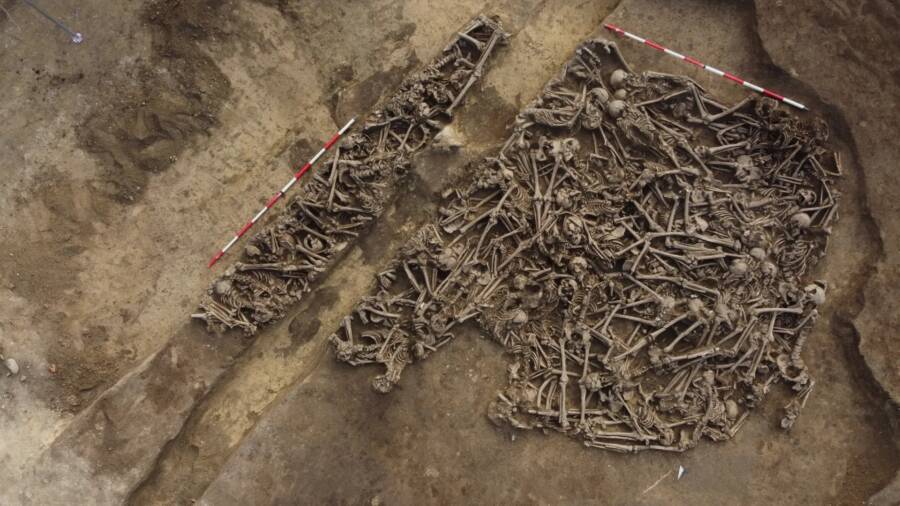
Novetus GmbHArchaeologists determined that a majority of the young men found in this Roman-era mass grave suffered serious pelvic injuries just before they died.
A Roman-era mass grave found beneath a soccer field in Vienna, Austria holds the remains of at least 129 skeletons — all of them young men.
The grave, which has been dated to the first or second century C.E., was initially excavated in 2024, but recent research has now confirmed that the men died in a violent mass fatality event, and that many of them suffered groin injuries right before they died. Researchers hope that these insights will shed more light on Roman-era warfare and military tactics.
New Analysis Of The Mass Grave Of Ancient Roman Soldiers Found In Vienna
Sheridan Strang, a bioarchaeologist at the archaeology firm Novetus, presented the new analysis on August 6 at the 25th European Paleopathology Association meeting.
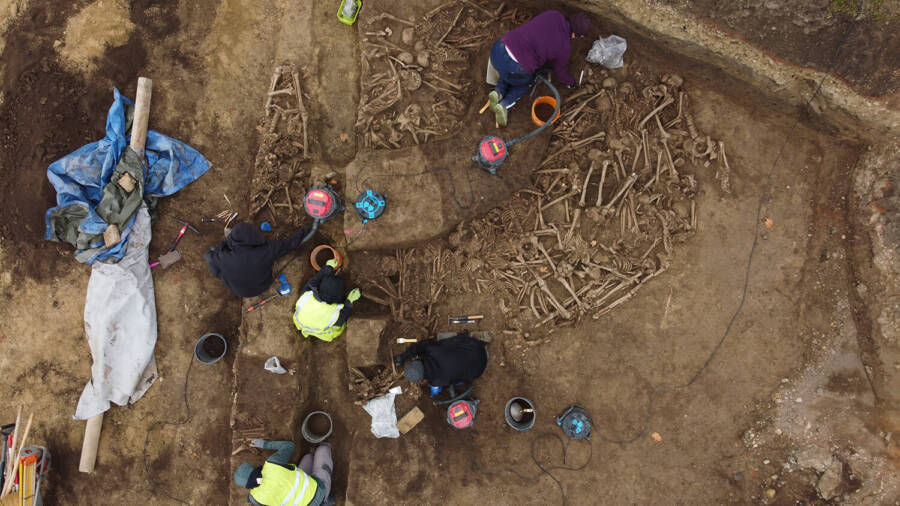
A. Slonek, Novetus/Vienna MuseumArchaeologists discovered the grave in 2024 while renovations were being done on a soccer field near Vienna.
“This is a spectacular find,” Strang told Live Science.
In 2024, the mass grave was discovered during renovations on a soccer field in Hasenleitengasse, a neighborhood on the outskirts of Vienna. Originally, archaeologists believed that the bodies could be from a medieval “plague pit” or even from the Second Ottoman Siege of Vienna in 1683, but carbon dating of the bones indicated that the men had died between 80 and 230 C.E.
“For us Viennese archaeologists, this is a sensational Roman find, the most surprising in my career,” Kristina Adler-Wölfl, Head of City Archaeology (part of the Vienna Museum) told All That’s Interesting in an email in 2025.
It then seemed clear to the archaeologists that the men had died during a catastrophic military clash, but only now has the fresh analysis confirmed this theory.
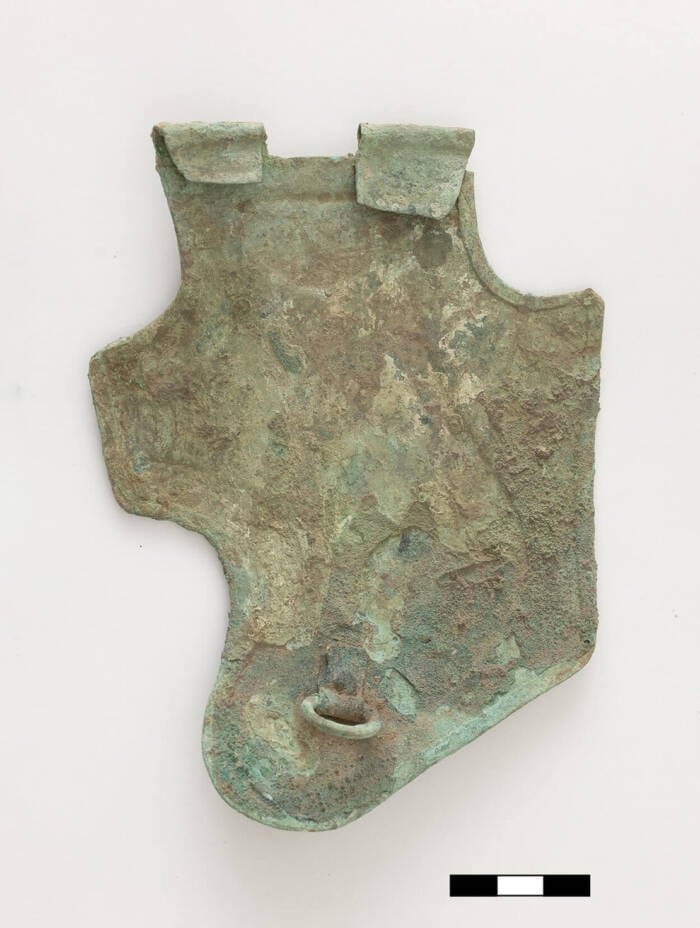
L. Hilzensauer/Vienna MuseumWhile excavating the mass grave in 2024, archaeologists found ancient Roman military artifacts, like the piece of a helmet pictured here.
This grave is located at the former site of the Roman military camp known as Vindobona. The team determined that all 129 skeletons came from men between the ages of 18 and 35, and a majority of them had suffered violent physical trauma at the time they died.
“We determined that these individuals were most likely soldiers, and they died from some kind of mass violence event, either a battle or a military campaign. But we have no other evidence of a battle in this area around this time,” Strang said in the research presentation, according to Live Science.
The men largely suffered injuries from sharp objects, such as swords or daggers, all over their bodies, while many also sustained blunt trauma to their skulls. Their groin areas, however, suffered injuries inflicted by projectile weapons — at a shockingly high rate.
What The Soldiers’ Pelvic Injuries Reveal About Ancient Roman Warfare
Because the pelvic injuries were caused by projectiles, researchers believe that the most likely scenario was that attackers on the ground threw lances that pierced the enemies’ armor while they were on horseback.
“We have one individual where the lance head was still inside the pelvis when we excavated him,” Strang told Live Science. “The people who caused these injuries were aiming for these sensitive areas.”
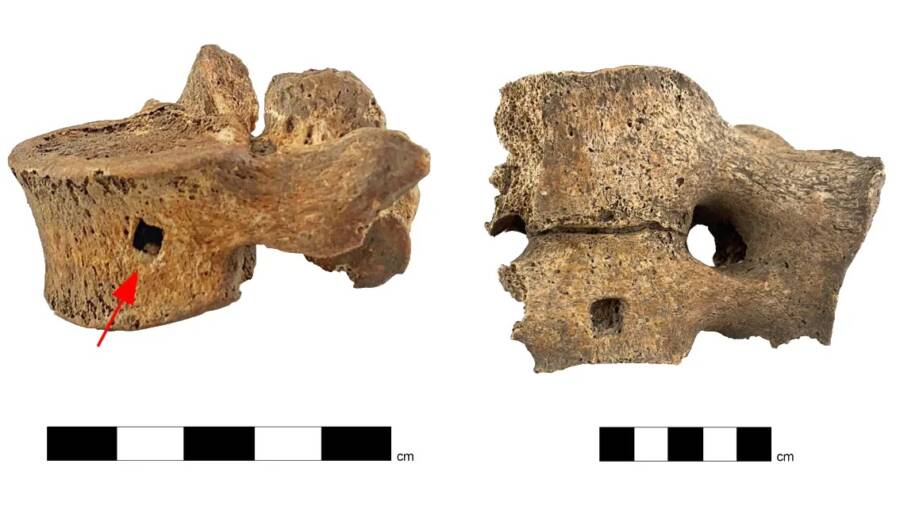
S. Strang, Novetus GmbHThe pelvic injuries were caused by projectile trauma — likely a lance aimed at the gap in the soldier’s armor.
Patrick Randolph-Quinney, a biological anthropologist at Uppsala University in Sweden who was not involved in the research, told Live Science that this site was important for understanding more about how projectile weapons were used in Roman times.
Due to the fact that the projectile attacks were focused on the groin area, it indicates to researchers that there was “a possible lack of armor and protection in those areas — but also that the attackers knew how to incapacitate based on soft-tissue anatomy,” Randolph-Quinney said.

Supa Ant 6x8ft. Welding Blanket Fireproof (Pack of 2) - Heavy Duty Weld Fire Blanket Tools - Welders Cover for Men Curtain with Gloves - Large Welding Gear for Welder Accessories
(as of October 26, 2026 01:02 GMT +00:00 - More infoProduct prices and availability are accurate as of the date/time indicated and are subject to change. Any price and availability information displayed on [relevant Amazon Site(s), as applicable] at the time of purchase will apply to the purchase of this product.)
Fire Cloak - 1500F CE Certified Emergency Fire Blanket for Home & Kitchen | 500GSM Fabric & 0.5mm Thick - Silicon Coated 100% Fiberglass Essentials in House, Warehouse Office - 55"L x 70"W by Supa Ant
$83.99 (as of October 26, 2026 01:02 GMT +00:00 - More infoProduct prices and availability are accurate as of the date/time indicated and are subject to change. Any price and availability information displayed on [relevant Amazon Site(s), as applicable] at the time of purchase will apply to the purchase of this product.)
RIVER OF GOODS Stained Glass Bird Accent Lamp - 8" W x 13.5" H - Tiffany Style Table Lamps for Home, Office Desk, Bedroom, Nightstand - Blue Jay Decor
(as of October 26, 2026 01:02 GMT +00:00 - More infoProduct prices and availability are accurate as of the date/time indicated and are subject to change. Any price and availability information displayed on [relevant Amazon Site(s), as applicable] at the time of purchase will apply to the purchase of this product.)
Fire Blanket - 1500F CE Certified Emergency Fire Blanket for Home & Kitchen | 500GSM Fabric & 0.5mm Thick - 100% Fiberglass Fire Extinguisher for Car,Warehouse Office - 2pc (47x47 inches) by Supa Ant
$53.45 (as of October 26, 2026 01:02 GMT +00:00 - More infoProduct prices and availability are accurate as of the date/time indicated and are subject to change. Any price and availability information displayed on [relevant Amazon Site(s), as applicable] at the time of purchase will apply to the purchase of this product.)