Mystery in the Ice: Unveiling the Identities of Four Lost Franklin Expedition Sailors After Nearly Two Centuries
Imagine setting out on a daring expedition to conquer the icy labyrinth of the Northwest Passage, only to become ensnared in a frozen tomb for nearly two centuries. That’s precisely what happened to Sir John Franklin and his 129 crewmen back in 1845. Nearly 167 years later, thanks to a little magic from science—specifically DNA pulled from living descendants—we’re finally putting names to the bones of those lost souls: William Orren, David Young, John Bridgens, and Harry Peglar. It’s like history decided to play hide-and-seek, only to be caught by a genetic game of Clue! How’s that for solving a centuries-old whodunit? As we uncover these shadows from the past, the tales of desperation, survival, and unexpected twists unfold anew, reminding us that behind every skeleton is a story yearning to be told. Ready to dive into this icy mystery unraveled? LEARN MORE
Scientists used DNA from living descendants to identify the bodies of Franklin expedition crewmen William Orren, David Young, John Bridgens, and Harry Peglar.

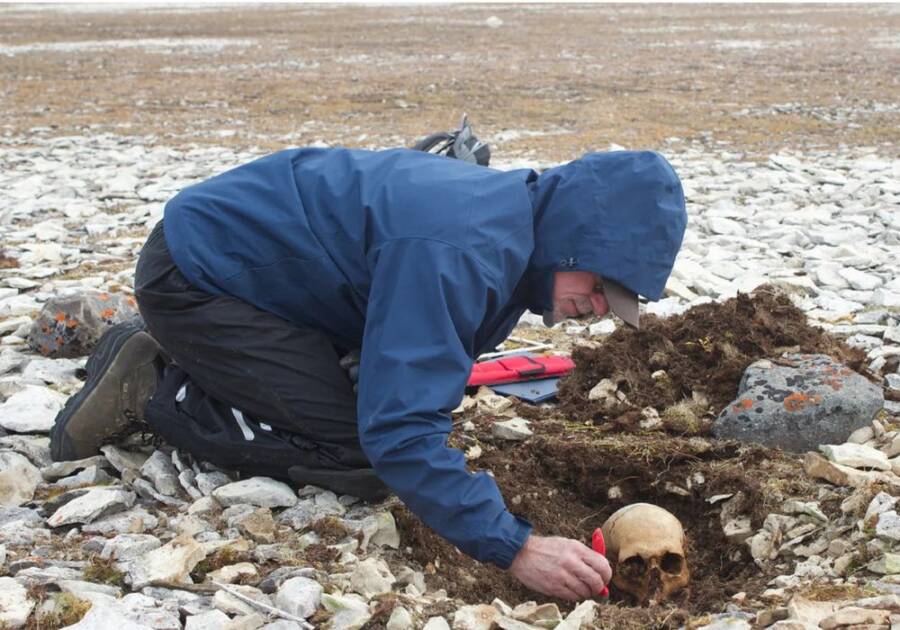
University of WaterlooAnthropologist Douglas Stenton of the University of Waterloo uncovers the skull of a sailor who perished during the Franklin expedition.
In May 1845, 129 men set out on an expedition to the Canadian Arctic led by British Royal Navy officer Sir John Franklin. They were seeking to traverse the Northwest Passage that connects the Atlantic Ocean to the Pacific, but when their two ships became trapped in ice in late 1846, they all succumbed to exposure and starvation.
The remains of nearly two dozen sailors from the doomed expedition have since been uncovered, but until recently, only two bodies had been linked to specific crew members via DNA. Now, researchers have used genetic analysis to identify four more skeletons — solving a 167-year-old mystery in the process.
The Grisly Fate Of The Lost Franklin Expedition Of 1845
In September 1846, a little more than a year into the Franklin Expedition, the HMS Erebus and HMS Terror became trapped in ice off the shore of King William Island in Nunavut. John Franklin died in June 1847, and by April 1848, the 105 crew members who were still alive had grown desperate.
The men loaded two small boats, equipment, clothing, and personal items onto two sleds and dragged them across the ice, aiming to walk hundreds of miles to mainland Canada. All of them died along the way — and those who survived the longest seemingly resorted to cannibalism.

Public DomainAn 1845 illustration of the HMS Erebus and HMS Terror departing from England.
In 1859, a British team searching for the lost expedition came across the remnants of one of the sleds with at least two skeletons nearby. Two years later, a local Inuit tribe discovered the second sled alongside a dozen more corpses.
The British team also found a lone set of human remains roughly 80 miles away from the others. The man was carrying the papers of Harry Peglar, the captain of the foretop on the HMS Terror. However, he was wearing the uniform of a lesser-ranking sailor, so for decades, experts assumed that Peglar had given the documents to a steward or an officer’s servant.
Now, DNA has solved the puzzle once and for all.
Unraveling The Mystery Of Harry Peglar
In a study recently published in the journal Polar Record, anthropologists extracted DNA from the bones of the mysterious lone sailor and compared it to living descendants of the Franklin expedition’s crew members.
As it turns out, the remains were indeed those of Harry Peglar.
“It was interesting to conclusively identify this sailor because the body was found with almost the only written documents from the expedition ever found,” said Dr. Robert Park, a professor of anthropology at Ontario’s University of Waterloo, in a statement.
These “Peglar Papers” included Peglar’s seaman’s certificate, various poems, and a few notes from the expedition. However, they were difficult to decipher, as Peglar often wrote backward and in strange, spiraling patterns. Some excerpts include phrases like “tertell came swimming sloley by” and “death wheare is thy sting.”

Royal Museums GreenwichA page from the Peglar Papers revealing Harry Peglar’s unique writing style.
But why wasn’t Peglar wearing an officer’s uniform? Heaps of clothing found among the sleds suggest that there was no shortage of warm apparel. Could he have been demoted?
Dr. Claire Warrior, the senior curator of content at the Royal Museums Greenwich, told CNN, “The possibility that he was disrated while aboard now seems clear, potentially because of unacceptable conduct. Joining the archaeological and material evidence up with archives adds fuel to the fire: Peglar’s previous naval service included incidents of drunkenness and ‘mutinous conduct.’”
So far, Peglar is the only sailor from the HMS Terror to be identified. But researchers also linked the remains of three men from the HMS Erebus to living descendants.
Identifying The Bodies Of The Franklin Expedition’s Doomed Crewmen
A second study by the same researchers, published in the Journal of Archaelogical Science: Reports, compared 49 DNA samples taken from 10 sites on King William Island to samples from 31 descendants of sailors from both the Erebus and Terror.

Kinsa Smart,Fever, Digital Medical Baby, Kid and Adult Termometro - Accurate, Fast, FDA Cleared Thermometer for Oral, Armpit or Rectal Temperature Reading - QuickCare
$29.00 (as of October 3, 2026 00:55 GMT +00:00 - More infoProduct prices and availability are accurate as of the date/time indicated and are subject to change. Any price and availability information displayed on [relevant Amazon Site(s), as applicable] at the time of purchase will apply to the purchase of this product.)
RIVER OF GOODS LED Boho Ceiling Fan with Hand Woven Brown/Natural Rope - Macrame Knot Work and Hemp Rope Style Eclectic Cottage Decor - 52" L x 52" W - Rich Barnwood/Light Driftwood Fan Blades
(as of October 3, 2026 00:55 GMT +00:00 - More infoProduct prices and availability are accurate as of the date/time indicated and are subject to change. Any price and availability information displayed on [relevant Amazon Site(s), as applicable] at the time of purchase will apply to the purchase of this product.)
RIVER OF GOODS Alabaster LED Mesh Caged Ceiling Fan - 52" L X 52" W - White/Oak Wood-Grain Blades
(as of October 3, 2026 00:55 GMT +00:00 - More infoProduct prices and availability are accurate as of the date/time indicated and are subject to change. Any price and availability information displayed on [relevant Amazon Site(s), as applicable] at the time of purchase will apply to the purchase of this product.)
PROMIXX FORM Protein Shaker Bottle - A Premium Shaker Bottle for Protein Shakes Infusions and Hydration - Durable Gym Shaker Bottle, Leakproof Lid, Odorless - 26oz (Graphite Gray)
$17.32 (as of October 3, 2026 00:55 GMT +00:00 - More infoProduct prices and availability are accurate as of the date/time indicated and are subject to change. Any price and availability information displayed on [relevant Amazon Site(s), as applicable] at the time of purchase will apply to the purchase of this product.)