Uncovering the Cosmic Code: Did Three Ancient Civilizations Secretly Align Their Monuments with the Stars?

You ever stumble across one of those mind-boggling theories that make you go, “Wait, what?” like civilizations from Egypt, Mexico, and Cambodia all got together (telepathically, apparently) to build pyramids and temples mirroring some cosmic event way back in 10,500 B.C.E.? Sounds like the ultimate ancient group project, right? Well, hold onto your hats because while this star-aligned storyline is captivating—pyramids mimicking Orion’s belt and rivers posing as the Milky Way—it turns out, experts have handed this cosmic tale a serious reality check. Buckle up as we dive into the mystery, mix in some debunking, and ponder whether our forebears were just stargazers with quirky tastes rather than cosmic mapmakers.
A long-standing theory suggests that civilizations in Egypt, Cambodia, and Mexico built similar structures that aligned with a mysterious cosmic event that took place in 10500 B.C.E. — but experts have debunked many of these claims.

Raimond Spekking/Wikimedia CommonsThe Pyramids of Giza are said to align with the belt of the constellation Orion.
Many ancient structures offer more questions than answers. While historians and archaeologists can glean a limited understanding of a building based on records and investigations of the surrounding areas, there is always a bit of mystery about a structure’s true purpose.
Because of this, it’s not particularly surprising that ancient history generates a lot of theories — some more conspiratorial than others. One of these theories has recently been garnering a considerable amount of attention online, and it relates to how seemingly disconnected civilizations appeared to be referencing the same cosmic phenomenon.
But is it true?
Were These Ancient Civilizations Mapping Out The Same Thing?
A popular theory spreading across the internet has to do with three separate, ancient structures that are located thousands of miles apart: the Giza pyramid complex in Egypt, Teotihuacan in Mexico, and the Angkor temple complex in Cambodia.
As explained in one viral TikTok from user @architecton_core with over 871,000 views, the curious thing about all of these structures is their layout.
“In 1983, engineer Robert Bauval noticed something,” the TikToker says, referring to the pyramids of Khufu, Khafre, and Menkaure. “The three pyramids viewed from above match the exact proportions of the three stars in Orion’s belt. Not approximately, exactly.”

Pascal Debrunner/UnsplashA debated theory states that the Pyramids of Giza would have lined up with Orion’s belt in 10500 B.C.E.
Not only that, but Bauval found that “the Nile River itself mirrors the Milky Way.”
“The way the galaxy curves in the night sky, the Nile curves the same way on Earth,” the TikToker explains. “The position of the pyramids relative to the Nile matches the position of Orion relative to the Milky Way.”
Assuming that the pyramids were built around 2500 B.C.E., this star position wouldn’t make sense. For the pyramid complex to accurately reflect stellar locations, it would have to be based on the skies of 10500 B.C.E. — “8,000 years before the pharaohs,” the TikToker says.
Similar shapes can be found in Mexico, specifically in the ancient Mesoamerican city of Teotihuacan.
Three structures — the Pyramid of the Sun, Pyramid of the Moon, and Temple of Quetzalcoatl — were completed between 150 and 250 C.E., according to the Metropolitan Museum of Art. This civilization had no connection to Egypt. Despite this, their structures shared a similar shape, claims the TikToker.
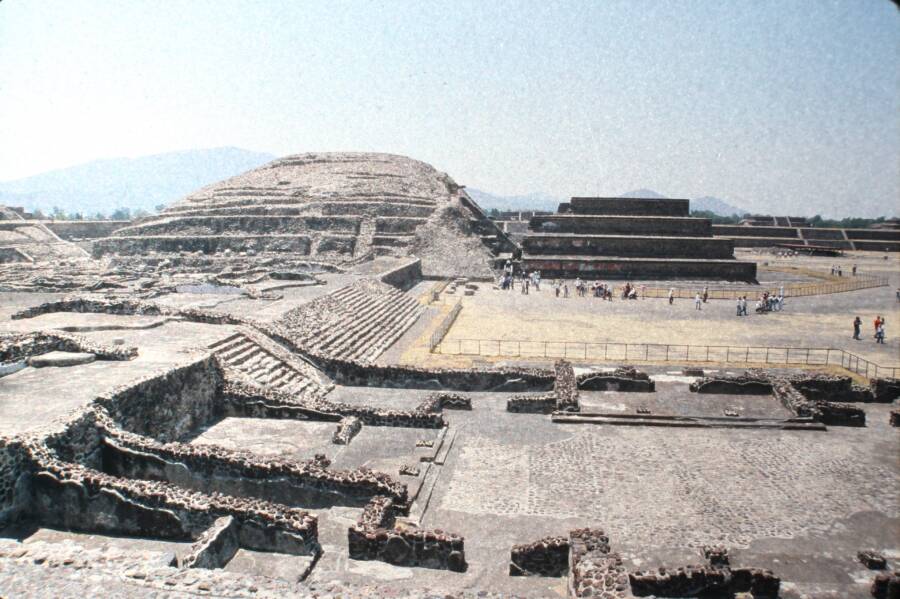
Gary Todd/Wikimedia CommonsThe ancient temples at Teotihuacan, which predates the Aztec Empire.
“Seen from above, the three pyramids form the same pattern as the three stars of Orion’s belt,” the TikToker says. “The proportions, the spacing, the offset angle: identical to the pyramids of Giza.” The TikToker says this, too, relates to the year 10500 B.C.E., though he does not explain how.
Finally, the TikToker alleges that the Angkor complex, built in 12th-century Cambodia, also displays this pattern.
“Every major temple in the Angkor complex faces east, except Angkor Wat. It faces west,” the TikToker explains. “For over a century, archaeologists called it an anomaly — until someone looked at the stars.”
According to the TikToker, researchers in 1996 discovered that, if one looked at the complex from above, the temples matched the constellation Draco.
“And the star positions they match don’t correspond to the 12th century, when Angkor Wat was built. They correspond to 10500 B.C.E.,” declares the TikToker.
So, were all of these societies linked? And what happened in 10500 B.C.E.?
A Deeper Look At The Theory
There’s no doubt that ancient civilizations oriented much of their lives around the stars. However, the claims made in videos like these stretch this idea to its extreme.
To start, the claims about all of the structures lining up with the skies in 10500 B.C.E. can be dismissed outright. While this has been claimed by people like Graham Hancock, Robert Bauval, and Adrian Gilbert, there’s just no compelling evidence that this is the case.

The Door Balancer Eliminates The Need for Door Props, Door Stops and Door Wedges
(as of October 3, 2026 00:55 GMT +00:00 - More infoProduct prices and availability are accurate as of the date/time indicated and are subject to change. Any price and availability information displayed on [relevant Amazon Site(s), as applicable] at the time of purchase will apply to the purchase of this product.)
RIVER OF GOODS Alabaster LED Mesh Caged Ceiling Fan - 52" L X 52" W - White/Oak Wood-Grain Blades
(as of October 3, 2026 00:55 GMT +00:00 - More infoProduct prices and availability are accurate as of the date/time indicated and are subject to change. Any price and availability information displayed on [relevant Amazon Site(s), as applicable] at the time of purchase will apply to the purchase of this product.)
RIVER OF GOODS Stained Glass Bird Accent Lamp - 8" W x 13.5" H - Tiffany Style Table Lamps for Home, Office Desk, Bedroom, Nightstand - Blue Jay Decor
(as of October 3, 2026 00:55 GMT +00:00 - More infoProduct prices and availability are accurate as of the date/time indicated and are subject to change. Any price and availability information displayed on [relevant Amazon Site(s), as applicable] at the time of purchase will apply to the purchase of this product.)
KiddyCare Diaper Caddy Organizer Cart for Nursery Baby Basket Gift for Boy/Girl | Diaper Caddy for Changing Table Basket Organizer with Dividers | Caddy for Baby Stuff Breast Pump Caddy - Regular
$8.95 (as of October 3, 2026 00:55 GMT +00:00 - More infoProduct prices and availability are accurate as of the date/time indicated and are subject to change. Any price and availability information displayed on [relevant Amazon Site(s), as applicable] at the time of purchase will apply to the purchase of this product.)