19 Secrets Kids Hide: What They Pretend to Understand but Actually Don’t
19 Secrets Kids Hide: What They Pretend to Understand but Actually Don’t

Often, “That’s not fair” means “I’m disappointed.”

“I wanted another turn.”

“I wish I could have what my brother has.”
“I’m sad that I wasn’t chosen.”

Children may not yet have the language to identify disappointment, so they describe the experience as unfair.

Acknowledging the feeling does not mean changing the decision, “I understand. You really wanted another turn, and you’re disappointed that it’s time to leave.”

Children are often better able to accept a limit after they feel understood. It doesn’t hurt to explain fairness either. Not getting the color they wanted in school is actually very fair, as a teacher cannot cater to every request. Help them to understand disappointment vs. fair.


Celia Kibler , Ejov Igor / Pexels Report

ADVERTISEMENT

ADVERTISEMENT

Parenting expert ideas for kids pretend play, addressing confusion they may have.

Time is invisible and surprisingly abstract for children.

Five minutes may feel like an hour when they are waiting for something exciting. “Next week” may have very little meaning without something concrete to help them understand it.

Visual timers can make shorter periods easier to see. Large wall calendars can help children understand longer periods of time. They can cross off days, count how many sleeps remain, and see birthdays, vacations, school events, family visits, or schedule changes approaching.

Making time visible can reduce repeated questions, improve patience, and help children feel more prepared.

Celia Kibler , Mikhail Nilov / Pexels Report

A parenting expert talking to a young girl on a bed, discussing things kids pretend to understand but are confused by.

Young children are sometimes accused of lying when they may actually be experimenting with imagination or blending fantasy and reality. Remember that a young child does not know the difference between fantasy and reality, so they are not saying certain things to spite you.

A preschooler may insist, “A dinosaur broke it. There was a dragon outside.”

Adults know these things are unlikely, but young children are still developing their understanding of what is real, imagined, possible, and pretend. Children have been taught storytelling almost from birth.
Intentional lying involves deliberately trying to deceive someone. Storytelling and imaginative thinking are part of normal development.

That does not mean honesty should not be taught. It means adults should consider the child’s age, development, intention, and understanding before assuming dishonesty.
We can respond with curiosity, “That sounds like an exciting story. Now tell me what really happened.”

Celia Kibler , Ketut Subiyanto / Pexels Report

ADVERTISEMENT

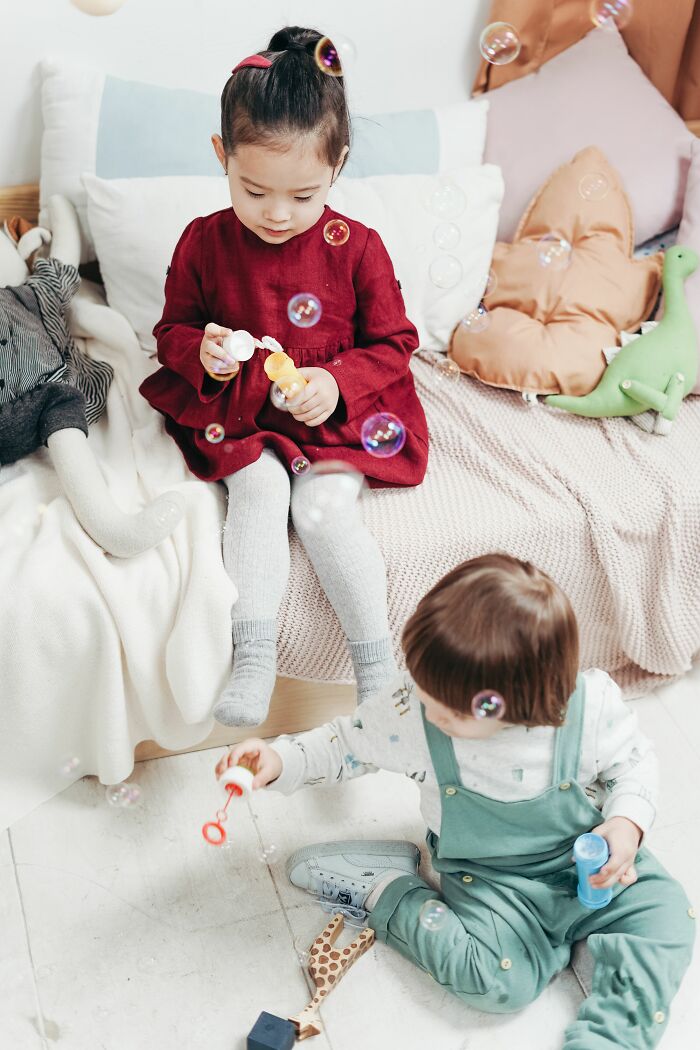
Two young kids playing with bubbles, a moment when kids pretend to understand but are confused by.

Adults often use the word “share” when they mean, “Please give someone else a turn.” But a child may hear, “Give away something that belongs to you.” Imagine an adult walking up to you while you are using your phone and saying, “You need to share.”

Most adults would want to know why, with whom, and when they would get it back. Children benefit from learning the specific skills involved, “You may finish your turn, and then your brother may have a turn.”

“Ask before taking something that belongs to someone else.”

“She said no, so you need to choose another toy.”

It’s important to remember that we are not born with compassion. Sharing is an act of compassion and therefore needs to be taught. Taking turns, asking permission, waiting, and respecting belongings are clearer skills than simply telling children to share.

Celia Kibler , cottonbro studio / Pexels Report

ADVERTISEMENT

A child's eye peeking through a wooden door, representing things kids pretend to understand but are confused by.

Children hear more than adults realize.

They may overhear conversations about money, work, illness, divorce, relationships, moving, school concerns, or family conflict.

Even when they do not understand the words, they often absorb the emotions. Children naturally try to fill in missing information, and their imagined explanation may be more frightening than reality. They may also assume they caused a problem that has nothing to do with them.

When children overhear something concerning, offer a simple, age-appropriate explanation and allow questions.

“You heard us talking about money. The adults are working on it, and you are safe and cared for.”

Children do not need every adult detail, but they do need reassurance and clarity.

Celia Kibler , Ketut Subiyanto / Pexels Report

ADVERTISEMENT

A child looking at a parenting expert, illustrating things kids pretend to understand but are confused by.

Most parents mean this sincerely. We want our children to come to us when they are worried, confused, in trouble, or facing something difficult.

But children do not decide whether it is safe to talk to us based only on what we say. They watch how we respond to smaller things first.

If admitting a mistake leads to yelling, a long lecture, immediate punishment, criticism, or disappointment, children may hesitate to share something bigger later, even after being told, “You can tell me anything.”

Creating open communication does not mean parents approve of every choice or avoid consequences. It means listening before reacting, asking questions before assuming, and helping children understand that telling the truth will not cost them their connection with us.

Pages: 1 2 3 4 5

Post Comment

WIN $500 OF SHOPPING!

    This will close in 0 seconds

    RSS
    Follow by Email