44 Incredible Moments You Won’t Believe Are Happening Right Now Around the World

 A Largely Self-Taught Indian Clerk Sends His Mathematics to Cambridge, Then Becomes a Fellow of the Royal Society
In January 1913, Srinivasa Ramanujan wrote to Cambridge mathematician G. H. Hardy with a selection of mathematical results.
He was working as a clerk at the Madras Port Trust, studying and developing ideas outside a conventional university course.
Books had helped him learn. Local supporters had recognized his ability. Now he was asking someone far away to examine his work.
Hardy and fellow mathematician J. E. Littlewood studied the results.
On February 8, Hardy replied with interest and asked to see proofs.
That exchange helped bring Ramanujan to Cambridge in 1914, where collaboration gave his ideas a wider audience.
In 1918, he became a Fellow of the Royal Society and later a Fellow of Trinity College, Cambridge.
One remarkable detail: notebooks he left behind continued to inspire mathematical research long after his passing in 1920.
His story connects extraordinary curiosity with the importance of someone taking unfamiliar work seriously.
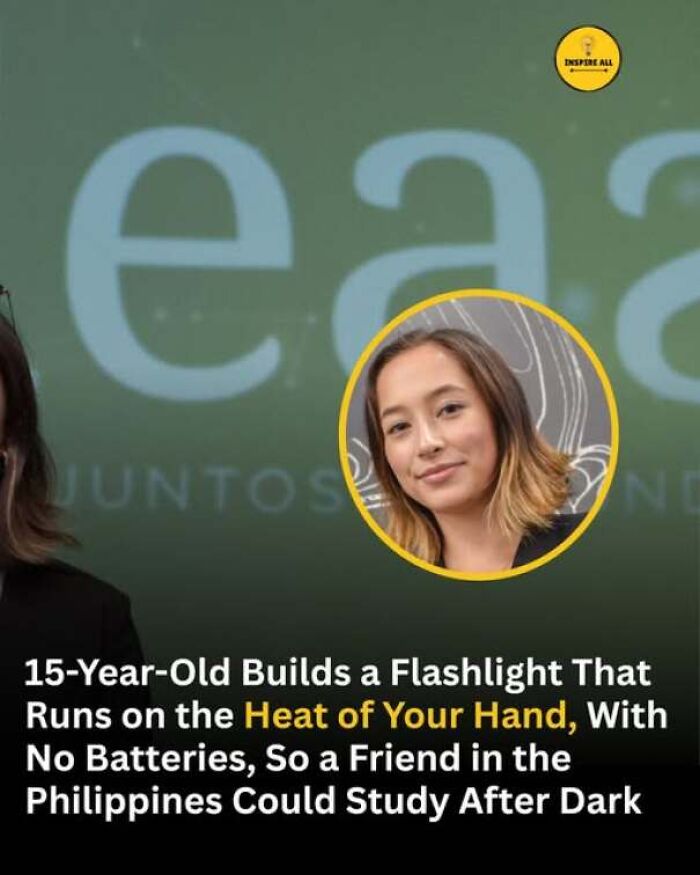 A Teenager Builds a Flashlight Powered by Hand Heat After Learning Her Friend Could Not Study After Dark
Ann Makosinski learned that a friend in the Philippines had no electricity at home and struggled to finish her schoolwork before daylight faded.
She began exploring another way to provide light.
Her idea became the Hollow Flashlight, a prototype that used the temperature difference between a warm hand and cooler surrounding air to generate electricity.
Thermoelectric tiles captured that difference, while a circuit helped provide usable power for an LED.
In 2013, her project won the 15–16 age category at the Google Science Fair.
One intriguing detail: the hollow tube was part of how it worked. Cooler air inside helped maintain the temperature difference across the tiles.
The prototype needed suitable conditions, so its performance could change with the surrounding temperature.
But it gave Ann a way to test a thoughtful question: could some of the heat leaving our bodies become useful light?
How did she turn that tiny energy supply into enough power for an LED?
 Fed Up With a Vacuum That Lost Suction, James Dyson Built 5,127 Prototypes While Working Toward a Better Design
It began with a familiar frustration: a vacuum cleaner that stopped picking up dirt properly as its bag clogged.
James Dyson wondered whether cyclone technology could separate dust from the airflow without relying on a bag.
He built a crude prototype from simple materials. It showed promise, but making the idea work reliably took much more.
In his own account, Dyson describes 5,127 prototypes and a longer journey that led to the DC01 reaching the market in 1993.
Each version gave him something else to investigate, adjust and test.
One intriguing detail: the cyclone did not trap dust in a filter bag. It used spinning airflow to separate dirt, changing how the machine collected it.
A working experiment was only the beginning. It still had to become an appliance people could use in their homes.
His story shows how much work can sit between having an idea and making it dependable.
But if the first rough model showed promise, why did thousands more versions follow?
Discover what Dyson’s prototype count reveals about the work behind his bagless vacuum.
Psychologist Barbara Fredrickson explains that positive emotions such as joy, interest, and contentment can broaden our thinking and help us develop better ways of coping with life’s challenges. They can also help us approach life with a more open and hopeful mindset.
 Student Builds a Voice-Controlled Braille Printer After a Blind Student Asks Why They Cannot Simply Speak
A simple question changed the direction of Lingampalli Himaja’s invention.
During a school visit, she saw students using a slate and stylus to punch Braille dots into paper by hand.
Her first prototype used six buttons. But when students tested it, one asked why they needed to press buttons when they could speak.
Himaja listened.
RUDHRA evolved into a system that converts spoken words into text, then embosses readable Braille onto paper. Users can check the text before printing, helping catch speech-recognition mistakes.
The project is still under development, but it has already won India’s 2026 James Dyson Award and reached the global Top 20 shortlist.
Sometimes, the most useful step in inventing is listening to the people who will use what you build.
But turning speech into text is only half the challenge. How does RUDHRA turn those words into raised dots that someone can read by touch?
 A Potter Who Once Sold Tea Built a Clay Refrigerator That Cools Without Electricity
Before Mansukhbhai Prajapati became known for his inventions, he worked at a tea stall and later in a factory.

RIVER OF GOODS LED Boho Ceiling Fan with Hand Woven Brown/Natural Rope - Macrame Knot Work and Hemp Rope Style Eclectic Cottage Decor - 52" L x 52" W - Rich Barnwood/Light Driftwood Fan Blades
(as of November 5, 2026 01:06 GMT +00:00 - More infoProduct prices and availability are accurate as of the date/time indicated and are subject to change. Any price and availability information displayed on [relevant Amazon Site(s), as applicable] at the time of purchase will apply to the purchase of this product.)
Fire Blanket - 1500F CE Certified Emergency Fire Blanket for Home & Kitchen | 500GSM Fabric & 0.5mm Thick - 100% Fiberglass Fire Extinguisher for Car,Warehouse Office - 5pc (40"x40") by Supa Ant
$89.95 (as of November 5, 2026 01:06 GMT +00:00 - More infoProduct prices and availability are accurate as of the date/time indicated and are subject to change. Any price and availability information displayed on [relevant Amazon Site(s), as applicable] at the time of purchase will apply to the purchase of this product.)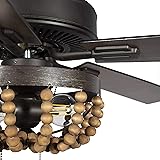
RIVER OF GOODS Coastal 52 Inch Wooden Bead LED Ceiling Fan, Brown
(as of November 5, 2026 01:06 GMT +00:00 - More infoProduct prices and availability are accurate as of the date/time indicated and are subject to change. Any price and availability information displayed on [relevant Amazon Site(s), as applicable] at the time of purchase will apply to the purchase of this product.)
RIVER OF GOODS Coastal 52 Inch Wooden Bead LED Ceiling Fan, Cream
(as of November 5, 2026 01:06 GMT +00:00 - More infoProduct prices and availability are accurate as of the date/time indicated and are subject to change. Any price and availability information displayed on [relevant Amazon Site(s), as applicable] at the time of purchase will apply to the purchase of this product.)




















Post Comment