44 Incredible Moments You Won’t Believe Are Happening Right Now Around the World

Research found that brief gratitude exercises improved positive mood and optimism. You don’t have to force yourself to be cheerful all the time. But acknowledging that something beautiful, interesting, or kind still exists is enough to give you a better view of life.
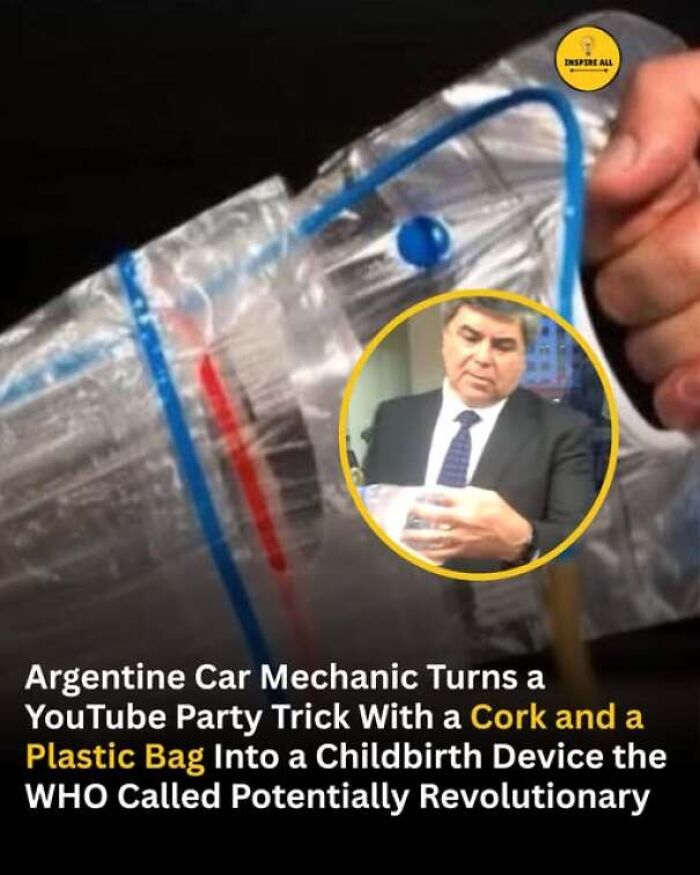 Car Mechanic Sees a Trick for Removing a Cork From a Bottle and Helps Inspire a New Childbirth Device
Jorge Odón worked on cars in Argentina. He had no medical training.
But after seeing a trick for retrieving a loose cork from inside a bottle, he wondered whether the same basic idea could help during a difficult birth.
That unexpected connection became the starting point for a device later known as OdonAssist.
Medical specialists joined the work. Early collaboration began in 2006, followed by simulator testing and a World Health Organization study protocol.
The idea needed years of development before researchers could investigate its use with mothers and babies.
The resulting device uses a soft sleeve with an inflatable cuff to help a trained clinician assist vaginal birth.
Here’s an intriguing detail: in one UK study, it successfully assisted 69 of 104 births. The researchers called for a randomized comparison with established methods, an essential step in understanding where it could help.
A mechanic supplied the unusual possibility. Clinicians and researchers brought the expertise needed to test it.
But how did an idea involving a bottle and a cork become something medical researchers took seriously?
Read More… https://trendingamerican.com/jorge-odon-odonassist-childbirth-device/.
 Boy Who Left School at 10 Keeps Learning, Develops the Lightning Rod, Bifocals and a Better Stove, and Patents None of Them
Benjamin Franklin’s formal schooling ended when he was ten. At twelve, he became an apprentice in his brother’s print shop. His classroom years were over, but his learning continued through books, work and experiments.
His curiosity started early. At eleven, he made wooden swimming fins that he held in his hands. They helped him move faster through the water, but tired his wrists.
He kept testing ideas.
In 1742, he designed a fireplace that provided more useful warmth while producing less smoke. His electrical research helped him develop the lightning rod to protect buildings and the people inside.
When switching between reading glasses and distance glasses became inconvenient, he combined both types of lenses in one frame: bifocals.
His inventions tackled problems people faced every day. Yet Franklin chose not to patent them.
He believed that benefiting from other people’s discoveries gave him a reason to share his own.
The inventions are familiar. The thinking behind that decision is just as remarkable. What did Franklin believe people owed one another when they discovered something useful?
Read More… https://trendingamerican.com/benjamin-franklin-inventions-school-patents/.
 An Inventor Builds a Wind-Up Radio So People Without Reliable Electricity Can Hear Important Information
In 1991, Trevor Baylis watched a television programme about the spread of AIDS in Africa.
Radio could help carry vital health information. But for people without electricity, keeping a receiver running meant finding and paying for replacement batteries.
He began working on another way.
His design used a handle to wind a clockwork spring. As it unwound, the spring drove a small generator that powered the radio.
The idea reached BBC’s Tomorrow’s World in 1994 and earned design recognition in 1996.
One remarkable detail: a radio Baylis later donated to the Institution of Mechanical Engineers remains in its collection, preserving the mechanism behind his idea.
His achievement began with noticing that access to information depended on something beyond the broadcast itself.
Someone still needed power to hear it.
But how could a spring keep a radio playing after a person stopped turning the handle?
Discover the mechanism, experiments and milestones behind Baylis’s wind-up radio.
Read More… https://trendingamerican.com/trevor-baylis-wind-up-radio-invention/.
Now, Pandas, which of these fascinating finds caught your attention the most? Tell us in the comments!
And if you’ve come across something wonderful or heartwarming in your own corner of the world, we’d love to hear about it, too. Let’s give each other a few more reasons to believe there’s still plenty of good in the world!
 At 48, After a Financial Setback, He Turned a Year of Backyard Experiments Into Instant Noodles
In 1958, Momofuku Ando introduced Chicken Ramen after working in a small shed behind his home in Ikeda, Japan.
Just a year earlier, a credit union where he served as a director had collapsed. According to Nissin’s history, he lost nearly everything except his rented home.
1MORE Triple Driver In-Ear Headphones - Silver - Wired - Adult - In Ear - 18 grams - 90 days limited warranty
(as of November 5, 2026 01:06 GMT +00:00 - More infoProduct prices and availability are accurate as of the date/time indicated and are subject to change. Any price and availability information displayed on [relevant Amazon Site(s), as applicable] at the time of purchase will apply to the purchase of this product.)
RIVER OF GOODS Stained Glass Magna Carta LED Ceiling Fan - 52" L x 52" W - Tiffany Style - Flush Mount Ceiling Fan with Remote - Teal
(as of November 5, 2026 01:06 GMT +00:00 - More infoProduct prices and availability are accurate as of the date/time indicated and are subject to change. Any price and availability information displayed on [relevant Amazon Site(s), as applicable] at the time of purchase will apply to the purchase of this product.)
RIVER OF GOODS Alabaster LED Mesh Caged Ceiling Fan - 52" L X 52" W - White/Oak Wood-Grain Blades
(as of November 5, 2026 01:06 GMT +00:00 - More infoProduct prices and availability are accurate as of the date/time indicated and are subject to change. Any price and availability information displayed on [relevant Amazon Site(s), as applicable] at the time of purchase will apply to the purchase of this product.)
The Door Balancer Eliminates The Need for Door Props, Door Stops and Door Wedges
(as of November 5, 2026 01:06 GMT +00:00 - More infoProduct prices and availability are accurate as of the date/time indicated and are subject to change. Any price and availability information displayed on [relevant Amazon Site(s), as applicable] at the time of purchase will apply to the purchase of this product.)




















Post Comment