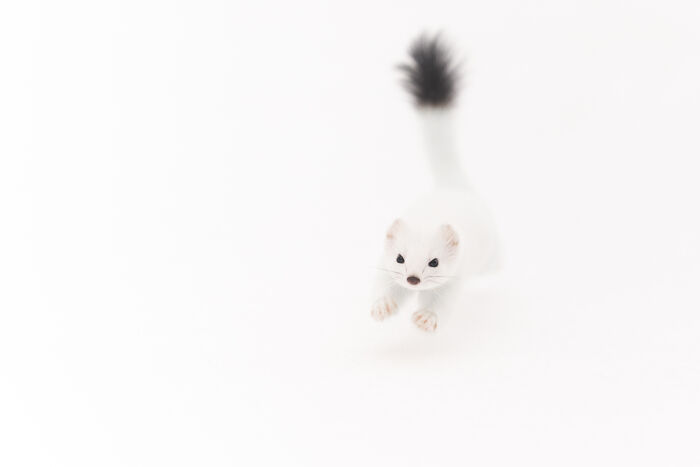
Award winning wildlife photo of a white stoat leaping through bright white snow

During my photo trip to Kuusavo, Finland, in March 2025, I had the chance to capture a small stoat darting through the snow. It was a magical moment: the animal moved swiftly, weaving back and forth across the white landscape in search of food. Its sleek white winter coat blended almost perfectly with the snow, making it both a challenge and a thrill to track with my camera. Every pause, every sudden leap offered a fleeting opportunity to press the shutter, and the combination of speed, light, and the sheer beauty of this tiny creature made the encounter unforgettable. After this trip, I still call it my “Little Star.”

Nature Photographer Of The Year Report

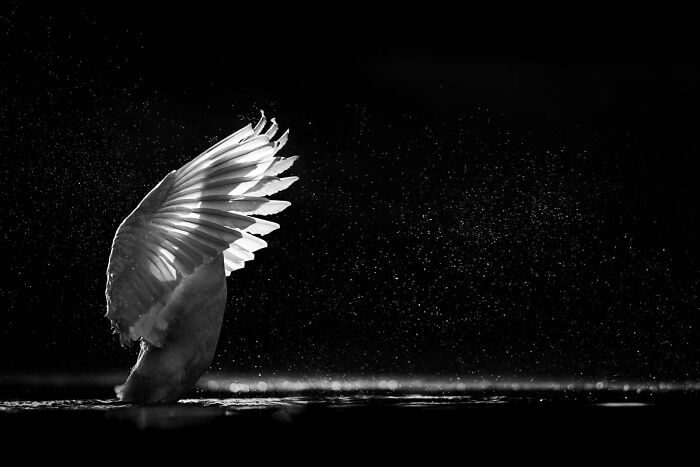
Black and white wildlife photo of a bird spreading its illuminated wing over dark water with splashing droplets

There’s something about the chill in the Dutch air that gets my pulse racing maybe, just maybe, we’ll get some snow! That’s exactly how I felt last December (2022) when I found a local pond that had completely frozen over. While there was no snow to be seen, I wasn’t disappointed. The thin layer of ice on the pond had driven all the ducks and geese to a single opening in the ice, perfectly positioned between the sun and me. Talk about a golden opportunity for some backlit shots, one of my go-to photography styles. After hanging around for a few days, I started to get the hang of the geese’s behavior. So, the moment I started stretching, my camera was already up and ready. That’s how I captured this shot. A white goose flapped its wings, sending droplets flying all around. I was pretty chuffed with that already, but when I reviewed the shots on my computer, one stood out. You could see the goose’s head as a shadow in the feathers, giving the photo that extra kick.

Nature Photographer Of The Year Report

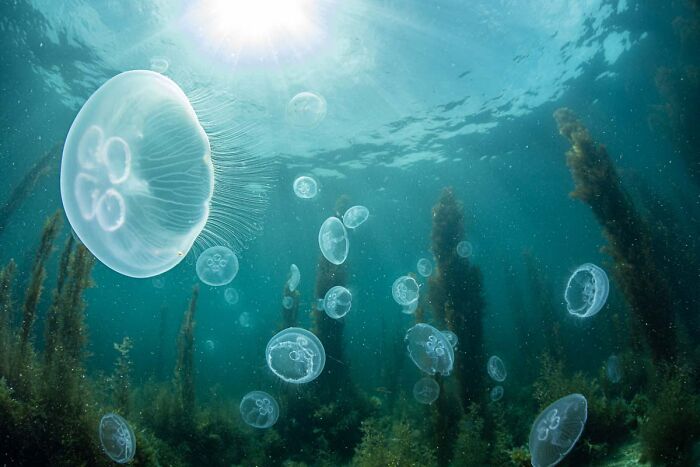
Translucent jellyfish swimming underwater in clear blue sea water surrounded by kelp in a wildlife photo

This is a small school of Moon jellyfish and Japanese kelp.

I took this image from the Minamata Sea, Kumamoto Prefecture, Japan, in April 2022. There is a phenomenon where lots of Moon jellyfish gather close to shore between April and May in the Minamata Sea; also, Japanese kelp grows in cold water from winter to spring in Japan. But it is very difficult to see these two subjects together unless you know when and where to dive for aiming. I was looking for these subjects together for two years, and finally, I succeeded in shooting Moon jellyfish in the kelp forest. The kelp forest will disappear by the middle of April due to water temperature, and Moon jellyfish won’t turn up until a certain temperature. It was very difficult to read the right timing to shoot this magical moment for collaboration with Jellyfish and the kelp forest. I have chosen the correct date for this and checked high tide and low tide and the sun’s direction before diving and choosing the right time to see them. I spent a week finding jellyfish, and finally, I could shoot this image after all my efforts.

There were not many jellyfish at that time, but I carefully chose the best composition so I could get as many jellyfish as possible into the frame in the kelp forest and Snell’s window effect. I never forget how it was such a beautiful time to see some moon jellyfish floating in the kelp forest, and it was a magical time.

Nature Photographer Of The Year Report

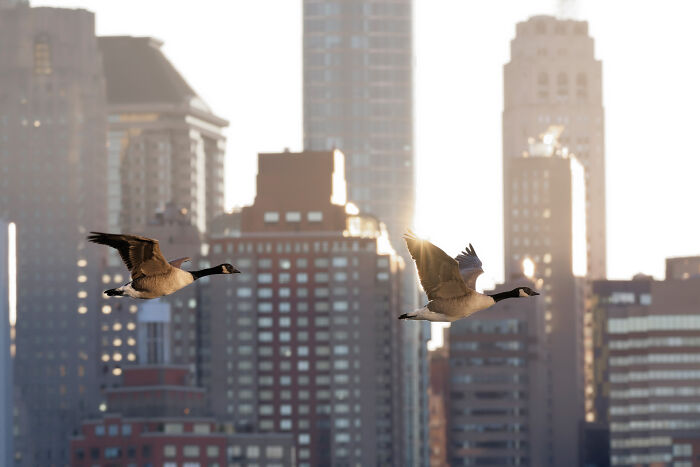
Urban wildlife photo featuring geese flying in front of city skyscrapers at sunset.

What a magnificent show of these flights of Canadian geese (Branta Canadensis) in the heart of New York City, one of the world’s largest megalopolis. They have made the city and its surroundings their home all year long. According to the NY Department of Environmental Conservation, 200,000 geese reside all year round in the state. A century ago, there were no resident geese, apart from a few descendants of captive birds set free.

Migrating geese were only seen between October and April, but in the ’50s and ’60s, the department intentionally released this species in the region of Albany to establish resident flocks for hunters. « You gotta know what you’re doing when you let something go », said Tait Johansson, naturalist-in-residence at the Bedford Audubon Society. Ever since, and after the 1990s, the birds have been considered a nuisance for some, and the population is regulated through eradication measures.

On January 15, 2009, a few minutes after taking off from La Guardia, US Airways flight 1549 made an emergency landing on the Hudson River after a flock of geese collided involuntarily with the plane. The idea behind this series is to show these two worlds from the angle of aesthetics, uniting the space and its urban structures with the local wildlife and its beauty.

This photograph was taken on November 23, 2019, at 8:29 am from the docks of Jersey City which faces the western side of downtown Manhattan. These two Canadian geese are flying at sunrise over the Hudson River towards Liberty Park, one of the places where they gather in peace…


Nature Photographer Of The Year Report

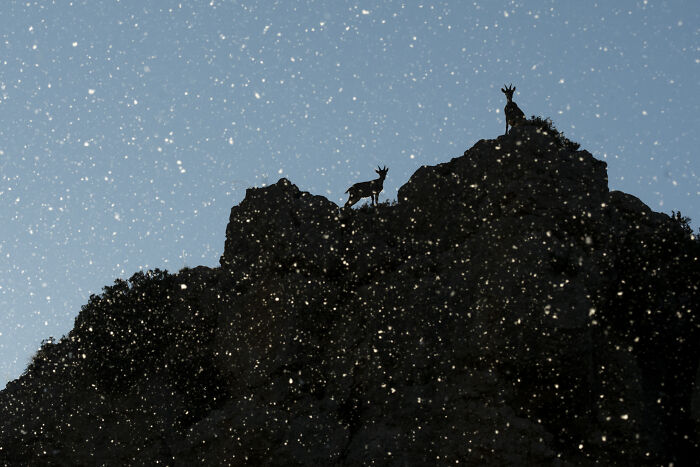
Wildlife photo of two mountain goats silhouetted on a rocky peak during falling snow.

I took this image in Teruel (Spain). I had taken a lot of pictures of Iberian Ibex. And a few years ago, I tried to take a few photos of the seeds of the poplar that were spread by the wind. After taking some photos, I realized that it was really interesting. So the next year I went there every afternoon when the seeds were spreading (which is not too many days), and I took some photographs like this one. It was a really short moment, because the sun had to lie just behind the rocks and the Ibex had to stand on top of the mountains, creating an enchanting moment in which the seeds seemed to be stars or snow.

Pages: 1 2 3 4 5 6 7 8 9 10 11 12 13 14

Post Comment

WIN $500 OF SHOPPING!

    This will close in 0 seconds

    RSS
    Follow by Email