Unseen Moments: 76 Stunning Wildlife Photos That Captivated the NPOTY People’s Choice Over the Years
Unseen Moments: 76 Stunning Wildlife Photos That Captivated the NPOTY People's Choice Over the Years

I made this image in Solio Game Reserve in Kenya, a private reserve nestled between Mount Kenya and the Aberdare Mountains. Solio is world-renowned not only for its rhino conservation but also for the abundance of other wildlife, including the reticulated giraffe (Giraffa camelopardalis reticulata), easily recognized by its sharp, polygonal coat pattern edged in white.

The idea for this frame emerged as I watched a small group of giraffes crossing a dry patch of land where loose dust drifted through the air. I realized that by positioning myself with the light behind the dust clouds, I could transform the moment into something more abstract and artistic. Rendering the photograph in black and white removed distractions and emphasized the sculptural forms of the giraffes and the ethereal texture of the dust. By slightly underexposing and using a longer focal length, I achieved the strong silhouettes and atmosphere I had envisioned.

The two giraffes walked quietly together, likely moving between feeding grounds. With each step, their steady gait lifted small clouds of dust from the dry earth, creating the natural backdrop that completes this scene. Their calm companionship highlights the subtle social bonds giraffes often maintain, whether between females and their offspring or smaller groups traveling within a larger herd.
Nature Photographer Of The Year Report

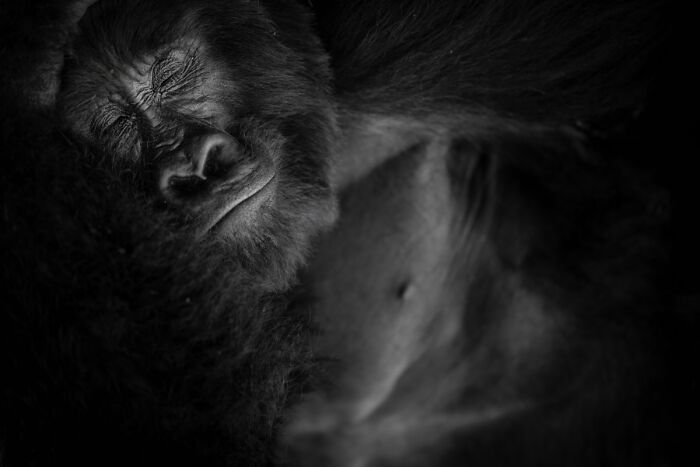
Close-up black and white portrait of a gorilla sleeping peacefully in NPOTY wildlife photos.

The conservation success story surrounding mountain gorillas is extremely positive. Although there were fears that gorillas might become extinct due to habitat loss and poaching, increased permit fees and better protection have led to gorilla populations almost doubling in the last 30 years. With close monitoring by anti-poaching units and ranger teams on a daily basis, these groups of gorillas can now rest a little easier.

Mountain gorillas generally spend their day either eating or sleeping, needing to consume up to 20kg of vegetation a day. This silverback had just finished his breakfast before settling down for a morning nap.

Nature Photographer Of The Year Report

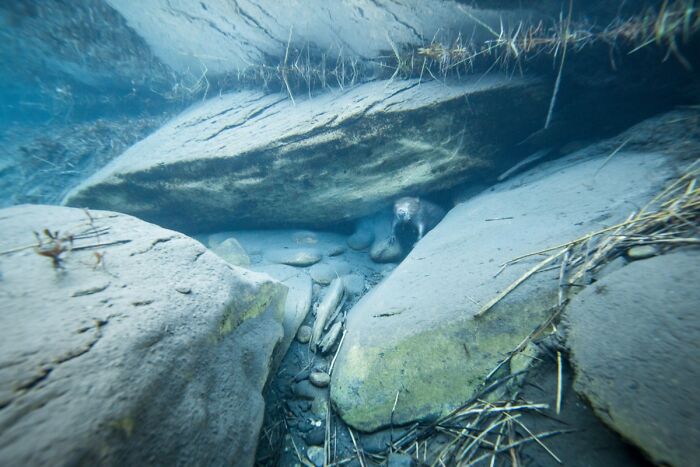
Underwater view of a small mammal hiding under river rocks, highlighted in NPOTY wildlife photos.

In the French Alps, July 2023. I’ve been waiting motionless against the bank in a rather uncomfortable position for over an hour now. Doubts are slowly creeping into my mind. Is this really the entrance to a beaver burrow? Situated between two rocks, the submerged cavity has a well-defined opening and looks relatively deep. But is it inhabited, or just a temporary shelter?

Absorbed in my thoughts, I pay no attention at first to the fine particles of sediment escaping from the gaping hole like tiny flakes. But a larger movement of water suddenly brings me back to reality. A beaver is emerging from the hole—the moment I’ve been hoping for is about to become real!

I can now clearly make out its head. It stops at the entrance and looks in my direction. Has it seen me? Possibly, but it’s hard to be sure. I huddle even closer to the bank. The animal extricates itself completely from its burrow, swims a few meters underwater before surfacing and heading toward the vegetation along the edge.

Its night has just begun. In all, this encounter will have lasted only a handful of seconds but felt like an eternity.

Nature Photographer Of The Year Report

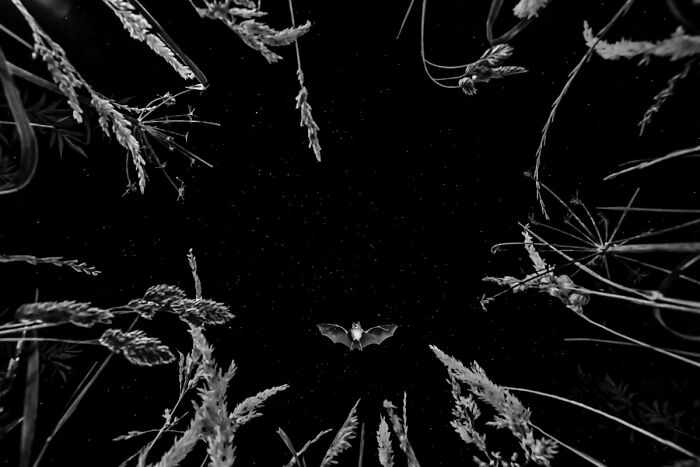
Low-angle black and white wildlife photo of a bat flying beneath starry skies and tall grass stems.

A lesser horseshoe bat (Rhinolophus hipposideros) takes flight on a starry night, hunting over grassland vegetation on an organic farm in Devon, England.

Intensive agriculture and development have decimated habitats such as meadows and native woodlands, leading to a significant decline in lesser horseshoe bat populations in Britain. To highlight the bat’s connection to this crucial habitat while minimizing disturbance, I used red filters on low-powered flashes for the image exposure.

I positioned the camera and trigger to face upwards along the route the bats typically follow from their roost. The camera was set to f14 with a 30-second exposure to capture both the bat and the starry night sky in intricate detail.

The lesser horseshoe bat was a focal species in the Back from the Brink project, a collaborative conservation initiative aimed at saving England’s most threatened species and habitats. I worked on this project in partnership with The Bat Conservation Trust.

Nature Photographer Of The Year Report

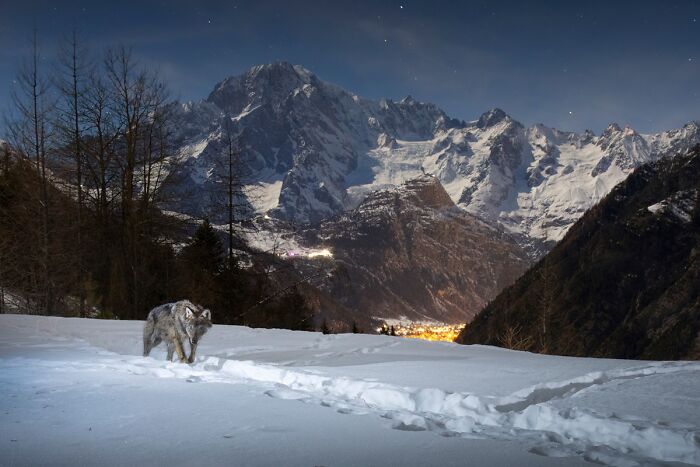
A lone wolf walks through snowy terrain at night for NPOTY Wildlife Photos

The wolf (Canis lupus italicus) has returned to the shadow of Mont Blanc. In recent years, I have followed the life of the pack, observing its hunting trips, the growth of the pups, and the social dynamics between them. It has been a unique privilege, for which I will always be grateful.

I discovered that wolves occasionally use this panoramic path during their hunting trips, so I set up a camera trap with the help of a PIR sensor and two flashes to capture their passage at the foot of the majestic Mont Blanc.

After several attempts and dealing with malfunctions caused by the freezing winter, I finally managed to get the shot I had long desired.

This photo is part of the project and photographic book Nuovi Equilibri, developed in collaboration with my friend André Roveyaz, documenting the return of the wolf to the upper Aosta Valley.

Pages: 1 2 3 4 5 6 7 8 9 10 11 12 13 14

Post Comment

WIN $500 OF SHOPPING!

    This will close in 0 seconds

    RSS
    Follow by Email