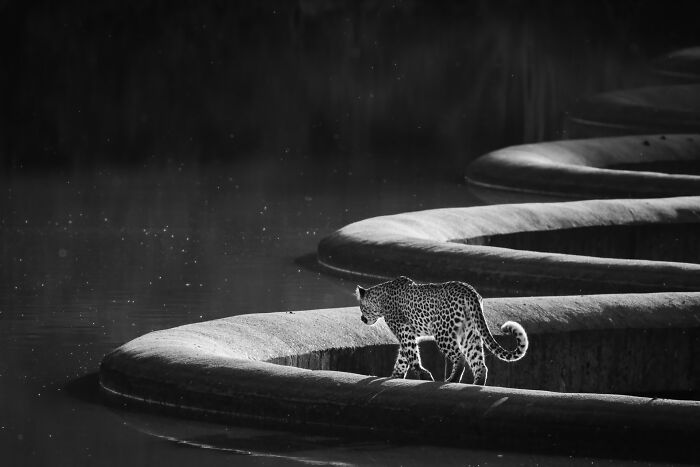
Black and white wildlife photo of a leopard walking along a concrete edge near water.

The Pilanesberg National Park in South Africa has a rich human history that dates back to the Stone Age. For centuries, people coexisted here with leopards and a diverse range of other wildlife. Imagine it’s the 13th century. You’re a hunter-gatherer in this ancient volcanic complex and your job is to find and provide food for your community while avoiding dangerous encounters with lions, leopards, buffaloes, and elephants.

Now imagine you’re a leopard and your job is to provide food for yourself and potentially a cub or two while avoiding dangerous encounters with humans and other predators. These are some of the things that cross my mind when photographing wildlife. It sounds like a tough life either way, but this is all a part of co-existing within a healthy ecosystem.

This image tells a story of co-existence in today’s world. Where the newly defined lines of human architecture meet something as wild and unpredictable as a leopard. Well before Pilanesberg became a protected area, dam walls were built to support farming and ranching. To this day, these dams remain a vital source of life for a large population of wildlife. In this case, it was simply a shortcut for a female leopard on a territorial patrol. We may not be as immersed in nature as we once were, but we surely are still a part of it. I can only hope for us to co-exist like this in more areas around the world.

The key to making this shot possible was an understanding of the subject and its behavior. Guiding in an area for a while allows you to begin to identify and notice certain habits from different individuals. This particular leopard is very relaxed in the presence of vehicles to start, which made it easy for me to maneuver into positions without disturbing her. As she made her way towards the dam wall, I positioned myself in line with the wall in case she crossed over it, and of course, she did.

Nature Photographer Of The Year Report

Wildlife photo showing a stick insect in the foreground with a toad behind it.

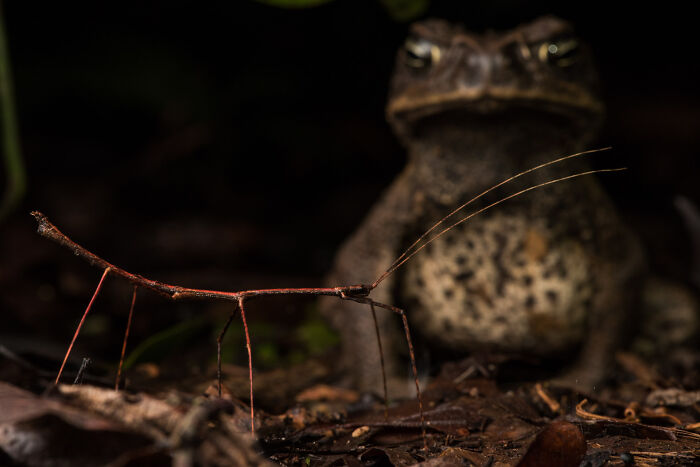
A dramatic moment on the Amazonian forest floor as this stick insect has wandered into a precarious position in front of the cane toad (Rhinella marina). Voracious predators, these toads are known for eating any smaller animals that fit into their mouths.

As I hiked through the Amazonian forest at night, I saw the toad from a distance, leaning forward and slightly angled at the forest floor – its body language told me something had caught its interest. I very slowly approached so as not to disturb the toad, and as I got closer, I could make out a stick insect that had wandered into a very dangerous situation on the forest floor in front of the amphibian.

The insect, realizing the danger, holds completely still, hoping its camouflage will save it. The toad knows its prey is nearby but is unsure of where and watches for any sign of movement to betray the location.

I lay down on the forest floor to get an intimate perspective of the scene – I waited for a long time, but of the 3 participants, my patience was the first to run out as I was being bitten by sandflies and mosquitoes. As a result, I was not able to see the resolution of this life -or- death game of patience and do not know how it ended.

Nature Photographer Of The Year Report

Wildlife photo of a young leopard leap in mid-air above high grass.

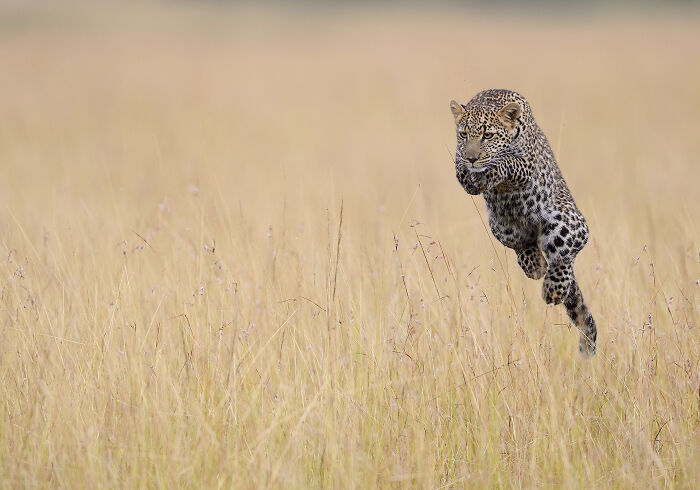
For several years, I was photographing for a new book, “Der richtige Augenblick” (“The right moment”). I tried to find the right moment in the behavior of birds and mammals, for example, fighting ruffs and black grouse, and hunting eagles. I spent a long time in Africa trying to photograph the fascinating hunt of cheetahs and leopards. One day in March 2016, I followed a leopard mother with her half-grown cub in the high grass of Mara Masai Preserve. The young leopard played with its mother and stalked her again and again and jumped on her back. It was very difficult to photograph, because you couldn’t see the young in the high grass at all. When you saw the cub, it was already in the air. So you had to anticipate where the young leopard was and rely on your autofocus system to focus on the animal. At least once it worked. In the end, it was luck.

Nature Photographer Of The Year Report

Puffins standing in a snowstorm, featured in wildlife photos.

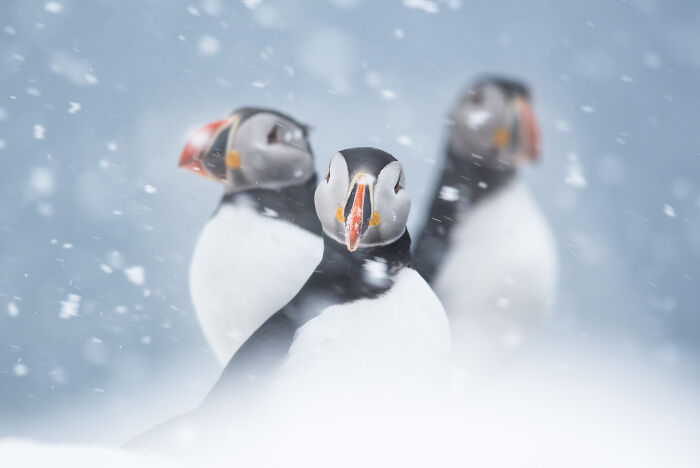
I have spent several days on the famous bird cliff on the island of Hornøya in Varanger, Northern Norway (slightly north of 70 degrees). Hoping for some heavy snow showers to make their magic work in my photos of the seabirds. Falling snow always breathes an illusion of life and presence in still images, and I will take snow photos whenever I can. (I also do this from people or dogs, too, if there’s no wildlife around.) However, the weather forecast was not very accurate though, and I returned home disappointed. After a few days, the weather reports were favourable again, and I rushed back to the island. This time, luck was on my side: dense clouds rolled from the Barents sea and shrouded the seabirds in white. I knew the shower would probably not last long. I shuttled frantically between shags, guillemots and puffins, taking flight shots and portraits as fast as I could. The island was flooded in sunlight again 34 minutes later. This puffin shot is one of the best images of the day. Nothing special – just a regular documentary photo – like 98 percent of my photos.

Pages: 1 2 3 4 5 6 7 8 9 10 11 12 13 14

Post Comment

WIN $500 OF SHOPPING!

    This will close in 0 seconds

    RSS
    Follow by Email