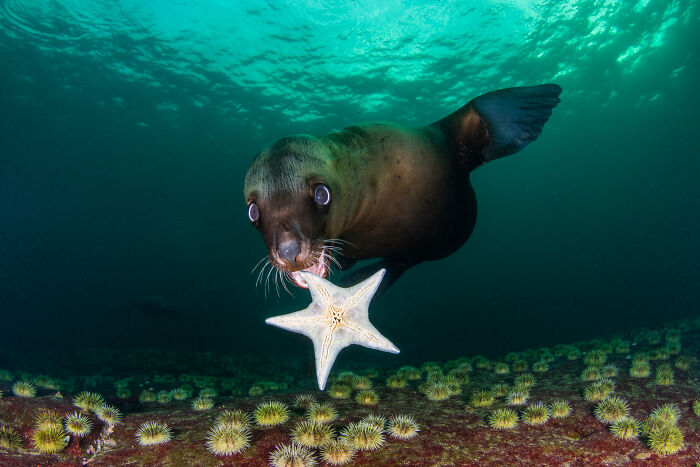
Wildlife photo of a sea lion swimming underwater while holding a starfish in its mouth.

Play is very important in the development of young Steller sea lions and they love playing with anything they find in their environment. When I was diving at Norris Rocks off Hornby Island, British Columbia, Canada, I watched this young sea lion play with a starfish. As I watched her, she swam over to me to show me her beautiful toy. I was able to capture the image just as she was presenting the starfish to me. Sadly, Steller sea lions are listed as Near Threatened on the IUCN Red List. By observing their playful nature, I hope people will feel a connection with them and want to protect them and their environment.

Nature Photographer Of The Year Report

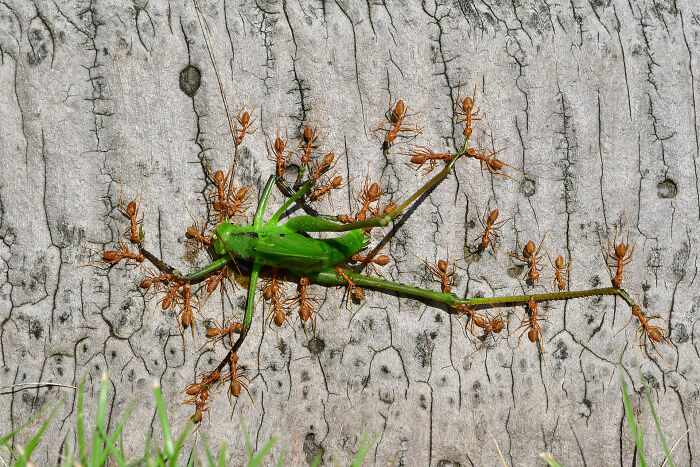
Wildlife photo of red ants swarming and carrying a large green grasshopper on a tree bark.

In Xishuangbanna Tropical Botanical Garden in Yunnan Province, there are several big trees near my hotel. The nest of Oecophylla smaragdina is built in the crown of the tree. They are ferocious by nature and are good at catching all kinds of insects. When the weather is fine, the workers will divide into several groups to hunt for insects. One morning, I found that they were working together to subdue a green katydid and carried it to a tree. Every kingdom of Oecophylla smaragdina will build a castle of its own. Although the kingdom of Oecophylla smaragdina maintained hostility and did not contact other similar kingdoms, there was a little war between their kingdoms. War usually only takes place with animals of other races. I knelt on the ground and shot this work at a low angle close to the ground in order to obtain the best focal plane.

Nature Photographer Of The Year Report

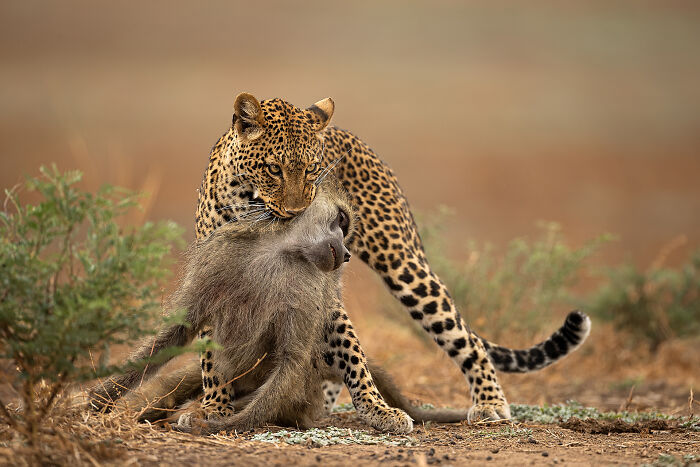
Wildlife photo of a leopard clutching a captured baboon in the wild.

This photo was taken in Zambia, in the South Luangwa Nsufe Sector National Park. The leopard had hunted a small baboon; the baboon’s older brother took the baboon with him for about 5 hours, released it, left it, and then came back. The leopard wanted to eat the baboon, but this other baboon wouldn’t let her. In the end, there was a confrontation between the two, and the older brother of the baboon also died.

Nature Photographer Of The Year Report

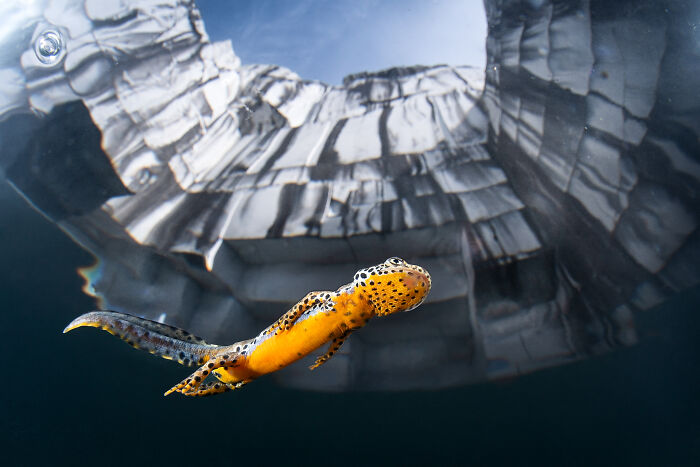
Wildlife photo of a yellow salamander swimming underwater near basalt rock reflections.

In spring, salamanders, like all amphibians, begin their breeding season. During this period, they inhabit various aquatic habitats, including springs, small ponds, and sometimes even old abandoned reservoirs.

This photo was taken in a unique setting: the Valsora quarries in Tuscany, in the province of Carrara, which take their name from the famous white marble.

It’s a surreal environment where the impermeable material has created natural pools, sometimes as deep as ten meters. Here, these beautiful, colorful creatures have found a permanent home.

Nature Photographer Of The Year Report

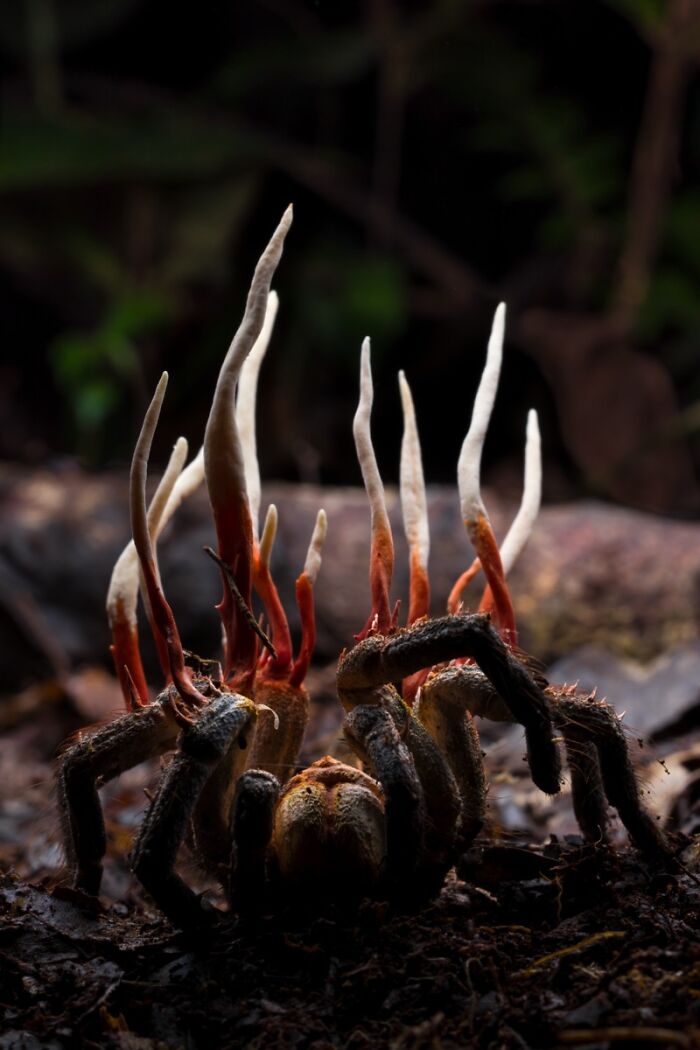
Unique macro image of cordyceps fungus growing from a tarantula, an extraordinary wildlife photo entry.

Tarantula Killed by Parasitic Fungi in the Rainforest near the Tambopata River, Peru (March 2022)

During my stay in the Peruvian Amazon, I went on numerous night hikes, and this discovery was among the most spectacular, thanks to the sharp eyes of a friend.

In the Amazon, insects and spiders are often hijacked by parasitic fungi that control their every move. This particular tarantula fell victim to a mind-controlling fungus known as Tarantula cordyceps (Cordyceps caloceroides). The fungus infects spiders through spores that attach to and penetrate the body, gradually taking control of the host’s behavior.

As the infection progresses, the “mind-controlled” spider is compelled to move to a microclimate favorable for the fungus’s growth. Meanwhile, the fungus feeds on the spider’s innards until the final stage of its life cycle. At this point, the spider moves to a specific location where it dies slowly.

Several days after the spider dies, the fungus’s fruiting bodies, or mushrooms, emerge from its shriveled corpse, turning it into a launchpad from which the spores can spread. These spores travel widely and infect new spiders.

To capture the eerie atmosphere, I used a low-angle shot with an off-camera flash, held by another friend, enhancing the dramatic and otherworldly mood of the scene.

Nature Photographer Of The Year Report

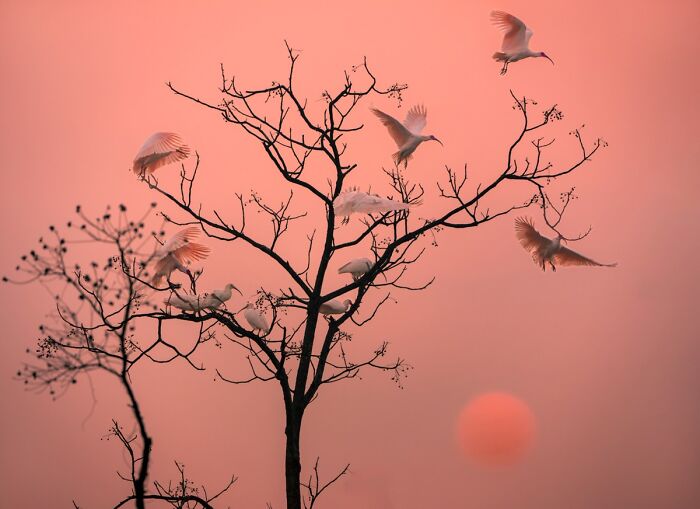
Silhouetted birds resting and flying around a tree at sunset in NPOTY award wildlife photos.

The crested ibis, once widely distributed across Japan, Korea, Russia, and most parts of China, is known as the “Oriental gem” and the “auspicious bird.” From 1963 to 1981, the species became extinct in three regions: Russia, Japan, and the Korean Peninsula. In 1981, only seven wild crested ibises were found in Hanzhongyang County, China. Thanks to the tireless efforts of countless individuals over the decades, the population has now grown to more than 10,000 crested ibises.

Winter is the most beautiful season for the crested ibis. Its feathers become dazzlingly white, and its head takes on a jewel-like red hue. This photo was taken on an early morning in Yang County, China, in December 2023.

Nature Photographer Of The Year Report

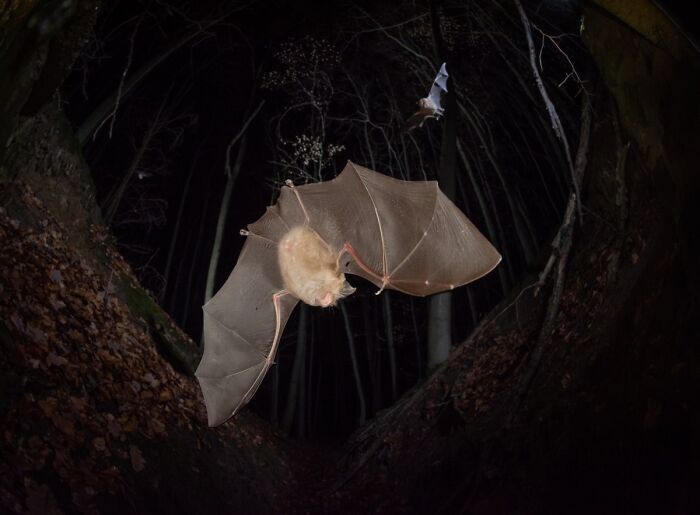
Wildlife photo of a bat flying through a dark forest at night.

Outside, it is freezing cold winter, but the 10°C temperature and the unique environment of the mine attract animals. Lesser horseshoe bats (Rhinolophus hipposideros) winter in an abandoned iron ore mine in the Börzsöny Mountains (Hungary). Researchers have pointed out that lesser horseshoe bats also move during the winter, meaning their strategy differs from other bats. This behavior is amazing and unusual. We wouldn’t expect insect-eating bats to fly in winter.

Pages: 1 2 3 4 5 6 7 8 9 10 11 12 13 14

Post Comment

WIN $500 OF SHOPPING!

    This will close in 0 seconds

    RSS
    Follow by Email